
Pauline Hanson and the frightening lesson of ‘Years and Years’
Posted on 07 Oct 2026
Our Community's founder and leader, Denis Moriarty, writes that when he watched an over-the-top…
Posted on 16 Jul 2024
By Greg Thom, journalist, Institute of Community Directors Australia

Advocacy is emerging as a key strategy used by charities and not-for-profits to engage with donors, as organisations battle for a slice of the giving pie.
In a keynote speech titled "The Future of Not-for-profits" to be delivered tomorrow at the Jobs Australia conference on the Gold Coast, the director of advisory at the social research firm McCrindle, Ashley Fell, will outline how changing societal expectations of the role of charities are partly driving the trend.
“Beyond their financial contribution, people are wanting to lend their voice in support of a cause or organisation to help bring about change,” she told the Community Advocate ahead of the conference.

Ms Fell said extensive research carried out by McCrindle had revealed that the term “advocacy” can mean different things to different people.
“While advocacy is a word that is being increasingly used, it can have multiple meanings and interpretations,” she said.
In an extensive survey of the sector, McCrindle asked Australians what advocacy for a cause or charity should look like, and the responses were mixed.
“Several donors show a lack of understanding of what advocacy is, seeing it as financial donations and volunteering,” said Ms Fell.
“This is different to how charities think about advocacy. Positively the most common responses focused on promotion and raising awareness of the charity or the cause.”
Ms Fell's comments followed the recent launch of a campaign to protect the right of charities to advocate.
The Stronger Charities Alliance believes proposed federal government electoral reforms could disproportionately affect the ability of charities to advocate on important causes during election campaigns.
It released a report, Regulating Charities in Australian Elections revealing that charities have accounted for less than one per cent of electoral spending since 2006.
However, the Alliance fears that changes proposed in a bill to amend the Electoral Act could place a disproportionately large administrative burden on charities, leading to an increase in self-censorship during public debates.
“The cause is also a driving factor for donors; to engage over and above a financial donation they need to be passionate about the cause and believe they can make a difference.”
Ms Fell gave her sector audience several pieces of advice:
Key considerations for charity and NFP leaders:
Ms Fell said Generation Z and Generation Y were the most likely to mention social media as specific avenues for raising awareness of a charity or cause.
“The cause is also a driving factor for donors; to engage over and above a financial donation they need to be passionate about the cause and believe they can make a difference,” said Ms Fell.
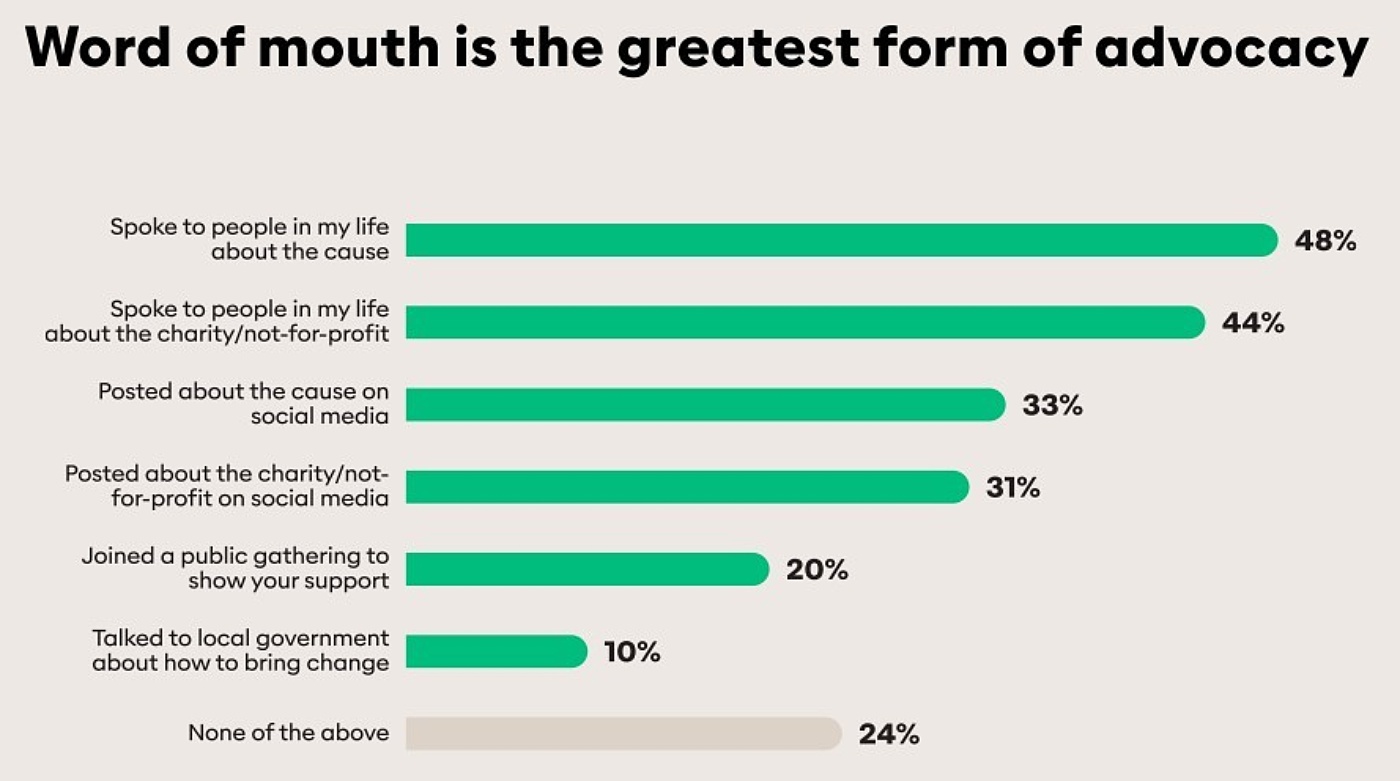
McCrindle research revealed donors most commonly engage in advocacy by speaking to people in their life about a cause (48%) or about a charity (44%).
The research also found:
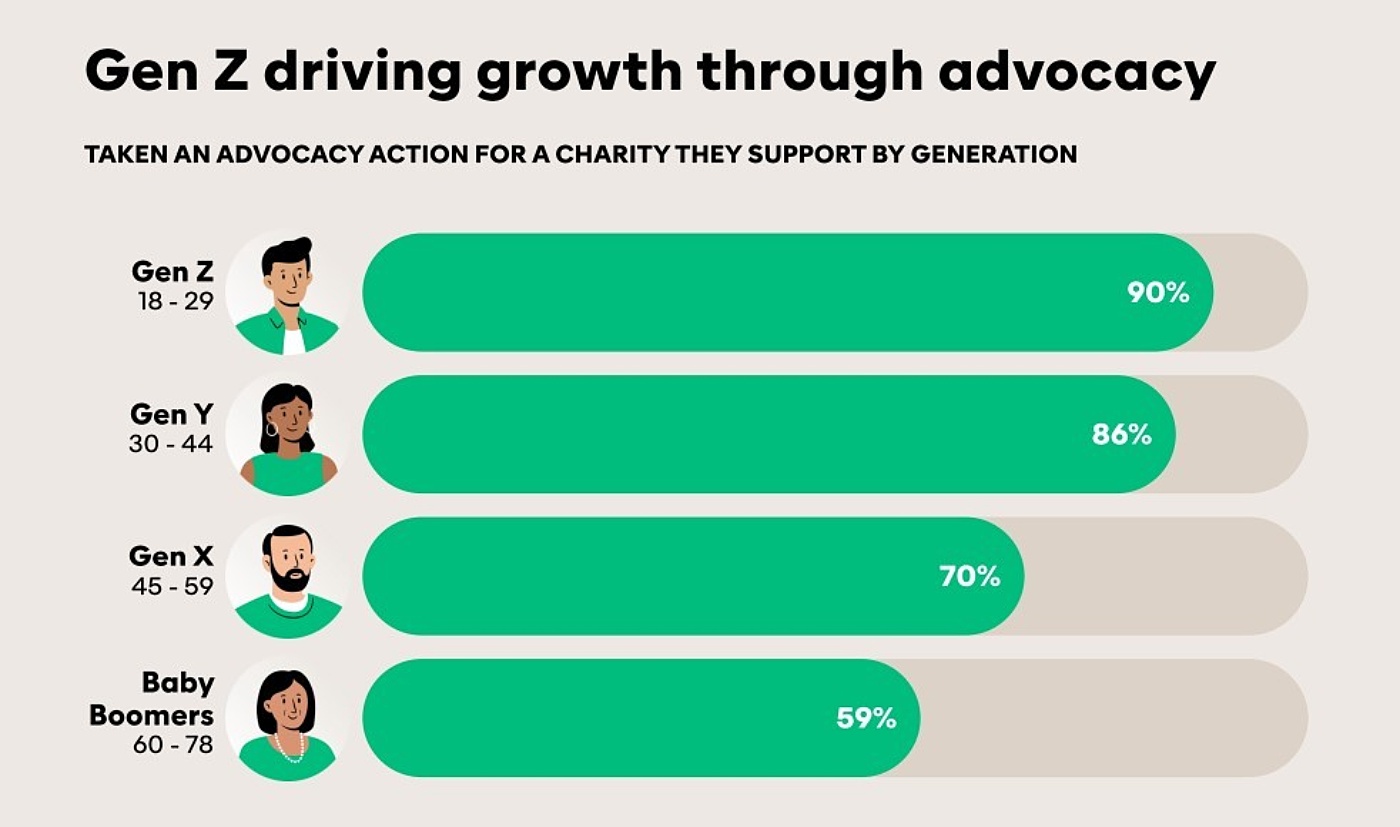
Ms Fell said that while younger generations are not as consistent in their financial giving or volunteer engagement, they are more likely than their older counterparts to advocate for a cause they believe in and are doing so through word of mouth as well as online.
The McCrindle research found younger donors are more likely to be engaged in charitable advocacy, with the rate declining as donors aged.
An estimated 90% of Generation Z donors have advocated in some way for a charity they support, compared to 86% of Generation Y, 70% of Generation X and just 59% of Baby Boomers.
Younger donors are showing their support for charities by amplifying their message on social media, with more than 44% of Generation Z having posted about a cause or charity compared to just 14% of Baby Boomers.
Charities' advocacy under threat: report
Posted on 07 Oct 2026
Our Community's founder and leader, Denis Moriarty, writes that when he watched an over-the-top…

Posted on 07 Oct 2026
A major public campaign launched this morning is calling on the federal government to restore…

Posted on 07 Oct 2026
The Australian Literacy & Numeracy Foundation (ALNF) has announced a partnership with mining…

Posted on 07 Oct 2026
A conference in Darwin will this morning hear detailed, strategic plans for how Australia could…

Posted on 07 Oct 2026
Joseph Friedman is co-founder and publisher of About Time, Australia’s only newspaper for…

Posted on 30 Sep 2026
There's been a lot of talk about AI this week, and some of it has been frightening. So, is AI good…

Posted on 30 Sep 2026
After the biggest AFL game of the year, one player proudly wore the flag of his birth country and…

Posted on 30 Sep 2026
At 21 years old, Tate Donohoe is the founder of Ecodia, an AI-assisted software development company…

Posted on 30 Sep 2026
Not-for-profit leaders have been warned to be wary of approaches from potential “funding partners”…
Posted on 30 Sep 2026
More than 200 fully funded Centre for Social Impact (CSI) scholarships will help equip for-purpose…

Posted on 30 Sep 2026
Personal stories are among the most powerful tools a charity can have to raise funds and awareness,…

Posted on 23 Sep 2026
In his new book Our Place, policy expert Matt Lloyd-Cope argues that housing must be at the heart…