How to build your digital capability
Posted on 30 Nov 2017
By Matthew Schulz, journalist, Institute of Community Directors Australia
Not-for-profits are being outspent on digital technology almost three-to-one by corporates, an expert in the sector's IT needs says, amid warnings organisations must do more to increase their digital capability.
Infoxchange's most recent snapshot of digital technology use by not-for-profits reveals the average IT spend by not-for- profits in Australia is $AUD4000 per staff member per year, with a similar $NZ3500 spent across the Tasman in New Zealand.
Infoxchange consulting services manager Matt Walton says this compares to $AUD12,000 for big corporates, some now competing to provide services - such as disability services - traditionally provided by the third sector.
Many of those not-for-profits are being expected to meet increased requirements from governments and funders to control data better and track outcomes, where not long ago they were storing information on paper.
"Now you've got corporations competing against not-for-profits in disability spending three times as much on technology. They've got much better websites, much better social media campaigns, much better client management systems, and much better outcome tracking.
"And that's where we're finding a lot of not- for-profits struggling to keep up and really acknowledge the investment required to get up to a higher standard."
On the other side of the equation, other not-for- profits - particularly smaller social enterprises -were taking advantage of easier-to-use and cheaper software to establish cloud storage, build websites and create a Facebook presence, all in a nimble fashion.
Why boards need IT talent
This is why "it's critical" that not-for-profit boards considering recruiting IT talent into their ranks.
"One of our key recommendations on many of our digital capability assessments is to get someone with an IT understanding on your board," Mr Walton says.
"They don't have to be a technical guru, but they need to understand the importance of technology to advocate for that."
And because many not-for-profits can't afford their own IT managers or chief information officers, "it's up to board members to play that role, to encourage the managers or CEO to think about some of those things, and drive that roadmap of what systems they use."
"Everyone thinks, 'We need an accountant, we need a lawyer, we need someone with a marketing background.' I would put IT up amongst those. I was on an NFP board which had a portfolio of 'technology', so you appoint someone who is capable of running that portfolio."
Similarly, boards need to ensure their IT strategy covers IT literacy for staff.
Increasingly, staff must be able to use computers and associated software such as client management systems to enter data, track users, and use online rostering.
And if they aren't capable, they may need support and training, he says.
Where do I start?
A good place to start with your IT strategy and thinking is the ImproveIT website, an up-to-date repository of useful advice about technology that's aimed at not-for-profits.
ImproveIT is a free resource developed by Infoxchange - with government, non-government and software business partners - to help not- for-profit and community organisations make the most of IT.
The site targets the many organisations that don't know where to begin, are confused about their IT needs, or don't think they can afford to call in IT consultants to solve their problems.
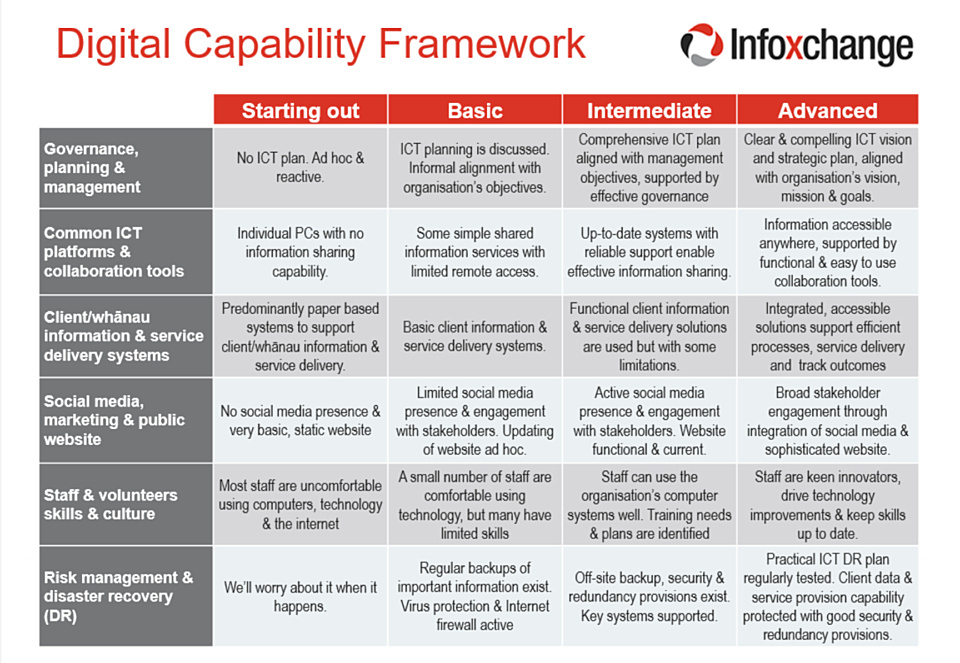
The site is built on the concept of "digital capability" (see above), based on abilities in the following areas:
IT management - technology management, governance and planning
Technology - PCs, infrastructure, servers, hardware, software and email
Information systems - Client information, service delivery, supporting members
Online presence - websites, social media, search engines and online communications
Staff IT skills - digital literacy, productivity tools and professional development
Security and risk - securing your information and disaster recovery.
As a first step, 10 minutes spent taking this ImproveIT's digital capability quiz (link at the end of this article), will show where you are on the digital spectrum from "basic" to "advanced".
Mr Walton said Infoxchange's consulting program uses a similar process when assessing needs for not-for-profits of all sizes, from neighbourhood houses to large national not-for-profits.
What are the benefits of an IT strategy?
Organisations with a fully fledged IT strategy will benefit in all six areas of Infoxchange's digital capability matrix, Mr Walton says.
He cites money savings, reduced risks, easy access to data while maintaining security, better stakeholder engagement and better organisational performance as potential improvements.
When it comes to costs, "a lot of it is around efficiency and reducing double handling."
It helped an Australian not-for-profit that relied on a paper-based payroll process for several hundred staff.
Infoxchange recommended spending "a few thousand" on new software that saved more than $100,000 in staff costs, and diverted resources into "tasks that drive the mission of the organisation".
And while it's expected large organisations will be capable of significant investments in technology, based on the $AUD4000 per year average, it doesn't follow that the money must be spent on servers, hardware or traditional technology.
"If you invest the money in more strategy, consulting, or staff, or recruiting someone onto your board ... we find the return on investment is much better as well," Mr Walton argues.
Set your strategy, and keep a close eye
The two main questions organisations need to ask are "Where do you want to be?" and "Where are you now?".
Not all organisations need to be at the "advanced" level of digital capability, and a "basic" level may be appropriate for a small start-up or not-for-profit.
Organisations with an accurate sense of their capability are better placed to plan, possibly with the help of an ICT (Information and Communications Technology) steering committee or through advisors.
That steering committee, a board member with IT strategy as their key portfolio, or an external provider, should be able to keep you abreast of software, security and data management issues.
Their assessment might lead you to recruit someone with IT skills to your board, "to help you move from basic to intermediate in the governance area".
In the same way, that evaluation may prompt you to rely more on volunteers for ICT support, or to seek a consultant's help sourcing new client information software.
How are you managing your data?
Organisations need strategies on information architecture, to set out how information is managed, backed up, and stored. This can avoid files being spread across individual desktop computers, laptops, servers and the cloud.
"Without structure, planning and management, it can lead to anarchy," Mr Walton warns.
"If staff are storing your data on DropBox accounts stored overseas, and a staff member leaves, that data can be lost to your organisation."
Nowadays nonprofits manage data in an fashion where "organisations have a responsibility to protect it, but are also expected to use it."
Organisations are increasingly pulling data from client management systems to display information that's valuable for staff, managers, boards, funders or donors.
So while you don't need to be a data scientist anymore to create a dashboard, and there many cheap and easy systems available, they aren't without pitfalls.
That's why Mr Walton advocates for "a single source of truth", rather than data spread across multiple systems.
"If a client calls and updates their email, you don't want to have to update four different systems."
"This all comes down to governance and management. And this is where boards and CEOs need to go through a thorough process, select the right tools for the right purpose and then support and train their staff to use those tools effectively and consistently."
Finally, Mr Walton urges organisations not to set up a system "and leave it for five years", because in the rapidly changing digital landscape, any strategy must be managed over the longer term.