Not-for-profit Sector Roadmap 2030
Not-for-profit Sector Roadmap 2030
Towards a sustainable and thriving not-for-profit sector
Across Australia, tens of thousands of charities and not-for-profit organisations are committed to their missions, with board members, executives, staff and volunteers working hard – but often with no idea how they their organisation is doing in comparison to others. That’s why the Institute of Community Directors Australia (Community Directors) has examined the sector’s engine rooms to ask: what’s going well? What are your struggles? What do you excel at, and what could you do better – especially in terms of governance?
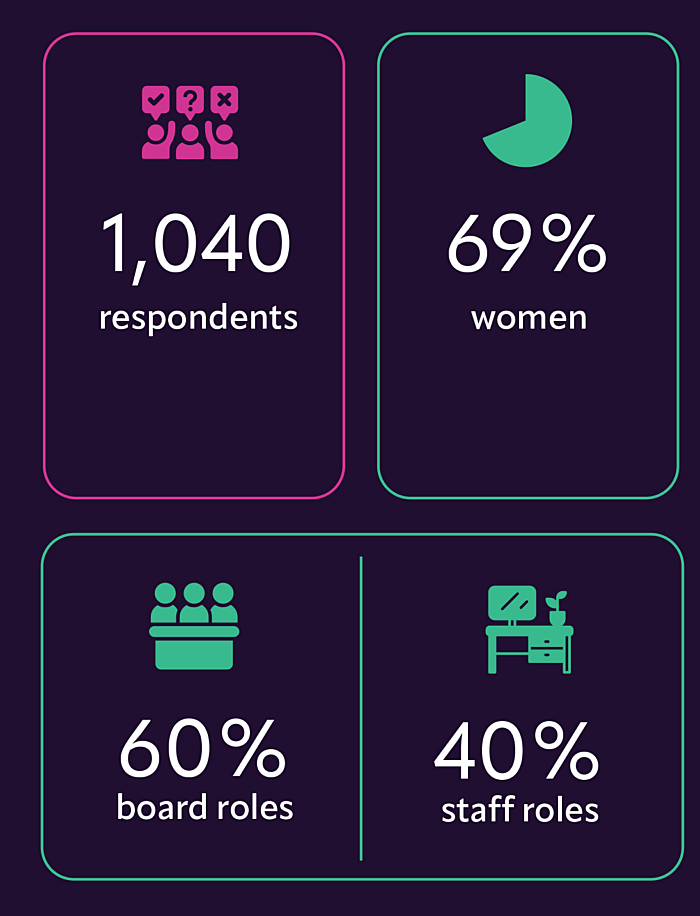
Not-for-profit Sector Roadmap 2030 provides that perspective. It draws on the views of almost 3,000 people who govern and lead Australian not-for-profit organisations, comparing more than 1,000 responses gathered in 2026 with more than 1,800 from 2019. The result is a rare seven-year view of how governance in the sector is changing, where organisations are struggling, and where boards can make a difference.
Adele Stowe-Lindner
Executive Director,
Institute of Community Directors Australia
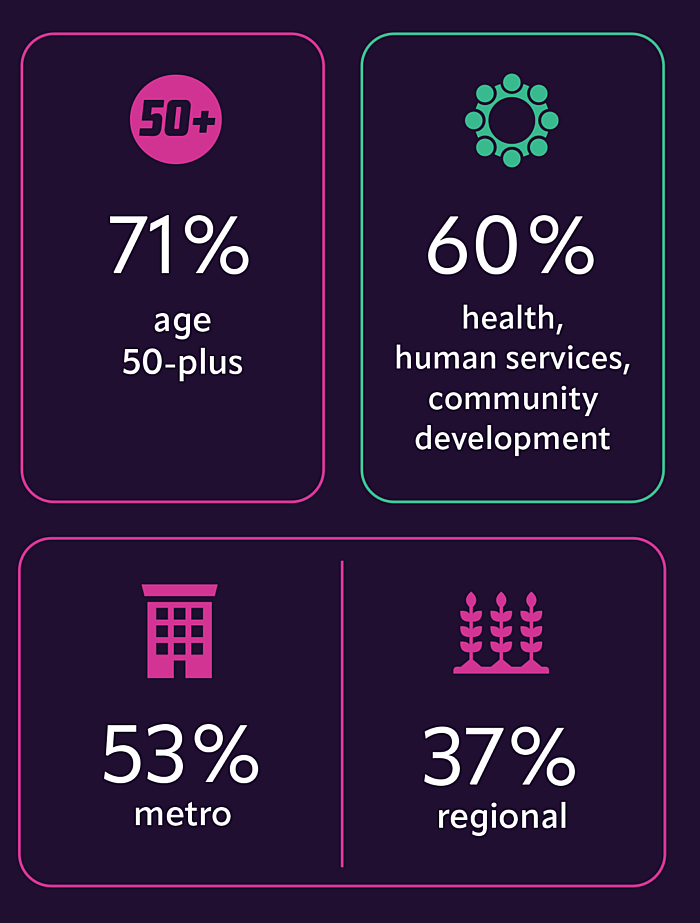
Respondents across Australia’s not-for-profit sector
The picture that emerges is of a sector not in crisis, but under chronic pressure. Funding instability, cost-of-living pressures and regulatory demands weigh heavily on organisations. Yet many of the factors associated with a well-functioning board are within the board’s own control. Practices such as good induction, board review, financial literacy, training and measurement can make a significant difference without requiring significant additional funding.
Money is a constant challenge
Financial sustainability is the single biggest concern identified by respondents, ranking first in all eight sectors examined. Just over half (52%) describe their organisations as being in good financial shape, while 30% are breaking even and 18% are struggling.
Yet financial position does not appear to determine whether directors stay on a board. Directors in financially struggling organisations are no more likely to be planning to leave than those in financially healthy organisations. Their experience of serving on the board matters much more: 60% of directors who do not enjoy their role plan to leave soon, compared with 18% of those who do.
Smaller organisations have less access to good governance
Access to governance practices and tools is strongly shaped by organisational size. Smaller organisations are much less likely to conduct formal board reviews, use board portals or measure their success. Almost one in five respondents from the smallest organisations say their organisation does not measure its success at all.
This matters because every board, regardless of the size of its organisation, faces governance responsibilities and needs the tools and skills to meet them.
Boards are changing
Board diversity has improved since 2019 in gender, cultural background and LGBTQI representation, although representation of directors with disability has not increased. Boards also remain considerably older than the populations they serve: nearly three-quarters of directors are aged 50 or over.
The sector’s training needs are changing too. Governance has overtaken fundraising as the most commonly identified training need, while demand for cybersecurity training has tripled since 2019. Artificial intelligence, barely mentioned in 2019, now accounts for more than half of technology-related concerns.
The sector responding to this survey is, by and large, resilient, engaged, and clear about its own challenges, which is a meaningful finding in a period that has tested it as much as the last seven years have.
Mid-career directors are an opportunity
Directors aged 26–49 enjoy their roles and feel valued at similar rates to other directors, but they are less likely to have completed governance training and more likely to want it. Many are also relatively new to board service. In short, they are arriving in numbers, under-prepared, and asking for help.
Good induction makes a difference
Only 55% of directors say they received a good induction when they joined their board, unchanged since 2019, and directors of smaller organisations are particularly likely to miss out.
The consequences are striking. Directors who did not receive a good induction are almost twice as likely to be planning to leave and are more likely to say they do not understand their responsibilities or feel valued. Most strikingly, respondents who did not receive a good induction are 10 times as likely to say they do not enjoy their role as those who did.
Next steps
Not-for-profit Sector Roadmap 2030 sets out 10 recommendations for achieving a thriving community sector by 2030. Many of the most promising interventions are also among the least expensive. Good inductions, board reviews, financial
literacy, measurement and early governance training are within reach of organisations of all sizes.
Financial pressure remains significant, but the findings offer grounds for optimism: some of the most important influences on how well a board functions are things boards and organisations can change themselves.