
The data is in: to rebuild Australian social cohesion, we need to repair political and community connections
Posted on 05 Nov 2026
Mapping Social Cohesion 2026, published today, has found that 48 per cent of Australian adults are…
Posted on 05 Jun 2024
By Greg Thom, journalist, Institute of Community Directors Australia

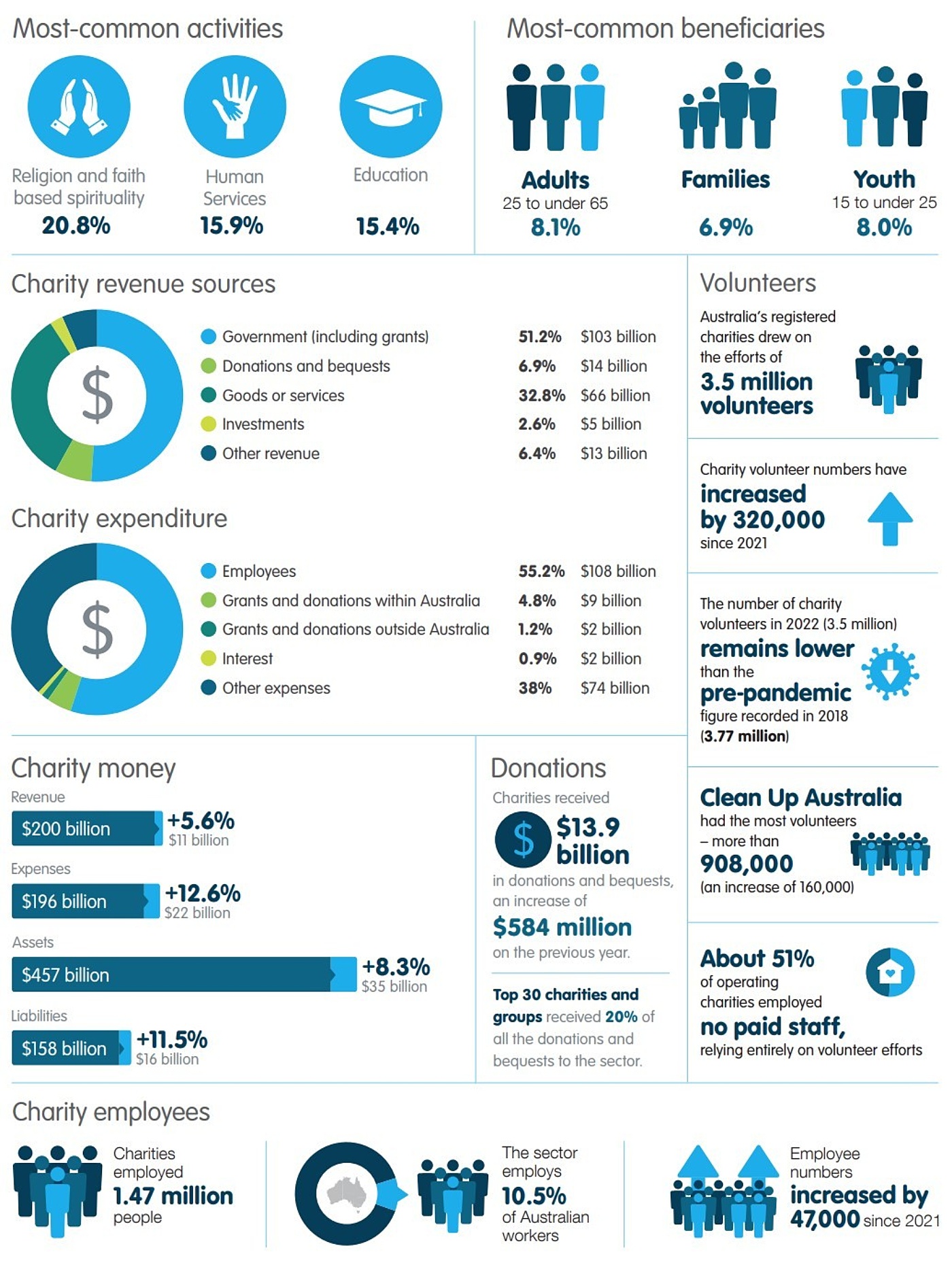
Charity revenues have surpassed $200 billion for the first time, according to a new report from the Australian Charities and Not-for-profits Commission (ACNC).
The 10th edition of the Australian Charities Report revealed that revenue surged 5.6% in the 2022 reporting period, pumping an additional $11 billion into charities coffers compared to the previous year.

However, the good news was tempered by a $22 billion increase in expenses – which at 12.6% was more than double Australia’s inflation rate.
Employee-expenses alone increased by almost 10% – the highest annual rise ever recorded.
ACNC commissioner Sue Woodward said it was important to recognise that the report’s comprehensive analysis helped highlight some of the challenges faced by charities.
“Our latest data demonstrates charities make an enormous contribution to Australia’s social fabric, its economy and employment,” she said.
“It is important to recognise that the rise in expenses and liabilities outpaced the rise in revenue and assets in percentage terms.”
The annual analysis of the charities sector looked at the annual information statements of more than 49,000 charities from the 2022 reporting period.
The report also revealed that in the 12 months to 30 June 2023:
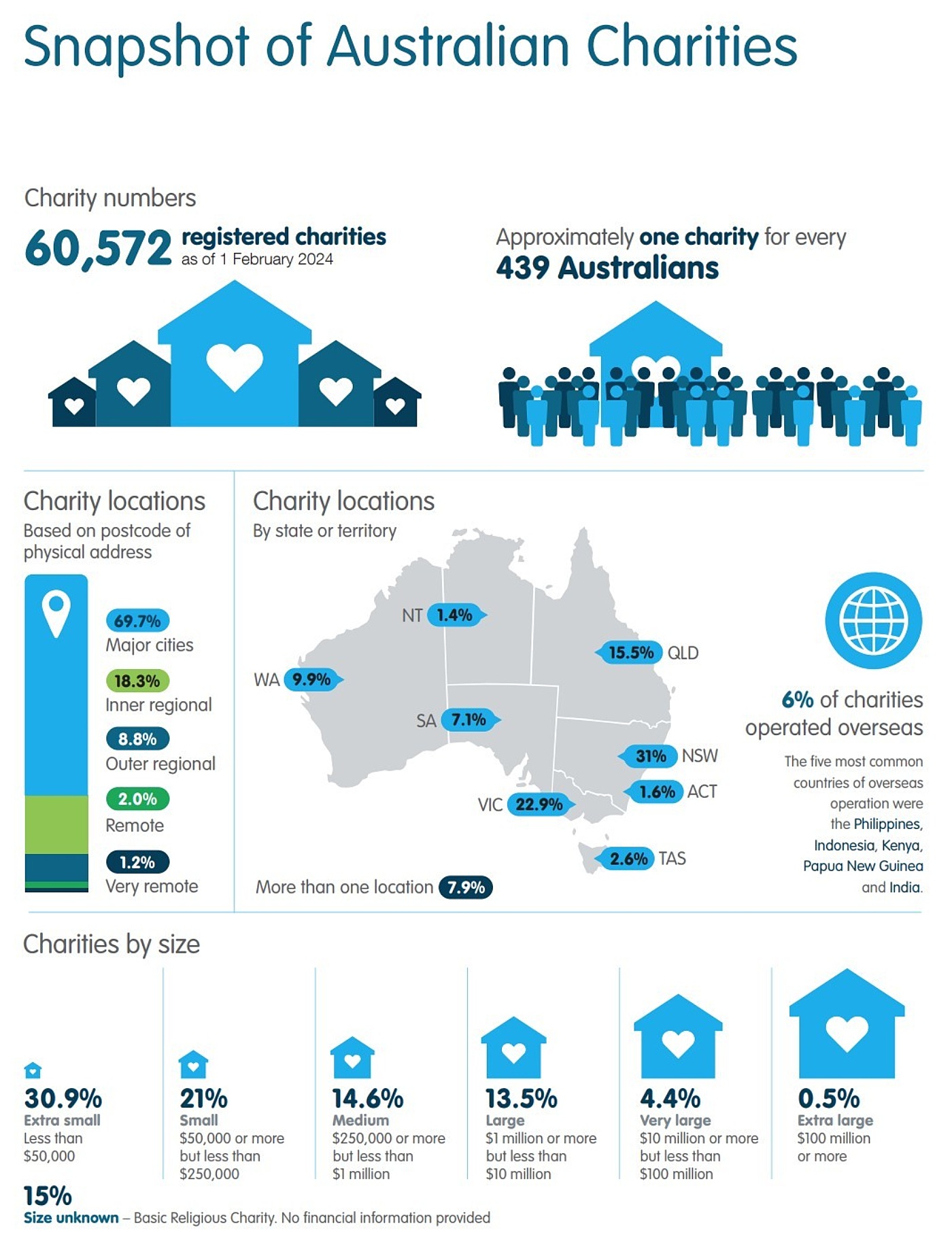
The report found that while the sector remained a major employer and accounted for 10.5% of the Australian workforce – adding more than 47,000 new employees in 2022 for a total of 1.47 million people - it was still heavily dependent on volunteers, with more than half of all charities operating with no paid staff.
The number of volunteers increased by 500,000 to more than 3.2 million, still below the pre-pandemic level of 3.77 million in 2018.
“So many Australians rely on programs that charities provide, especially as cost-of-living pressures impact across the community.”
Ms Woodward said charities distributed $11.7 billion in grants and donations, mainly to other charities and not-for-profits.
“That’s an increase of 21% on the previous period, which is a substantial rise in philanthropic giving.
“As the government considers the Productivity Commission’s recommendations to boost giving in Australia, this data offers an important insight.”
The education sector dominated Australia’s top charities by revenue, with the Victorian Catholic Education Authority ($3,269,680,738) ranked number one, followed by the University of Sydney ($3,159,373,417) and the University of Melbourne ($2,998,419,000).
World Vision Australia topped the list of charities with the largest donations and bequests at $291,340,000 followed by mining magnate Twiggy Forrest’s Minderoo Foundation ($266,410,388) and the Australian Red Cross Society ($146,220,000).
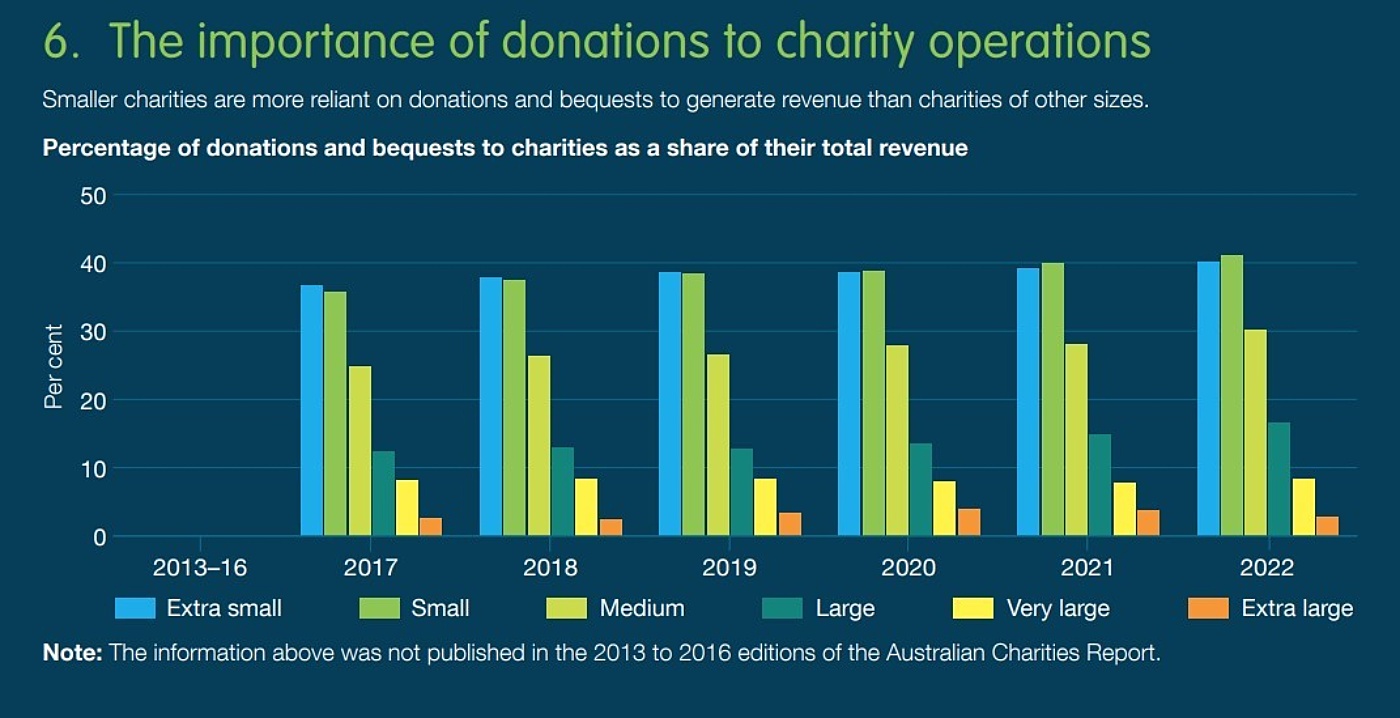
While the previous year’s report focused on philanthropy, the latest version put extra-small charities – those with annual revenue under $50,000 – under the microscope.
The report found that while these charities constituted almost a third of the sector (31%), they operated with just 0.1% of total revenue.
This compared to extra-large charities (defined as those bringing in more than $100 million in annual revenue), which make up only 0.5% of the sector but pull in more than half (54%) of total revenue.
An analysis of data relating specifically to extra-small charities for the five years up to 2022 revealed:
Ms Woodward said the differences between Australia’s smallest and largest charities could not be starker.
“This five-year focus data shows the cost of operating and delivering services has increased but extra-small charities haven’t received sufficient revenue or donations to keep pace.”
Ms Woodward said the latest Australian Charities Report highlighted the enormous diversity – and different needs – of the sector.
“While the ACNC does not set policy, we can highlight that most of the sector operates on low revenue with no paid staff.”
Ms Woodward said this made it even more important to ensure the differences in resources and capacity among charities was top of mind when talking about the needs of charities and formulating policy to meet them.
“So many Australians rely on programs that charities provide, especially as cost-of-living pressures impact across the community.”
Australians more generous to the tune of $676 million: ACNC Report
Charities report reveals covid-era volunteering drop could have been worse
Posted on 05 Nov 2026
Mapping Social Cohesion 2026, published today, has found that 48 per cent of Australian adults are…

Posted on 04 Nov 2026
I watched an angry man on the TV news. “Australia is stuffed, going backwards,” he said. “No one is…

Posted on 04 Nov 2026
Working for a cause you believe in can be deeply rewarding, but it can also lead to burnout. Jackie…

Posted on 04 Nov 2026
Leading lawyer and anti-racism advocate Mariam Veiszadeh has told a Human Rights Commission…

Posted on 04 Nov 2026
A leading advocate and service provider for new arrivals in Australia has urged the nation’s…

Posted on 04 Nov 2026
As the Scanlon Foundation Research Institute prepared to release its annual social cohesion report…
Posted on 28 Oct 2026
Altering Australia’s path from anger and potential violence needs more than asking one another to…

Posted on 28 Oct 2026
Are compliance processes crowding out the boardroom conversations that really matter? The…

Posted on 28 Oct 2026
Almost 25 years after taking a receptionist's job to get her foot in the door of the not-for-profit…

Posted on 28 Oct 2026
Violet Roumeliotis, the chief executive of Australia’s biggest migrant support organisation, will…

Posted on 21 Oct 2026
The wider not-for-profit sector doesn't pay much attention to owners corporations, but maybe it…

Posted on 21 Oct 2026
Backed by tangible successes and government support, community foundations are gaining momentum as…