
Pauline Hanson and the frightening lesson of ‘Years and Years’
Posted on 07 Oct 2026
Our Community's founder and leader, Denis Moriarty, writes that when he watched an over-the-top…
Posted on 21 Sep 2023
By Greg Thom, journalist, Institute of Community Directors Australia

An innovative program that harnesses the power of music to combat violent attitudes in young boys has celebrated a decade of making a difference.
The RESPECT program aims to teach boys aged under 12 about domestic violence and gender equality in the hope of heading off potential antisocial behaviour.
Run by the Sydney-based youth arts organisation Outloud, the 12-week early intervention program pairs professional musicians with family violence counsellors in primary schools.
Program participants write and rehearse an original song and perform it at their school assembly, and at an annual showcase at Sydney’s Bankstown Central shopping centre.
The songs are also filmed and made into music videos.
The initiative has been assessed by Murdoch University as a model project that leads to long-term change in participants.
An estimated 98% of students who took part in the program came away with increased awareness and understanding of domestic violence and healthy relationships.
About 92% had a better understanding of respectful relationships and gender equity.
Outloud CEO and artistic director Finn O’Branagáin said music had proved an effective tool to engage young people.
“Domestic violence is a topic that is not often talked about and is often seen as taboo.”
Sitting around and discussing domestic violence was likely to leave students feeling bored and uncomfortable, she said.
“By using music, performance, and song writing, we can tackle a difficult subject and make it fun and interesting. The students actually want to be there.”
Finn said at the heart of the program was an approach called ”stop it at the start”.
“This concept is all about stopping negative attitudes, behaviours and stereotypes before they develop into disrespect, control or abuse.”
Finn said there were three elements that made the RESPECT program a success:
“By writing their own song, they put what they learn into their own words,” said Finn.
“By rehearsing and recording, they sing and embody the message, and by performing at school, on YouTube, and in public, they are getting positive feedback through claps and cheers that this is the right message to spread.”
“We have seen boys change their attitudes and opinions and develop a passion for the prevention of domestic violence.”
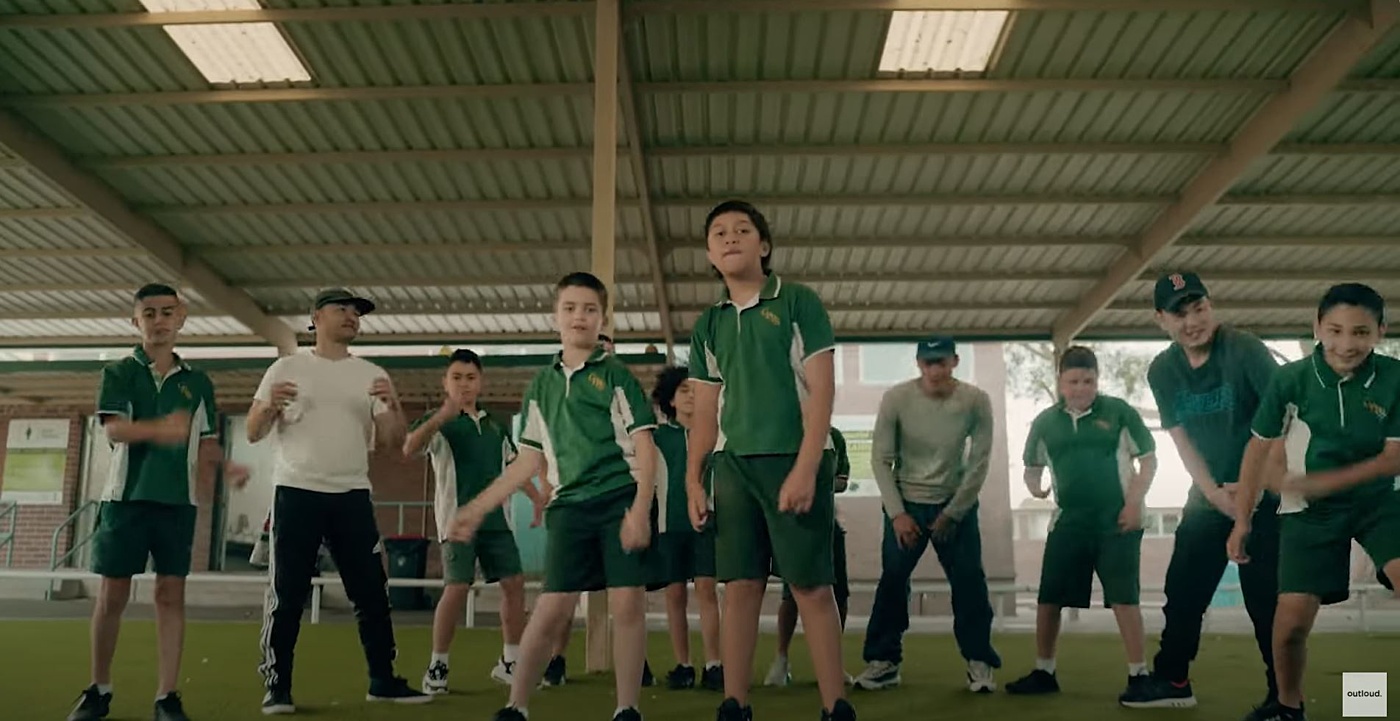
RESPECT program manager Craig Taunton, who pioneered the ground breaking initiative a decade ago, said thousands of boys have participated in the years since.
Many are now old enough to have children of their own.
“This milestone means we are now working with intergenerational change in this area and seeing the difference and cultural shift made by the program when we return to schools year after year,” said Craig.
“We have seen boys change their attitudes and opinions and develop a passion for the prevention of domestic violence.”
Teachers and school principals had also remarked on the positive change in student attitudes and a welcome shift in school culture.
Buoyed by the success of RESPECT, the Outloud team have also been working on a new program aimed at alumni students now in high school.
“It is evident that these students still remember a lot of what they learned years ago when they were in primary school,” said Craig.
“Not only have they retained the knowledge they have learnt, but we can see first-hand they have also applied it to their own lives and relationships.”

The ten year anniversary of the RESPECT program comes as federal and state governments vow to set targets to reduce rates of violence against women and children.
Acknowledging that changing societal attitudes will be required to reduce violence against women, the new targets include a goal to reduce the number of female victims of intimate partner homicide by 25 per cent a year.
Finn said early intervention programs such as RESPECT are critical if the government is to meet these targets.
“The best kind of intervention programs are the ones that focus on prevention,” she said.
“We deliberately target boys aged 10–12 years of age because that’s the ideal age to start these conversations and plant the seeds in their minds.
“Research shows that if you wait until they are older, a lot of their attitudes are already cemented in place.”
The RESPECT program ensures this doesn’t happen.
“Students who complete the program are far more aware of the negative stereotypes and behaviours that exist in our society,” said Craig.
“They are also very knowledgeable about the impact of domestic violence on women. They have a great understanding of what control and abuse look like in a relationship and the importance of treating your partner equally and respectfully.
“By arming these students with such valuable tools, we hope that they will go on to have healthy, respectful relationships of their own.”
While early intervention is crucial, Finn said the prevention of violence against women must be society-wide to have the most impact.
“The more that we recognise, as a society, that violence against women stems from negative attitudes, the more our society can begin to shift.”
Posted on 07 Oct 2026
Our Community's founder and leader, Denis Moriarty, writes that when he watched an over-the-top…

Posted on 07 Oct 2026
A major public campaign launched this morning is calling on the federal government to restore…

Posted on 07 Oct 2026
The Australian Literacy & Numeracy Foundation (ALNF) has announced a partnership with mining…

Posted on 07 Oct 2026
A conference in Darwin will this morning hear detailed, strategic plans for how Australia could…
Posted on 07 Oct 2026
Joseph Friedman is co-founder and publisher of About Time, Australia’s only newspaper for…

Posted on 30 Sep 2026
There's been a lot of talk about AI this week, and some of it has been frightening. So, is AI good…

Posted on 30 Sep 2026
After the biggest AFL game of the year, one player proudly wore the flag of his birth country and…

Posted on 30 Sep 2026
At 21 years old, Tate Donohoe is the founder of Ecodia, an AI-assisted software development company…

Posted on 30 Sep 2026
Not-for-profit leaders have been warned to be wary of approaches from potential “funding partners”…

Posted on 30 Sep 2026
More than 200 fully funded Centre for Social Impact (CSI) scholarships will help equip for-purpose…

Posted on 30 Sep 2026
Personal stories are among the most powerful tools a charity can have to raise funds and awareness,…

Posted on 23 Sep 2026
In his new book Our Place, policy expert Matt Lloyd-Cope argues that housing must be at the heart…