
Fence-sitting isn’t going to work if we want better owners corporations
Posted on 21 Oct 2026
The wider not-for-profit sector doesn't pay much attention to owners corporations, but maybe it…
Posted on 28 Nov 2023
By David Crosbie

Despite the political risk, it may be time for Australia to bite the bullet and introduce an inheritance tax, writes Community Council for Australia CEO David Crosbie.
The Productivity Commission Inquiry into Philanthropy is due to release its draft report at 10.30pm on Thursday, November 30.
Its brief was to “analyse motivations for philanthropic giving in Australia and identify opportunities to grow it further”.
There have been many roundtables and consultations on a broad range of issues affecting philanthropy in Australia, and 275 submissions have been made to the inquiry.
Once the report is released the Productivity Commission will embark on another series of consultations and calls for submissions.
This first draft will be an important report, both for the Productivity Commission and for the government.
The word in the sector is that the government is prepared to back real change to promote giving in Australia.
It will be some months before we know whether the Productivity Commission can make a strong enough case for change, and whether a first-term Albanese government has the political will to implement the changes needed.
Figures from the Australian Taxation Office (ATO) and the Australian Charities and Not-for-profits Commission (ACNC) suggest that charities currently receive less than $15 billion in donations and bequests each year.
This is well under 10% of charities’ collective total annual revenue of $176 billion.
Revenue from government is around $90 billion – over 50% of all charitable income. About a third of annual income for charities in Australia comes from income earned through provision of services and activities.
Donations are a relatively small part of the charity pie, but they are important because often they provide vesting capital, flexibility, and funding for innovation and improvement.
The income pattern of Australian charities differs from that of other countries.
In the US, for instance, the annual income of charities from donations and invested bequests is twice as big as annual income from governments.
There are many reasons for these differences, but one major factor is that Australia abolished inheritance taxes more than 40 years ago and has been paying the price ever since.
Researchers from the Urban-Brookings Tax Policy Center in the US found that if the US abolished death duties, levels of bequests would fall by about a third (between 22% and 37%) and lifetime giving would be reduced by a similar amount:
“We find evidence that the incentives for charitable giving present in state and federal estate and inheritance taxes have a strong effect on charitable bequests.”
"An inheritance taxes is one of those evidence-based positive policies that would benefit most Australians and strengthen our communities, but it would also work exceptionally well in a misinformation scare campaign."
Most wealthy families in Australia lag a long way behind those in countries like the US when it comes to giving to charities, and the lack of inheritance taxes is a key factor.
Once Queensland Premier Joh Bjelke-Petersen abolished death duties in 1978, every other state and territory had to either follow suit or accept that it would face an exodus of its cashed-up seniors to Queensland.
A great deal has been written in Australia on inheritance taxes or what the Henry Tax Review termed a “bequest tax”. A 2019 Treasury Paper by Frank Stilwell provides a good summary.
The Community Council for Australia has consistently supported some form of inheritance tax for more than a decade. It makes a lot of sense at many levels.
The Henry Review argued that a tax on estates would “fit well with Australia’s demographic circumstances in the coming decades. Over the next 20 years the proportion of all household wealth held by older Australians is projected to increase substantially and large asset accumulations will then be passed on to a relatively small number of recipients.”
Mike Truman, the then editor of the UK journal Taxation, argued: “the problem with inheritance tax is that we’re not paying enough of it… For all its faults in practice, it is in principle a perfect tax. … the tax liability comes at a point where those who did have the money no longer need it, and those who are about to get the money have managed quite well so far without it. Except in a very few cases, there is no problem with liquidating assets in order to get the funds to pay the tax.”
Supporters of inheritance taxes include Elon Musk and Warren Buffett, who have both conceded that it isn’t fair to offer very significant economic advantages for a limited number of people based on how wealthy their parents are.
Inheritance taxes would raise increasingly high levels of government revenue, even if we only taxed those with income above $10 million.
A limited and targeted tax would reduce inequality, only be collected when people are no longer alive, have no negative impact on productivity, encourage giving while people are still alive, and bring Australia into line with most other OECD countries.
Of course, even though an inheritance tax would be beneficial and a boost to giving in Australia, the Productivity Commission is unlikely to recommend it in its upcoming report. Governments are reluctant to even discuss the possibility of any form of estate duties or inheritance taxes.
The last time I talked to an assistant treasurer about an inheritance tax, it was suggested that perhaps I might run for parliament with the introduction of an inheritance tax as my key policy promise and see how many votes I get.
An inheritance taxes is one of those evidence-based positive policies that would benefit most Australians and strengthen our communities, but it would also work exceptionally well in a misinformation scare campaign.
Make up your own lines – the government reaching into your coffin, robbing you of everything you’ve saved for your family throughout your life of hard work, just so politicians and their mates can keep their piggy snouts in the publicly funded trough of taxpayer funded entitlement.
Some might argue this is why we need minority government; major political parties are unlikely to ever support any policy that allows them to be depicted as some form of taxation vampire sucking money away from the recently deceased and their grieving families.
It will be interesting to see what path the Productivity Commission chooses to tread.
Will it go with the evidence and argue for some form of inheritance tax to boost giving and reduce inequality, or will it take a safe political path and suggest that an inheritance tax can’t be seriously recommended because it might prove unpopular?
A new Productivity Commissioner, an important new report into philanthropy, a lot of eyes watching. I somehow doubt evidence will win the day over popularism, but we can hope.
David Crosbie has been CEO of the Community Council for Australia for the past decade and has spent more than a quarter of a century leading significant not-for-profit organisations, including the Mental Health Council of Australia, the Alcohol and Other Drugs Council of Australia, and Odyssey House Victoria.
Posted on 21 Oct 2026
The wider not-for-profit sector doesn't pay much attention to owners corporations, but maybe it…

Posted on 14 Oct 2026
In the ongoing political debates about migration levels, Asylum Seeker Resource Centre founder Kon…

Posted on 14 Oct 2026
Over the weekend, federal Liberal leader Angus Taylor told the Conservative Political Action…
Posted on 07 Oct 2026
Our Community's founder and leader, Denis Moriarty, writes that when he watched an over-the-top…

Posted on 30 Sep 2026
There's been a lot of talk about AI this week, and some of it has been frightening. So, is AI good…

Posted on 30 Sep 2026
After the biggest AFL game of the year, one player proudly wore the flag of his birth country and…

Posted on 23 Sep 2026
In his new book Our Place, policy expert Matt Lloyd-Cope argues that housing must be at the heart…

Posted on 23 Sep 2026
There are solutions to counter the rise of One Nation but they might not be residing in the mess…

Posted on 03 Sep 2026
Denis Moriarty has an issue with insurance companies varying premiums because of what they perceive…
Posted on 02 Sep 2026
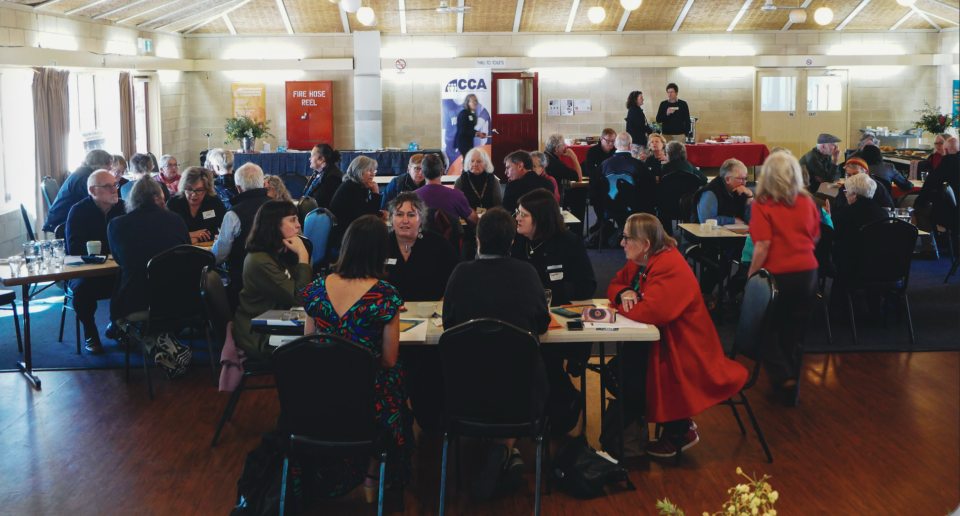
Yesterday, at a meeting just outside Castlemaine in Victoria, 70 people came together to hear…

Posted on 26 Aug 2026
Our Community's founder and leader, Denis Moriarty, says he commissioned a new piece of street art…

Posted on 19 Aug 2026
Government funding is at the centre of Australia's charity and not-for-profit sector – our number…