
Pauline Hanson and the frightening lesson of ‘Years and Years’
Posted on 07 Oct 2026
Our Community's founder and leader, Denis Moriarty, writes that when he watched an over-the-top…
Posted on 01 Oct 2024
By Greg Thom, journalist, Institute of Community Directors Australia

Charities are being placed under increasing pressure as the cost-of-living crisis drives a surge in demand for non-food items by people in need, according to a new report.
The research by Good360 Australia revealed that 82% of charities reported unprecedented demand for essential items such as hygiene products, clothing, furniture and education supplies.
A similar number of charities (84%) said they expect the year ahead to be even tougher as demand for non-food aid increases.
The Good360 Australia Communities in Need Report revealed:
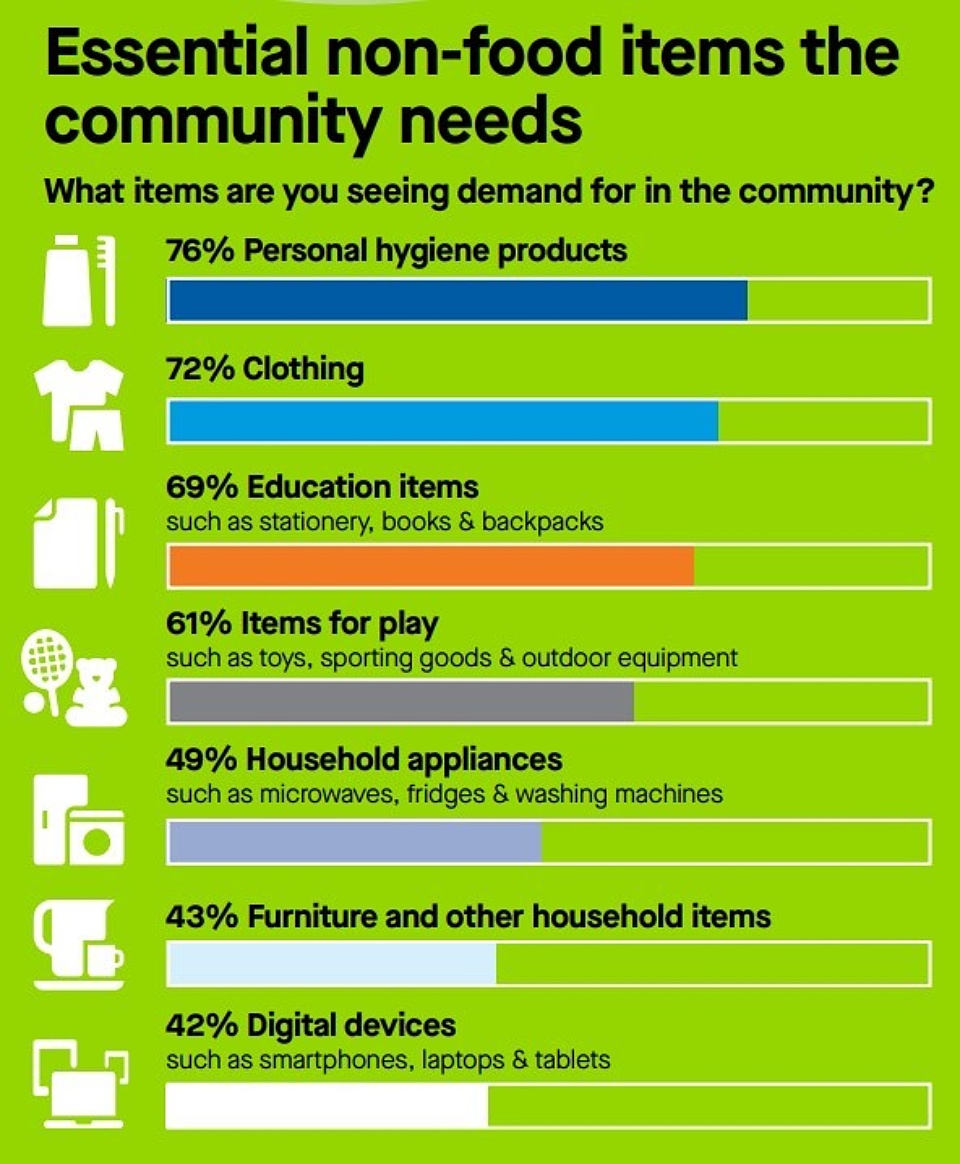
The online survey of 504 charities and disadvantaged schools across Australia, conducted in August 2024, revealed that personal hygiene products topped the list of essential items in demand and were needed by 76% of organisations, followed by clothing (72%), and educational supplies (69%).
Good360 Australia describes itself as the nation’s largest digital marketplace where retailers can donate unused and unsold consumer goods to people in need.
Alison Covington, founder and managing director of Good360 Australia, said the report’s findings emphasised the urgent need to address the rising demand for non-food-related help in the community.
“The cost-of-living crisis is pushing more Australians to the brink, and we are seeing a significant increase in the number of people turning to charities for help,” she said.
“The reality is that our communities need more than just food; they need everyday essentials that contribute to a dignified life.”
“The situation is becoming increasingly untenable for so many Australians.”
The founder and managing director of the anti–period poverty charity Share the Dignity, Rochelle Courtenay, said she was not surprised by the survey results.
Ms Courtenay said her organisation's recent August Dignity Drive saw requests from charities for period products skyrocket to more than 300,000 – the highest number of requests in Share the Dignity's history.
"The demand from our charity partners is higher than ever before," she said.
"I think it really highlights how when the cost of living increases, items like pads and tampons are one of the first to be bumped off the shopping list."
Ms Courtnay said cost-of-living pressures meant fewer people were able to donate.
"The unfortunate reality is unless people can access them [period products] from a charity or our Dignity vending machines, people end up using wadded-up toilet paper, socks or towels to manage their period."

Ms Covington said it was not only the volume of need that was of concern, but the fact that 58% of charities have reported an increase in people seeking help for the first time.
“We need to do more to ensure that all Australians, regardless of their circumstances, have access to the essentials,” she said.
“This includes items to support personal hygiene, for education, for living comfortably at home, and for play.”
The survey asked charities to share their greatest concerns about the year ahead.
Top of the list were deteriorating economic conditions and the cost-of-living crisis (89%).
This was followed by declining donations and fundraising challenges (65%), and not having enough donated goods to help people in need (62%).
More than 89% of charities believed government should be doing more to help people in need, while 85% said businesses could help more by donating excess or unsold goods.
“The situation is becoming increasingly untenable for so many Australians,” said Ms Covington.
“Meanwhile, we know that $2.5 billion of unsold essential household goods are unnecessarily wasted each year.
“There’s so much more we can do to reduce both need and waste in our community, including by working with more retailers to donate more excess or unsold goods to people who need it most.”
Struggling Australians on income support cut back on life essentials: report
New research confirms continued cost-of-living pain for struggling Australians
Posted on 07 Oct 2026
Our Community's founder and leader, Denis Moriarty, writes that when he watched an over-the-top…
Posted on 07 Oct 2026
A major public campaign launched this morning is calling on the federal government to restore…
Posted on 07 Oct 2026
The Australian Literacy & Numeracy Foundation (ALNF) has announced a partnership with mining…
Posted on 07 Oct 2026
A conference in Darwin will this morning hear detailed, strategic plans for how Australia could…

Posted on 07 Oct 2026
Joseph Friedman is co-founder and publisher of About Time, Australia’s only newspaper for…

Posted on 30 Sep 2026
There's been a lot of talk about AI this week, and some of it has been frightening. So, is AI good…

Posted on 30 Sep 2026
After the biggest AFL game of the year, one player proudly wore the flag of his birth country and…

Posted on 30 Sep 2026
At 21 years old, Tate Donohoe is the founder of Ecodia, an AI-assisted software development company…

Posted on 30 Sep 2026
Not-for-profit leaders have been warned to be wary of approaches from potential “funding partners”…

Posted on 30 Sep 2026
More than 200 fully funded Centre for Social Impact (CSI) scholarships will help equip for-purpose…

Posted on 30 Sep 2026
Personal stories are among the most powerful tools a charity can have to raise funds and awareness,…

Posted on 23 Sep 2026
In his new book Our Place, policy expert Matt Lloyd-Cope argues that housing must be at the heart…