
Pauline Hanson and the frightening lesson of ‘Years and Years’
Posted on 07 Oct 2026
Our Community's founder and leader, Denis Moriarty, writes that when he watched an over-the-top…
Posted on 23 Jul 2024
By Greg Thom, journalist, Institute of Community Directors Australia
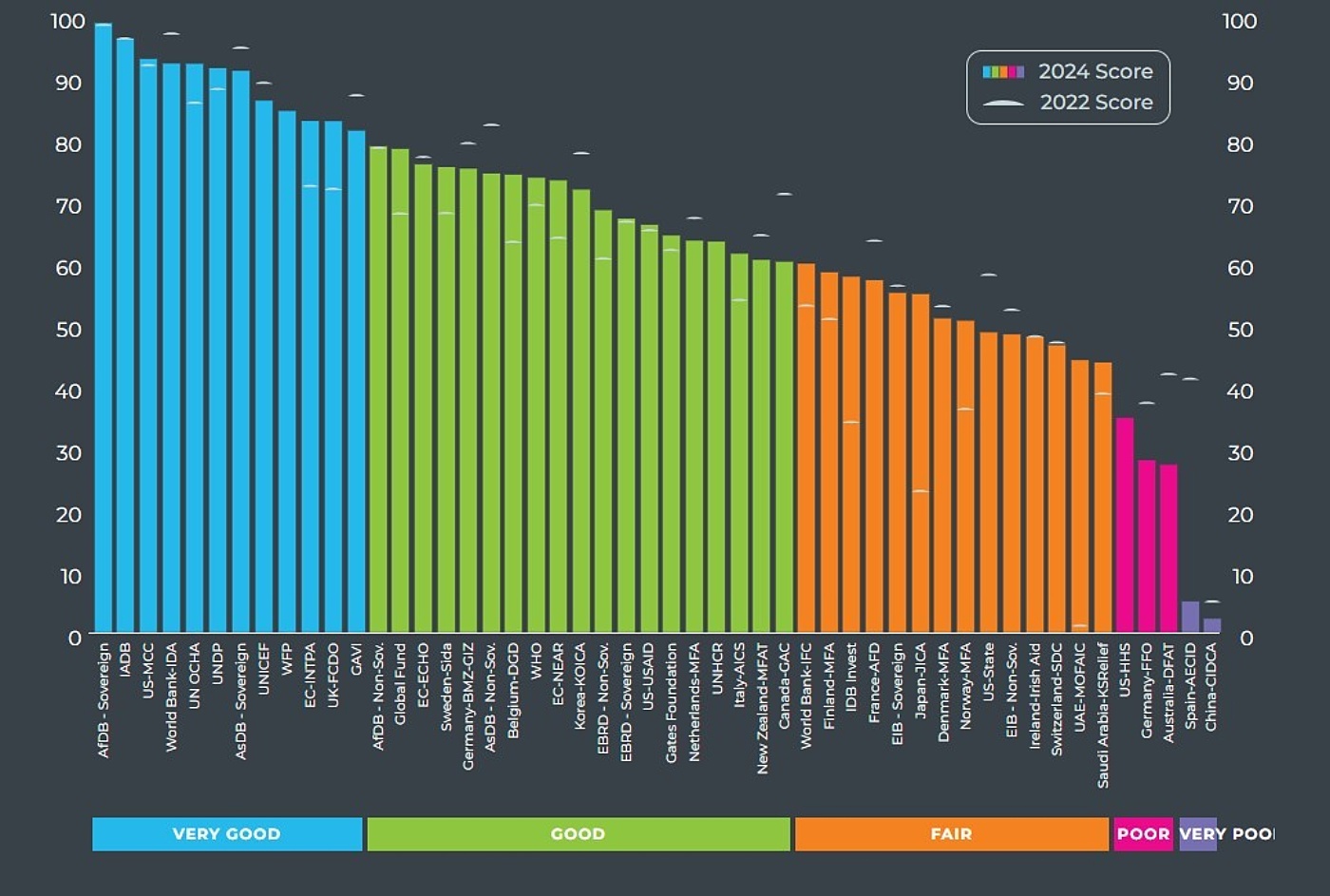
Australia’s performance has been labelled ‘poor’ in a global ranking of international aid and development transparency.
The 2024 International Aid Transparency Index (IATI) showed the Department of Foreign Affairs and Trade (DFAT) has plummeted seven places to rank 48 out of 50 international aid organisations.
The only donors of humanitarian aid and development ranked lower than Australia were Spain and China.
Australia’s ranking on the IATI has fallen each year since 2018.
The Australian Council for International Development (ACFID), Australia’s peak body for humanitarian and development agencies, expressed alarm at the fall from grace.
ACFID chief of policy and advocacy Jocelyn Condon said it was the first time Australia had received a "poor" transparency rating, having failed to provide data to IATI for its latest reporting period (2019–22).

“Australia has fallen to the back of the global pack, behind the likes of Saudi Arabia and the United Arab Emirates and only two places ahead of China, when it comes to transparency about development and humanitarian aid spending,” said Ms Condon.
“Aid transparency matters. Open and transparent data to allow Australians to easily find out how the government spends crucial official development assistance.”
The IATI is researched and written by Publish What You Fund, a global campaign that seeks to improve the transparency of development and humanitarian resources and their impact in relieving poverty and crises.
The body brings together governments, multilateral institutions and private sector organisations in a bid to shine a light on the resources flowing into developing countries.
IATI said it encouraged all organisations that distribute or spend resources to publish information about their development and humanitarian activities using its data standard, designed to ensure information is easy to access, understand and use.
The organisation made several recommendations on how DFAT could improve its approach to transparency, including:
“Increasing transparency is crucial to bolster the coordination, accountability and effectiveness of development and humanitarian assistance for the world’s poorest and most vulnerable people.”
Ms Condon said ACFID members had rigorous transparency requirements under the organisations code of conduct and it was critical that the federal government lives up to the same standards.
“It’s important that Australia is clear and unwavering in meeting its commitments to reforming our international reputation as a development partner of choice,” said Ms Condon.
“The aid sector acknowledges Australia’s renewed commitments under its new International Development Policy, but it is clear more needs to be done.”
Ms Condon said ACFID hoped DFAT would show improvements in subsequent reporting years when slated new initiatives under the policy were in place.
“Increasing transparency is crucial to bolster the coordination, accountability and effectiveness of development and humanitarian assistance for the world’s poorest and most vulnerable people.”

The Minister for the Pacific and International Development, Pat Conroy, defended the government’s record on international aid transparency.
“Over nine wasted years, the Liberals and Nationals slashed Australia’s development assistance by $11.8 billion, reduced our influence and left a vacuum for others to fill,” he said.
“And to make it worse, they tried to cover it up by not reporting to the International Aid Transparency Initiative. As a result, Australia’s ranking in the Aid Transparency Index has plummeted.”
Mr Conroy said the Albanese Government had boosted official development assistance by $10.4 billion in its first two years in office.
“As part of our commitment to transparency and accountability across the international development program, we will recommence reporting to the IATI.
“We have also launched a landmark International Development Policy that implements new transparency measures including a new online data portal on all of our development initiatives, investments in data analytics and capability to increase our reporting to the IATI, and an annual Performance of Australian Development Cooperation Report.
“We expect our work to see Australia’s [IATI] rating rise over the coming years.”
Co-ordinated aid approach transforms lives of vulnerable women and children in Africa
Aussie NFP is helping female entrepreneurs to fly in Fiji
Running toward the guns to help others
Charity regulator issues advice on overseas aid amid a flood of crises
Posted on 07 Oct 2026
Our Community's founder and leader, Denis Moriarty, writes that when he watched an over-the-top…

Posted on 07 Oct 2026
A major public campaign launched this morning is calling on the federal government to restore…

Posted on 07 Oct 2026
The Australian Literacy & Numeracy Foundation (ALNF) has announced a partnership with mining…

Posted on 07 Oct 2026
A conference in Darwin will this morning hear detailed, strategic plans for how Australia could…

Posted on 07 Oct 2026
Joseph Friedman is co-founder and publisher of About Time, Australia’s only newspaper for…

Posted on 30 Sep 2026
There's been a lot of talk about AI this week, and some of it has been frightening. So, is AI good…

Posted on 30 Sep 2026
After the biggest AFL game of the year, one player proudly wore the flag of his birth country and…

Posted on 30 Sep 2026
At 21 years old, Tate Donohoe is the founder of Ecodia, an AI-assisted software development company…

Posted on 30 Sep 2026
Not-for-profit leaders have been warned to be wary of approaches from potential “funding partners”…

Posted on 30 Sep 2026
More than 200 fully funded Centre for Social Impact (CSI) scholarships will help equip for-purpose…

Posted on 30 Sep 2026
Personal stories are among the most powerful tools a charity can have to raise funds and awareness,…

Posted on 23 Sep 2026
In his new book Our Place, policy expert Matt Lloyd-Cope argues that housing must be at the heart…