
Fence-sitting isn’t going to work if we want better owners corporations
Posted on 21 Oct 2026
The wider not-for-profit sector doesn't pay much attention to owners corporations, but maybe it…
Posted on 04 Jun 2025
By Greg Thom, journalist, Institute of Community Directors Australia

A cost-of-living fuelled surge in demand for help from struggling Australians has helped spark significant growth in the size of the nation’s charity sector according to a new report.
The 11th edition of the Australian Charities and Not-for-profits Commission (ACNC's) Australian Charities Report revealed an increase in charity sector revenue and staff.
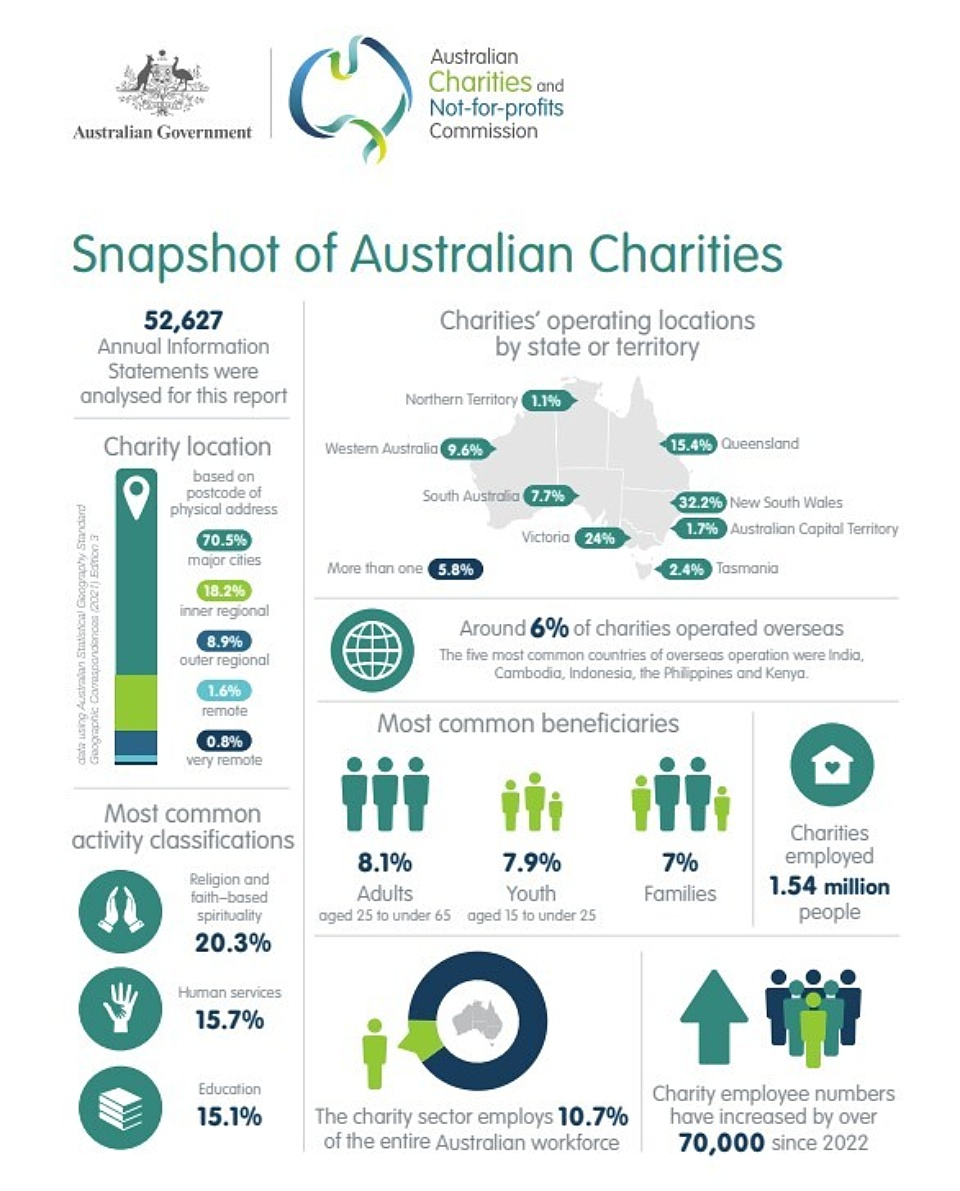
The report drew on data contained in the Annual Information Statements submitted by 52,267 charities for the 12 months to June 30, 2024.
It revealed that the number of people employed by the sector was up by 70,000 on the previous year to more than 1.54 million people.
The sector now comprises 10.7 per cent of Australia’s workforce and employs more workers than the construction and manufacturing industries.
Sector revenue surged by 10.7 per cent to reach a record high of $222 billion.
ACNC commissioner Sue Woodward said the statistics demonstrated the significant contribution charities make.
“The charity sector is a powerhouse of good, bringing benefits to people and communities who need support,” she said.
“It is also an active economic contributor, with growth year on year.”
“The addition of more staff reflects sector growth, but it’s growth that is needed to try to match greater demand for services.”
Woodward said the growth in the number of workers employed by the sector was matched by rising demand from Australians in need.

“The addition of more staff reflects sector growth, but it’s growth that is needed to try to match greater demand for services,” said Woodward.
“Many parts of the sector, including foodbanks and crisis accommodation services as just a couple of examples, are consistently reporting that cost of living pressures are driving higher demand, sometimes stretching capacity to the point where, sadly, people seeking help have to be turned away.”
Commenting on the surge in charity revenue, Woodward was at pains to point out that the operating environment for many organisations was still challenging.
She said in the previous reporting period, efforts to address demand amid the cost-of-living crisis had negatively affected charities, with expenses outstripping revenue.
Woodward said in a significant turnaround detailed in the current report, the rise in revenue was greater than the rise in expenses, which grew 8.4 per cent to $212 billion.
Staff costs were the largest cost type, accounting for more than half of total expenses (55 per cent).
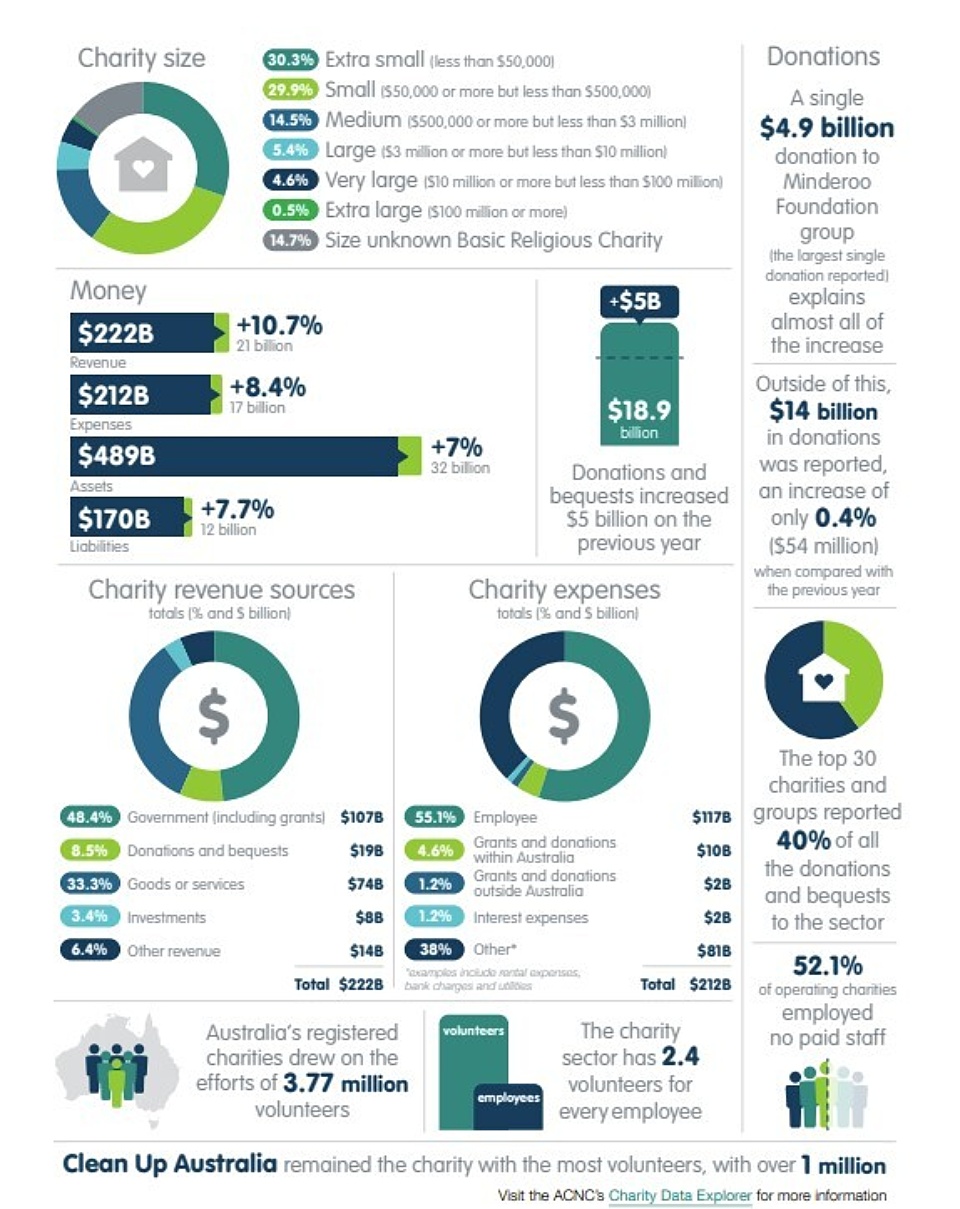
When it came to donations and bequests, the report confirmed that not all charities are equal, with about 40 per cent of all contributions going to just 30 charities.
Donations comprised about 40 per cent of revenue earned by extra small charities (those earning $50,000) compared to just six per cent for those deemed extra-large (earning more than $100 million).
The report revealed total donations and bequests jumped by $5 billion to $18.9 billion.
However, the increase was almost entirely due to a $4.9 billion donation to the Minderoo Foundation group – the largest single gift ever reported to the ACNC.
Aside from that, there was little increase, with donations increasing just 0.4 per cent, or $54 million.
The report found volunteers are the backbone of the charity sector, with 2.4 volunteers for every employee.
More than half (52 per cent) of all charities had no paid staff; for extra small organisations that figure was nearly 90 per cent.
The number of volunteers increased by 270,000 to 3.77 million nationwide, a result welcomed by Woodward.
“This is really pleasing. It’s close to the highest number of volunteers [which was] recorded in the sixth edition of the report, which covered 2018,” she said.
Download the 11th edition of the ACNC Charities Report
Podcast: Regulator ready to support new charities amid surge in numbers
Posted on 21 Oct 2026
The wider not-for-profit sector doesn't pay much attention to owners corporations, but maybe it…

Posted on 21 Oct 2026
Backed by tangible successes and government support, community foundations are gaining momentum as…

Posted on 21 Oct 2026
A national campaign to restore federal funding for Ask Izzy has attracted such strong grassroots…
Posted on 21 Oct 2026
In the wake of an act of violence against federal independent MP Helen Haines, Charities Minister…

Posted on 21 Oct 2026
If your charity takes a stance that happens to align with a political party’s stance in a public…

Posted on 15 Oct 2026
Good cybersecurity must be the foundation of not-for-profits’ efforts to adopt artificial…

Posted on 15 Oct 2026
A few years ago, I sat on a small community board that was still held together by email threads and…

Posted on 15 Oct 2026
“Build a better mousetrap, and the world will beat a path to your door”, the old saw goes.…

Posted on 15 Oct 2026
The nation's digital inclusion advocate is pushing for more equity in the rollout of AI in light of…

Posted on 15 Oct 2026
Not-for-profit leaders should be conducting regular “fire drills” that replicate AI-powered…

Posted on 15 Oct 2026
Boards that leave cybersecurity to the one director with IT expertise are leaving their…

Posted on 15 Oct 2026
Community Directors has a warehouse-style office filled with artworks, and if I glance up towards…