Pauline Hanson and the frightening lesson of ‘Years and Years’
Posted on 07 Oct 2026
Our Community's founder and leader, Denis Moriarty, writes that when he watched an over-the-top…
Posted on 22 Sep 2023
By Greg Thom, journalist, Institute of Community Directors Australia

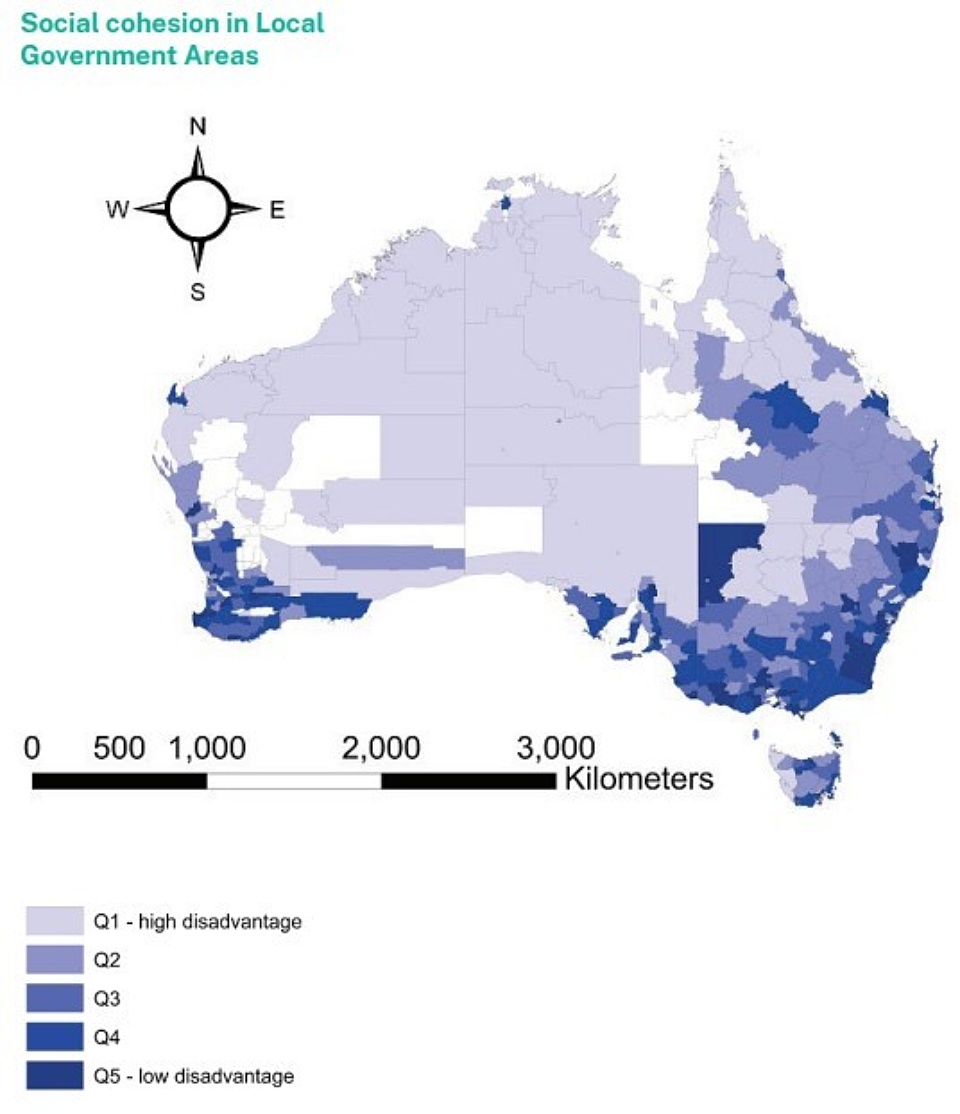
From the unifying force of Matildas mania to the increasingly rancorous debate around the Voice, a new report shines a light on just how united Australia really is as a nation
Young adults and people experiencing financial difficulties are among the least trusting in society, a new snapshot of the threads that bind the nation’s social fabric together has revealed.
The Australian Cohesion Index 2023 found that negative attitudes in these groups point to important social inequalities in Australia that are constraining our overall social cohesion.
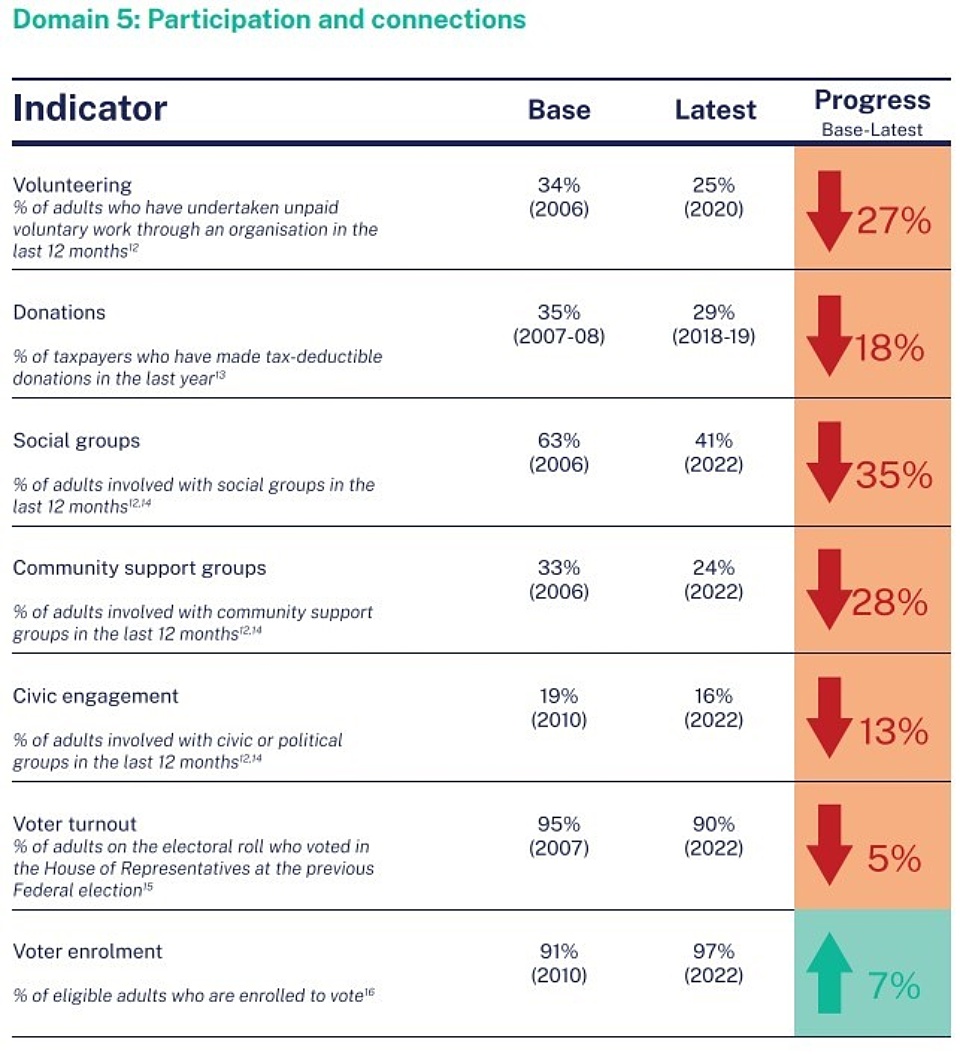
The wide-ranging analysis also pointed to several worrying trends, from the fall in volunteer numbers and donations to charity to increasing distrust of government and a dramatic decline in the number of people who have pride in the Australian way of life.
Produced by the Scanlon Foundation Research Institute (SFRI), the biennial index is designed to provide a comprehensive assessment of Australia’s societal wellbeing.
The results are broken down into four main themes: trust in society; belonging and engagement; economics and material wellbeing; and health and personal wellbeing.
The report found that in the years between 2007 and 2022:
There was a 21% fall in the number of Australians who believed those on low incomes received enough financial support.
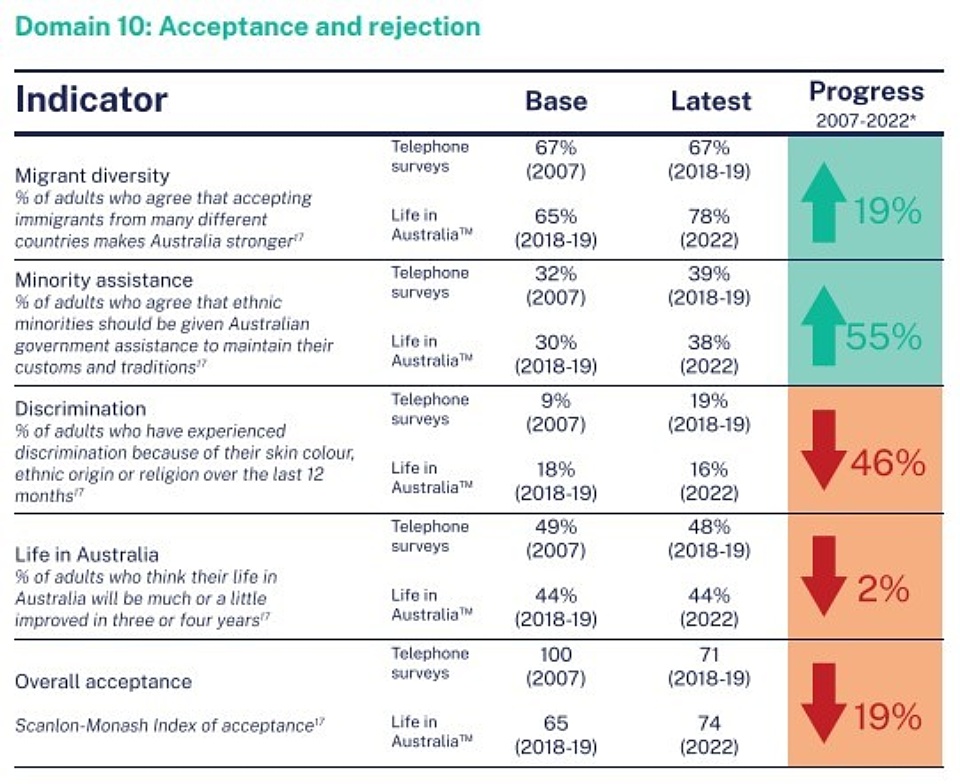
The study revealed the sense of national pride and belonging among Australians appeared to be in decline, along with our involvement in local communities (down 28%).
Despite continued economic growth, an increasing number of Australians were affected by financial and cost-of-living pressures.
On the plus side, Australians were generally healthy overall, enjoying among the world’s longest life expectancies.
The Institute said the ACI report, which covers the period 2007 to 2022, brought together data from multiple sources to provide the nation’s most comprehensive understanding of the social landscape.
“Whichever way you look at it, trust, the pursuit of social justice and the belief that we can change for the better is foundational to our social cohesion.”
In launching the report, the lead researcher and primary author, Australian National University lecturer and demographer Dr James O’Donnell, acknowledged the challenges faced by Australians over the past few years, from the covid pandemic to the cost-of-living crisis and rising international tensions.
“And as I speak, we're engaged in a difficult debate over the Voice referendum, all of which puts pressure on Australian society, our connections to others, our sense of belonging and trust and our engagement and participation in community and civic life,” he said.
“That's not to say we're not connected as a society. Indeed. Our social cohesion is resilient, but it is also fragile.”
Dr O’Donnell said trust and a sense of belonging were the core ingredients in how we engaged in society, the economy, with our friends, and local communities.
“At the societal level, trust is the political capital that our leaders draw on to make hard policy decisions,” he said.
The report revealed that trust in Australia was a fragile commodity, though, with fewer than one in three people believing the federal government could be trusted to do the right thing by the Australian people most of the time.
“One silver lining of COVID-19 is that it showed us how to strengthen social cohesion in Australia.”
Encouragingly, both trust in people and trust in government increased during the covid-19 pandemic.
“Our collective response to the pandemic had a galvanising effect and we were substantially more likely to trust one another and governments both state and federal,” said Dr O’Donnell.
“The effect is not fully worn off yet, but it has been declining since.”
While high levels of political activism such as that being experienced during the current Voice debate could be seen by some as detrimental, Dr O’Donnell said they were in fact central to our democracy.
The study revealed an 8% increase in the number of Australians who had written to an MP, a 51% surge in those who had joined a boycott of a product or company and a 5% jump in overall political participation.
“In an open and free democracy, is it better for us to stay home feeling like the helpless and marginalised or conversely content and happy to place blind faith in our leaders, or to take steps to protect and enhance our collective way of life?” asked Dr O’Donnell.
“Whichever way you look at it, trust, the pursuit of social justice and the belief that we can change for the better is foundational to our social cohesion.”
Despite the challenges contained within its pages, in his introduction to the report, the federal Minister for Immigration, Citizenship and Multicultural Affairs, Andrew Giles, highlighted the unifying effect of the Matildas’ barnstorming World Cup campaign as offering hope for the future.
“There was a moment in August 2023 when Australia appeared united. It seemed the entire nation was willing on the Matildas and their unprecedented march to the football World Cup semifinals.
“Perhaps this was entertainment to distract us from more pressing concerns.
“More optimistically, that sudden burst of shared enthusiasm for our national football team showed Australians see themselves as connected to one another and sharing a common destiny.”
Posted on 07 Oct 2026
Our Community's founder and leader, Denis Moriarty, writes that when he watched an over-the-top…

Posted on 07 Oct 2026
A major public campaign launched this morning is calling on the federal government to restore…
Posted on 07 Oct 2026
The Australian Literacy & Numeracy Foundation (ALNF) has announced a partnership with mining…
Posted on 07 Oct 2026
A conference in Darwin will this morning hear detailed, strategic plans for how Australia could…
Posted on 07 Oct 2026
Joseph Friedman is co-founder and publisher of About Time, Australia’s only newspaper for…
Posted on 30 Sep 2026
There's been a lot of talk about AI this week, and some of it has been frightening. So, is AI good…

Posted on 30 Sep 2026
After the biggest AFL game of the year, one player proudly wore the flag of his birth country and…

Posted on 30 Sep 2026
At 21 years old, Tate Donohoe is the founder of Ecodia, an AI-assisted software development company…

Posted on 30 Sep 2026
Not-for-profit leaders have been warned to be wary of approaches from potential “funding partners”…
Posted on 30 Sep 2026
More than 200 fully funded Centre for Social Impact (CSI) scholarships will help equip for-purpose…
Posted on 30 Sep 2026
Personal stories are among the most powerful tools a charity can have to raise funds and awareness,…
Posted on 23 Sep 2026
In his new book Our Place, policy expert Matt Lloyd-Cope argues that housing must be at the heart…