
Is your board treating philanthropy as a relationship or a transaction?
Posted on 17 Sep 2026
Charities reported $14.8 billion in donations and bequests last financial year, the second-highest…
Posted on 11 Nov 2025
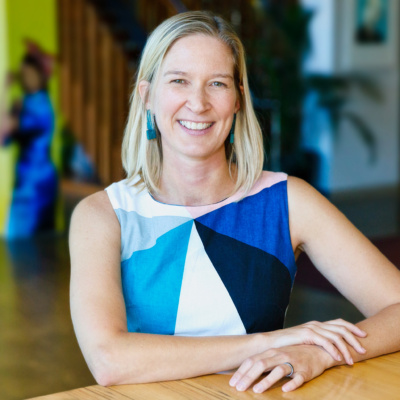
By Nina Laitala, training lead, Institute of Community Directors Australia

I’ve seen what happens when fear of conflict wins out over taking a principled stand.
During the 2017 marriage equality debate, the board of the youth organisation I worked for at the time decided to stay silent on the issue, on the basis that “the organisation can’t vote.” In truth, it was fear, not realpolitik, that kept the organisation from speaking out in favour of equality: fear of controversy, fear of funding loss, fear of discomfort. That silence created dissonance and mistrust. Avoiding the mess only deepened the divide.
To be a radical moderate is not to sit on the fence or avoid hard questions or stay silent. It’s to hold steady in the centre while the noise pulls from every side. It’s to resist the comfort of certainty and instead wrestle with what’s complex.
That’s what social cohesion requires.
Social cohesion isn’t about everyone agreeing or getting along. It’s about people feeling connected, belonging, and willing to work together for something beyond personal gain. It asks us to keep engaging, even when it’s uncomfortable. It asks those of us with power to notice it, share it, and sometimes give some of it up.
As a community leader, I’ve learned that the most valuable thing I can do is not to speak louder, but to listen more deeply. Not to have all the answers, but to ask better questions. Listening with intention, to understand rather than to confirm, is at the heart of radical moderation.
"As a community leader, I’ve learned that the most valuable thing I can do is not to speak louder, but to listen more deeply. Not to have all the answers, but to ask better questions."
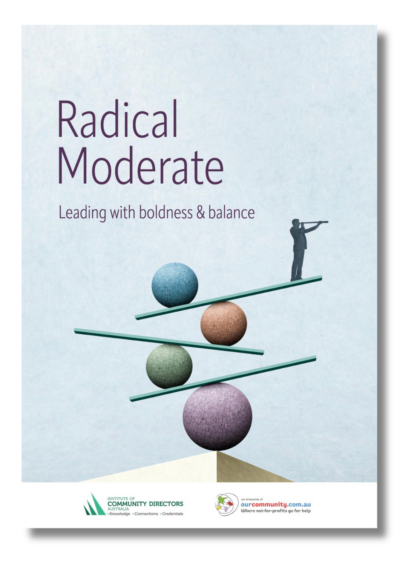
Because being moderate, in this sense, doesn’t mean being neutral. It means being anchored. It’s choosing balance without becoming bland. It’s being open without being passive. It’s showing empathy without surrendering principle.
I once joined a not-for-profit board with someone I didn’t expect to like. We held very different views and values, and I worried that our disagreements would make collaboration impossible. But a few shared principles, fairness, respect, and honesty gave us common ground to work from. We still disagreed often, but we listened with curiosity rather than contempt. That made our decisions better, and our governance stronger.
This kind of leadership is what holds communities together. It’s the same principle as board solidarity: disagreement and dissent are part of the process, but once a collective decision is made, we move forward together. The debate is not the problem. Avoiding it is.
In times of polarisation, radical moderation asks us to keep showing up to talk. To stay at the table. To value empathy as much as conviction.
Social cohesion isn’t a project or an action plan. It’s a lifelong practice, one that calls for the courage to stay calm, curious and connected when it would be easier to turn away.
That’s also what it means to be a radical moderate. And it might just be what holds our communities together.
Posted on 17 Sep 2026
Charities reported $14.8 billion in donations and bequests last financial year, the second-highest…

Posted on 13 Aug 2026
Innovation isn't just a buzzword, and it isn't just about technology. It’s a necessary part of…

Posted on 22 Jul 2026
I once worked with an organisation that had become expert at keeping the lights on. Every year it…

Posted on 10 Jun 2026
ICDA training lead Nina Laitala examines the governance issues facing Australian not-for-profits.

Posted on 18 May 2026
ICDA training lead Nina Laitala examines the governance issues facing Australian not-for-profits.

Posted on 12 Mar 2026
Fundraising is often parked in the operational corner. And yes, the execution of fundraising is an…

Posted on 10 Dec 2025
Stressed, overwhelmed, exhausted… if you’re on a not-for-profit board and these words sound…

Posted on 15 Oct 2025
Writing grant applications is usually seen as an operational job, but that doesn’t mean the board…

Posted on 18 Sep 2025
Organisations using artificial intelligence to transcribe and summarise meetings must ensure they…

Posted on 14 Aug 2025
ICDA training lead Nina Laitala examines the governance issues facing Australian not-for-profits.

Posted on 17 Jul 2025
ICDA training lead Nina Laitala examines the governance issues facing Australian not-for-profits.

Posted on 26 Jun 2025
ICDA training lead Nina Laitala examines the governance issues facing Australian not-for-profits.