
How can your board balance digital inclusion with cyber security?
Posted on 15 Oct 2026
A few years ago, I sat on a small community board that was still held together by email threads and…
Posted on 10 Dec 2025
By Nina Laitala, training lead, Institute of Community Directors Australia
Stressed, overwhelmed, exhausted… if you’re on a not-for-profit board and these words sound familiar, you’re not alone.
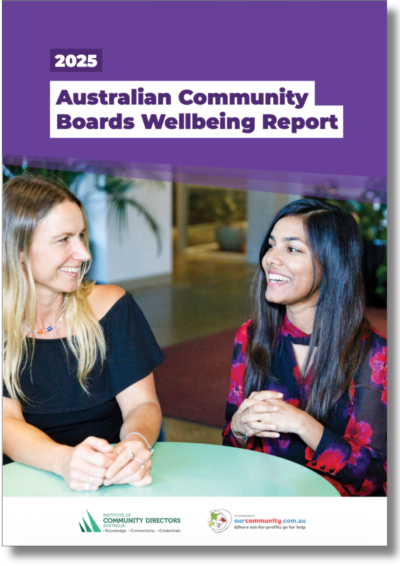
More than two thirds of board members who responded to the Institute of Community Directors Australia’s 2025 annual wellbeing survey said they had considered stepping down because of these feelings.
Wellbeing is not a nice-to-have for not-for-profits (NFPs) and community organisations. It is essential for effective, sustainable work. When organisations take wellbeing seriously, they see higher retention of staff and volunteers, greater innovation and stronger long-term stability.

Wellbeing is about more than feeling challenged in a healthy way, and feeling valued. It also influences – and is defined by – how an organisation responds to threats, problems and crises. And while wellbeing belongs to everyone, the board sets the tone. The board has the first and last words on expectations, culture and boundaries. Good governance and good wellbeing go hand in hand.
So what does this mean in practice? Below are six aspects of wellbeing where the board’s oversight makes a significant difference, along with practical ideas and tools from the Institute of Community Directors Australia to help you put them into action.

A healthy culture does not happen by accident. Boards need to pay attention to how people treat each other, how disagreements are handled and whether people feel safe to ask the hard questions. When these issues are not considered, things can go wrong quickly. Years ago, I worked with a board that unravelled over one contentious issue. Perspectives were dismissed, questions were ignored and toxic behaviour was allowed to continue. The chair was not experienced in managing conflict, the board imploded and the impact rippled through the broader community.
The role of the chair is central to cultivating a healthy culture. A strong chair who knows how to facilitate discussion, manage conflict and include quieter voices can lift a board from average to high functioning. But the whole board shares the responsibility. Everyone needs to turn up with good intentions for the organisation and a willingness to work together with everyone else.
Try these ideas to create and maintain a healthy and open culture that starts with the board:
Related resources: Board code of conduct template | Tips for resolving conflict
"One of the biggest sources of board stress is not knowing where governance ends and operations begin."

Nothing drains goodwill faster than long, rambling meetings or unclear expectations of how much work is involved. Many board members tell us they joined with the best intentions but had no real idea of the workload or their legal accountability, and they didn’t even receive a basic induction. I recently spoke to a board member of a small charity who had stepped into the secretary role at the AGM and was immediately thrown into the job with no guidance, no handover and no induction. They persisted until the following AGM, by which time the stress had outweighed their passion for the cause and they resigned.
Clear and accurate role descriptions help volunteer board members join with confidence rather than confusion. A board also needs to be thoughtful about meeting structures and workloads so the organisation can progress its purpose without overwhelming people.
Try these tips:
Resources: Better meetings | Board meeting checklist

A not-for-profit I worked with in northern Australia was struggling to move out of crisis mode and maintain clear boundaries between the board and the staff. While the board needed to be more hands-on during a period of major change, the ongoing lack of clarity about roles and responsibilities was creating confusion and anxiety across both groups. Board members felt out of their depth and staff were taking increasing amounts of sick leave.
One of the biggest sources of board stress is not knowing where governance ends and operations begin. Clarity in this area reduces confusion, prevents micromanaging and strengthens decision making. The relationship between the board and staff should be a partnership managed by the chair and the CEO, who should ensure both sides receive appropriate and timely advice and guidance.
Consider these practical strategies to create and maintain a more cohesive board:
Related resources: Induction checklist | Reducing the chances of board burnout | Office bearer role descriptions

Most boards are meeting their basic work health and safety obligations, so the next step is taking a more proactive approach to wellbeing. Understanding how wellbeing intersects with different areas of governance helps boards develop more considered policies and practices. When wellbeing is built into governance, it sends a clear message about what the organisation values.
An organisation I once worked with prided itself on understanding intersectionality and on its commitment to staff wellbeing. However, when staff challenged the definition of “family” in the organisation’s leave policy and asked for permission to swap public holidays for cultural holidays, the professed commitment did not hold up in practice. The result was confusion, feelings of exclusion and a decline in mental health. It was a reminder that wellbeing policies must be lived, not just written.
Consider these ideas:
Related resources: Wellbeing strategy template | Work health and safety policy template | Risk register template

Chairs, secretaries and treasurers carry high levels of responsibility and often experience greater stress than other board members. These roles usually shoulder the bulk of leading decision-making, keeping paperwork and records in order and making sure compliance obligations are met. When they are unsupported, the whole board feels the impact. If these leaders are relied upon to do too much, the rest of the board can feel unnecessary or undervalued. If they do not step up at the right time or in the right way, the organisation can miss opportunities or be exposed to risks. Leadership needs to be acknowledged and supported across the board.
I once worked with a community sports organisation that struggled for years to recruit experienced leaders for the committee of management. When the organisation finally engaged someone who knew what they were doing, that person was quickly weighed down with responsibility for compliance, key decisions and dragging the rest of the committee along. The reluctance of others to engage in professional development or build their governance skills led to burnout, resignations and eventually the organisation merging with a more mature club.
Some practical ideas to support leaders:
Related resources: Damn Good Advice for Board Chairs | Damn Good Advice for Board Secretaries | Record-keeping for treasurers

Even the best board will struggle if it does not have enough people, if it lacks the necessary skills and experience, or if the workload is unevenly shared. Smaller organisations in particular need solid structures and systems to prevent burnout at both board and staff level.
I once worked with a small community board that placed higher value on diversity of experience than on core skills such as legal knowledge, financial literacy and risk management. As the organisation grew, this gap became serious. Basic governance practices were overlooked and the board eventually found itself before VCAT when members challenged its decisions. It was a hard lesson in the importance of balancing representation with essential capability.
Your board should be thinking about recruitment pathways, such as observership programs, as well as using sub-committees with external members to bring in additional skills and insight. Ongoing training is also important to build capability among existing board members.
Some other ideas for building your board pipeline and composition:
Related resources: Board effectiveness self-review | Board skills and experience matrix
Finally, remember that governance and leadership are, at their heart, about people. People need connection, compassion and care. When the board remembers this, everything else becomes easier.
Good governance and good wellbeing go hand in hand. A board that models healthy and sustainable behaviour gives the whole organisation permission to do the same.
Posted on 15 Oct 2026
A few years ago, I sat on a small community board that was still held together by email threads and…

Posted on 17 Sep 2026
Charities reported $14.8 billion in donations and bequests last financial year, the second-highest…

Posted on 13 Aug 2026
Innovation isn't just a buzzword, and it isn't just about technology. It’s a necessary part of…

Posted on 22 Jul 2026
I once worked with an organisation that had become expert at keeping the lights on. Every year it…

Posted on 10 Jun 2026
ICDA training lead Nina Laitala examines the governance issues facing Australian not-for-profits.

Posted on 18 May 2026
ICDA training lead Nina Laitala examines the governance issues facing Australian not-for-profits.

Posted on 12 Mar 2026
Fundraising is often parked in the operational corner. And yes, the execution of fundraising is an…

Posted on 11 Nov 2025
I’ve seen what happens when fear of conflict wins out over taking a principled stand.

Posted on 15 Oct 2025
Writing grant applications is usually seen as an operational job, but that doesn’t mean the board…

Posted on 18 Sep 2025
Organisations using artificial intelligence to transcribe and summarise meetings must ensure they…

Posted on 14 Aug 2025
ICDA training lead Nina Laitala examines the governance issues facing Australian not-for-profits.

Posted on 17 Jul 2025
ICDA training lead Nina Laitala examines the governance issues facing Australian not-for-profits.