
Pauline Hanson and the frightening lesson of ‘Years and Years’
Posted on 07 Oct 2026
Our Community's founder and leader, Denis Moriarty, writes that when he watched an over-the-top…
Posted on 03 Sep 2024
By Matthew Schulz, journalist, Institute of Community Directors Australia

Charity groups have been urged to campaign in support of proposed reforms to encourage philanthropy and fundraising, amid warnings by an author of those reforms that the “window of opportunity” to push for change is closing quickly.
The Stronger Charities Alliance and the Australian Democracy Network last week hosted a briefing
for charity advocates about the Productivity Commission’s inquiry into philanthropy, called Future Foundations for Giving.
Those groups are hoping the reforms will bolster the ability of charities to advocate by bringing in tax benefits for groups excluded from deductible gift recipient (DGR) status in the past.
The background to the 468-page Productivity Commission report is that the federal government wants to “double philanthropy” by 2030. The report’s main recommendations centre on a shake-up of DGR status.
The report predicts reforms would drive a surge in the number of charities and boost generosity. It estimates up to15,000 more charities would win DGR status.
The Alliance believes that all registered charities should have DGR status.
While the federal government formally released the report in July, after sitting on it since May, it is yet to formally respond, apart from ruling out a recommendation to scrap building fund perks for private schools.
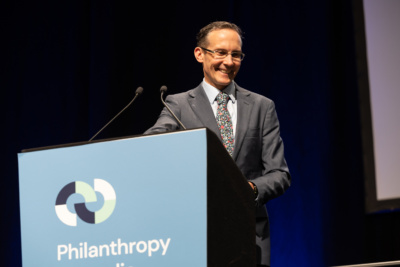
In a speech to the Philanthropy Australia conference early last month, Charities Minister Andrew Leigh signalled his support for the DGR reform but did not commit to further changes.
Instead, he flagged that the government would “allow a reasonable window for a direct conversation with the sector as we consider its recommendations”.
Now a co-author of the report has warned that implementation of the Productivity Commission recommendations is no certainty, especially in the light of repeated past inquiries whose reforms were shelved.
"There is a window of opportunity here, a reform window, to influence the government's response and create a better taxation and regulatory framework for advocacy charities.”

A former Productivity Commission associate commissioner, and now Philanthropy Australia’s executive director in charge of policy, government relations and research, Krystian Seibert, issued the alert in a webinar briefing last week.
He told Australia’s leading charity advocates that the government appeared engaged, ready to hear charity perspectives, and potentially set to progress the biggest reform to the sector since the formation of the Australian Charities and Not-for-profits Commission (ACNC) in 2012.
But Mr Seibert told the group that the sector would need to press for those reforms for them to be adopted, ideally before the government released its final position.
“If those on this call and other stakeholders think that the current DGR system is a problem, that there are issues for advocacy charities, and they would like that reformed, they're in a powerful position to engage with government and convey those views, because there is a window of opportunity here, a reform window, to influence the government's response and create a better taxation and regulatory framework for advocacy charities.”
But he stressed that “that window won't exist forever”, and that any adopted changes would “depend on people advocating to government to actually reform it and improve it”.
He said the sector should accept that any reforms adopted by the government were “not going to be perfect … because there are these trade-offs”.
“Whether they [proposed reforms] are going to be acted upon or not, charity advocates are in the box seat in terms of influencing and shaping the government's response.
“I speak as an employee of a peak body that is very closely involved in these discussions and debates, and has been for a long time. If charities advocates in the sector think the current system isn't working and they want to want it to be reformed and improved, well, I think it's incumbent upon them to engage with the government to make their voices known to advocate for reform.”
He said that after witnessing the troubles with the DGR system as a ministerial advisor more than a decade ago, “I've seen how bad an approach it is”.
Lawyers, too, grapple with the complexity of the current system, he said, and many charities miss out.
He said the Productivity Commission report repeated earlier calls to repair the “broken” DGR system, but if anything was going to change, the sector would need to put pressure on government.
“Perhaps this will be the last inquiry that says this,” he said.
He criticised the existing system in which a not-for-profit organisation that focused on preventing a problem rather than providing direct relief in relation to that problem could miss out on the tax benefit.
For example, an organisation set up to prevent injuries in children can’t get DGR status as easily as one set up to prevent illnesses in children.
A case raised before the Productivity Commission highlighted a charity (the International Campaign to Abolish Nuclear Weapons, or ICAN) that had won a Nobel Peace Prize for advocating against nuclear war yet could not achieve DGR status.
While the problematic system wasn’t intentionally designed to hamper charities, “when you've got all these categories, gaps emerge, and they add up over time,” Mr Seibert said. Australians were left with a DGR system that “was not transparent, was not consistent”.
“Reform of the DGR system is long overdue, and the government should prioritise immediate changes.”

The Stronger Charities Alliance is set to campaign in support of the changes to DGR status and will be sending a joint letter from members to the government.
Alliance spokesperson Hassan Nasir Mirbahar said it was time for the government to fulfil the need for change.
"It’s not the first time a government-sponsored review or inquiry has recommended simplifying the DGR system,” Mr Mirbahar said.
“The latest recommendation by the Productivity Commission reiterates that the current system is overly complex and unsuitable for modern Australian charities - a problem that has been known for a while.
“Reform of the DGR system is long overdue, and the government should prioritise immediate changes.”
He said while there were “divergent views” in the sector about some of the Commission’s recommendations “everyone agrees that simplifying the DGR system and its extension to advocacy and harm prevention organisations is long warranted”.
“We will advocate for the government to prioritise the DGR reforms in its next term,” Mr Mirbahar said.
Posted on 07 Oct 2026
Our Community's founder and leader, Denis Moriarty, writes that when he watched an over-the-top…

Posted on 07 Oct 2026
A major public campaign launched this morning is calling on the federal government to restore…

Posted on 07 Oct 2026
The Australian Literacy & Numeracy Foundation (ALNF) has announced a partnership with mining…

Posted on 07 Oct 2026
A conference in Darwin will this morning hear detailed, strategic plans for how Australia could…

Posted on 07 Oct 2026
Joseph Friedman is co-founder and publisher of About Time, Australia’s only newspaper for…

Posted on 30 Sep 2026
There's been a lot of talk about AI this week, and some of it has been frightening. So, is AI good…

Posted on 30 Sep 2026
After the biggest AFL game of the year, one player proudly wore the flag of his birth country and…

Posted on 30 Sep 2026
At 21 years old, Tate Donohoe is the founder of Ecodia, an AI-assisted software development company…

Posted on 30 Sep 2026
Not-for-profit leaders have been warned to be wary of approaches from potential “funding partners”…

Posted on 30 Sep 2026
More than 200 fully funded Centre for Social Impact (CSI) scholarships will help equip for-purpose…

Posted on 30 Sep 2026
Personal stories are among the most powerful tools a charity can have to raise funds and awareness,…

Posted on 23 Sep 2026
In his new book Our Place, policy expert Matt Lloyd-Cope argues that housing must be at the heart…