
Save Izzy: campaign calls on government to restore funding for vital services directory
Posted on 07 Oct 2026
A major public campaign launched this morning is calling on the federal government to restore…
Posted on 30 Jul 2025
By Matthew Schulz, journalist, Institute of Community Directors Australia

Just 20 per cent of not-for-profits have lodged a new self-review return to prove they are exempt from income tax, eight months after the original deadline to do so.
Australian Taxation Office (ATO) assistant commissioner Jennifer Moltisanti told two charity conferences this week that 32,000 not-for-profits – or just one in five of those required to do so – had lodged the “self-review return”, which allows them to qualify for income tax exemption.
Originally, the ATO alerted 155,000 organisations that they needed to lodge the return by October last year, but it extended the deadline to March amid widespread confusion and concern about the changes, which led to a Senate inquiry.
That inquiry heard complaints about poor communication, a complex process, unnecessary red tape and high costs for organisations seeking accounting and legal advice.
It suggested lifting the income threshold, which is currently just $416, extending the lodgment deadline, handing over responsibility for the returns to the Australian Charities and Not-for-profits Commission (ACNC) and improving engagement.
"We can argue about why, but what we cannot argue about is that the measure has failed to achieve the desired policy outcome."

Community Council for Australia chief executive David Crosbie argued that the policy had failed, and it was time for a new approach.
Crosbie said he was sorely disappointed that in the government’s formal response to the long delays last week, “Neither the government nor the ATO have in any way acknowledged the findings of the Senate Economics Reference Committee that the implementation of this flawed policy is a major burden on many small volunteer-run NFPs and is not working”.
In a scathing commentary in the Community Advocate, Crosbie argues that the ATO has tried for more than two years to make the self-review process work, but “the vast majority of targeted NFPs have not lodged returns”.
“We can argue about why, but what we cannot argue about is that the measure has failed to achieve the desired policy outcome,” he said.


The ATO suggested that from this month it would “start to review NFPs that intentionally ignore their obligations”, after earlier suspending penalties for late lodgements.
The rules require non-charities with an Australian Business Number (ABN) to lodge the annual return or face losing that tax exemption.
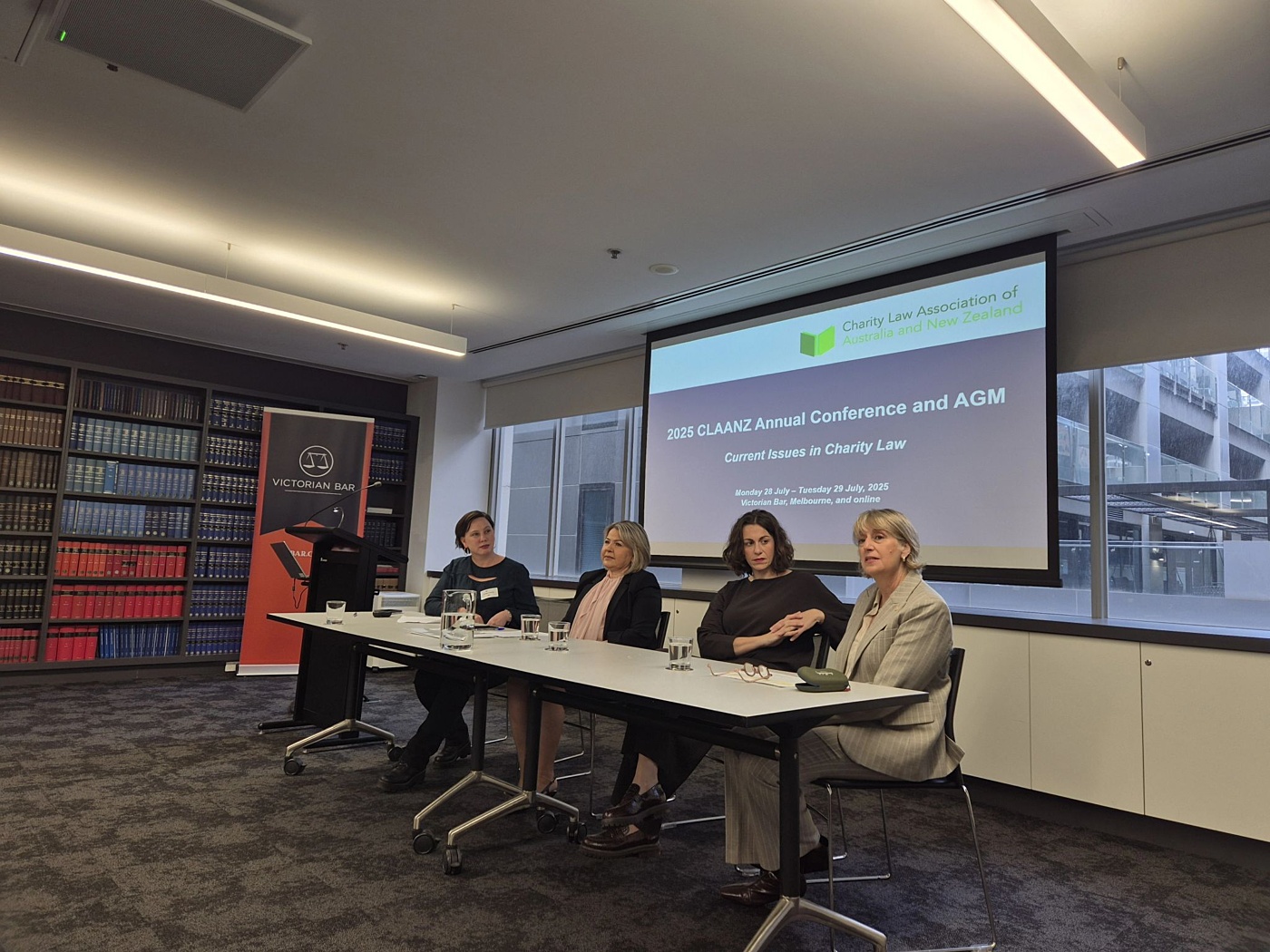
In response to questions after her panel talk at the Charity Law Association of Australia and New Zealand (CLAANZ) conference in Melbourne this week, Moltisanti said of the affected organisations:
Addressing charity law experts at the event, Moltisanti flagged that the ATO would continue to “look at opportunities to streamline things in the system”.
“We are building a roadmap for the not-for-profit sector with a view to looking at those pain points and pressure points, whereby we can alleviate some of that,” she said.
Moltisanti also made similar comments at the ACNC-hosted Governing for Good Forum hosted in Melbourne this week.
“We introduced the not-for-profit self-review return, but there was no law change.”
Moltisanti stressed that despite concerns raised by sector advocates and media coverage about the new requirement, “the return itself is relatively simple”, comprising contact details, answers to five questions and the declaration itself.
She stressed that no financial information was needed.
But she said the process had highlighted some concerning lessons about not-for-profit records, with the ATO discovering that “thousands” of not-for-profits had not maintained governing documents or Australian Business Number (ABN) details.
“It is a requirement for not-for-profits to have governing documents in place, but it’s somewhat surprising when … not-for-profits said that they didn’t have governing documents [or] didn’t know where the governing documents were [or] didn’t know about the exclusion clauses.
“There’s a little bit of work to do there,” Moltisanti said.
According to ATO figures, 21,000 NFPs have updated their ABN details since January last year.
Staff also learned that many charitable not-for-profits wrongly assumed they were automatically income tax exempt, and that thousands of NFPs did not meet the income tax exemption criteria.
“They weren’t charities, but they just assumed that they were income tax exempt,” she said.
Moltisanti said the discovery came as a surprise, because “the law hasn’t changed”.
“We introduced the not-for-profit self-review return, but there was no law change.”
“The pathway to income tax exemption has always been that you’re either registered with the ACNC and endorsed by the ATO or you meet one of those eight categories. And if you don’t meet one of those two pathways, you’ve always been a taxable not-for-profit.”
She said the return was not aimed at increasing revenue but at boosting the “integrity in the sector”.
In a statement to the Community Advocate, Moltisanti said her office would continue its focus on assisting NFPs with the transition.
“The ATO will support NFPs trying to do the right thing and has suspended penalty application for late lodgment of the 2023–24 NFP self-review return as part of the transitional support arrangements for the sector.”
But she also warned that this softer approach would not last.
“Penalties may apply if NFPs don’t lodge their 2024–25 NFP self-review return by the due date,” she said.
She said NFPs needing help to lodge should visit: ato.gov.au/NFPtaxexempt.
Posted on 07 Oct 2026
A major public campaign launched this morning is calling on the federal government to restore…

Posted on 07 Oct 2026
The Australian Literacy & Numeracy Foundation (ALNF) has announced a partnership with mining…

Posted on 07 Oct 2026
A conference in Darwin will this morning hear detailed, strategic plans for how Australia could…

Posted on 30 Sep 2026
Not-for-profit leaders have been warned to be wary of approaches from potential “funding partners”…

Posted on 30 Sep 2026
More than 200 fully funded Centre for Social Impact (CSI) scholarships will help equip for-purpose…

Posted on 30 Sep 2026
Personal stories are among the most powerful tools a charity can have to raise funds and awareness,…

Posted on 23 Sep 2026
A just-released major global survey of charities has found that demand for charity assistance has…

Posted on 23 Sep 2026
Fresh from welcoming delegates to last week’s Philanthropy Australia conference in Brisbane,…

Posted on 23 Sep 2026
A national strategy to develop Australia's regional cities is needed to break the housing…

Posted on 23 Sep 2026
Eight years after a report to Treasury first suggested the charities regulator should be more…

Posted on 17 Sep 2026
Australia’s biggest gathering of philanthropists, which drew more than 1200 delegates to Brisbane…

Posted on 16 Sep 2026
A new partnership between Paul Ramsay Foundation (PRF) and Atlassian Foundation aims to attract…