
Save Izzy: campaign calls on government to restore funding for vital services directory
Posted on 07 Oct 2026
A major public campaign launched this morning is calling on the federal government to restore…
Posted on 11 Feb 2026
By Nick Place, journalist, Community Directors

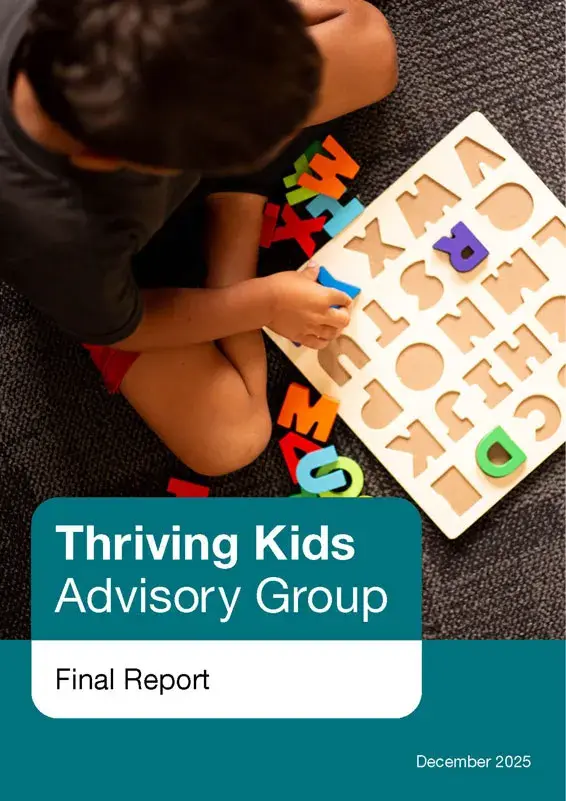
Service providers have expressed cautious support for the federal government’s Thriving Kids Advisory Group report, released last week, with the CEO of the Autism Association of Australia (AAA) among those urging sector leaders to give the program a chance.
“Families and the community have wanted to know more about what Thriving Kids actually means in practice,” AAA CEO Nicole Rogerson said, in response to the report’s release. “Today we do have more information, which is welcome, but it also raises new and important questions about how this will work on the ground.”
The report contains ideas for what Rogerson described as some strong and encouraging policy settings, such as a proposed universal three-year developmental check, which AAA saw as “a significant step forward and directly addresses the long-standing ‘wait and see’ approach that has left too many children without early support.”

“Ending ‘wait and see’ matters enormously to families,” she said. “Earlier identification means children can get help when it makes the biggest difference, rather than losing precious time while concerns are minimised or dismissed.”
AAA was also happy with the planned “diagnostic-agnostic” approach, which will prioritise responding to developmental delays, once identified, over requiring families to wait for an official diagnosis before support can begin.
Rogerson said it was essential that the implementation of Thriving Kids paid sufficient attention to schools and early childhood education and care (ECEC).
“We already know inclusion is inconsistent and often poor in many schools and early childhood settings, and there is currently limited specialist capability within ECEC to take on this role at scale,” she said. “Without serious investment in workforce development, Thriving Kids risks placing unrealistic expectations on systems that are already under strain.”
However, Rogerson advocated for the sector to digest the report and its plans before reacting too strongly.
“In principle, we like what they’re trying to do with Thriving Kids,” she told the Community Advocate. “What they’re trying to build is a beast and I just hope everybody doesn’t go straight into panic mode. It would be better, as a sector, if we took some time and got to know it, and then solve issues as we go.
“This is an enormous piece of national reform, and the risks identified in the report are real. Workforce capacity will make or break Thriving Kids.
“The intent is right and the opportunity is significant. We will continue to work constructively with government to help ensure Thriving Kids is properly resourced, carefully staged, and able to genuinely deliver on its promise for families across Australia.”
The report claims that Thriving Kids will better support children under nine who have “developmental delay and/or autism, with low to moderate support needs, through a more appropriate model of national model of supports, outside the NDIS.”
Announcing the report, federal Health Minister Mark Butler said, “Thriving Kids combines delivery of existing and new services in settings where children and families live, learn and play with a focus on enabling better awareness and earlier identification of developmental delays”.
“I just hope everybody doesn’t go straight into panic mode. It would be better, as a sector, if we took some time and got to know it, and then solve issues as we go.”
Federal and state governments have agreed to spend a combined $4 billion to deliver the NDIS alternative, with half that money coming from the Commonwealth. Thriving Kids is due to begin rollout in October this year, with full implementation slated for January 1, 2028.
Butler emphasised that children with permanent and significant disability, including those with developmental delay and/or autism with high support needs, will continue to be eligible for the NDIS.
“Thriving Kids will empower and support families early in a child’s developmental journey with tailored supports in community settings,” he said. “The NDIS remains a critical pathway to access support for adults and children with permanent and significant disability.”
Settlement Services International (SSI) cautiously welcomed the report, especially its emphasis on equality and inclusion, including “the recognition that government must coordinate with sector organisations and children and families with lived experience to ensure the program’s proposals are implemented in person-centred, culturally safe ways.”
SSI’s general manager for children, families and disability support, Ben Fioramonte, said, “We welcome the recommendation to consider the eligibility of children and families who live in Australia regardless of visa or citizenship status. Our social supports should be based on need, not the number on your visa, and these groups are particularly vulnerable to exclusion from crucial systems that facilitate health and wellbeing outcomes.”
Children from migrant and refugee backgrounds access early childhood education at lower rates than other children, according to SSI research, and those with development concerns are at risk of not receiving early intervention.
“Providers with a strong understanding of cultural norms and parenting practices are better equipped to create culturally safe environments. It is critical that we adopt the report’s proposal to co-design programs with community leaders and parents to build this trust and security,” Fioramonte said.
“We work with thousands of CALD families every year and understand how critical language accessibility is to these communities. Translations by qualified interpreters and the use of plain language resources can address gaps in English proficiency and understandings around disability, enabling confident service navigation.”
A question hovering over the report is exactly how diagnoses will decide which children have mild-moderate autism and are therefore eligible for Thriving Kids support, and which have significant and permanent disability requiring ongoing NDIS support.
“Clear pathways should be created so that children with significant and permanent disabilities are directed to the NDIS and feel supported in gaining access to the scheme,” Fioramonte said.
More information
The Front Project will present a free “explainer” webinar on Friday February 13, noon–1 pm AEDT, to discuss Thriving Kids and how it might work. Details here.
Posted on 07 Oct 2026
A major public campaign launched this morning is calling on the federal government to restore…

Posted on 07 Oct 2026
The Australian Literacy & Numeracy Foundation (ALNF) has announced a partnership with mining…

Posted on 07 Oct 2026
A conference in Darwin will this morning hear detailed, strategic plans for how Australia could…

Posted on 30 Sep 2026
Not-for-profit leaders have been warned to be wary of approaches from potential “funding partners”…
Posted on 30 Sep 2026
More than 200 fully funded Centre for Social Impact (CSI) scholarships will help equip for-purpose…

Posted on 30 Sep 2026
Personal stories are among the most powerful tools a charity can have to raise funds and awareness,…

Posted on 23 Sep 2026
A just-released major global survey of charities has found that demand for charity assistance has…
Posted on 23 Sep 2026
Fresh from welcoming delegates to last week’s Philanthropy Australia conference in Brisbane,…

Posted on 23 Sep 2026
A national strategy to develop Australia's regional cities is needed to break the housing…

Posted on 23 Sep 2026
Eight years after a report to Treasury first suggested the charities regulator should be more…

Posted on 17 Sep 2026
Australia’s biggest gathering of philanthropists, which drew more than 1200 delegates to Brisbane…

Posted on 16 Sep 2026
A new partnership between Paul Ramsay Foundation (PRF) and Atlassian Foundation aims to attract…