
Is your board treating philanthropy as a relationship or a transaction?
Posted on 17 Sep 2026
Charities reported $14.8 billion in donations and bequests last financial year, the second-highest…
Posted on 22 Jul 2026
By "Governance Guru" and Community Directors training lead, Nina Laitala

I once worked with an organisation that had become expert at keeping the lights on. Every year it applied for whatever funding was available, took on projects that were broadly connected to its purpose, and kept the doors open. By most measures, it was not only surviving, it was busy.

Then came the annual report.
When the board sat down to account for the year’s work, the directors found themselves struggling to answer a question that should have been straightforward: what difference had they actually made? They had run a lot of activities. They had acquitted a lot of grants. But when it came to articulating impact, the real, meaningful change their organisation existed to create, the page stayed largely blank. They had done lots of things, but without a clear thread connecting those things back to their mission.
It was not a funding problem, it was a governance problem, and a common one.
This problem is particularly common in small organisations where the board and the operational team are the same people, and in large ones where data is plentiful but nobody has drawn a clear line between what is being measured and why the organisation exists.
Not-for-profit organisations face constant pressure to prove they are having an impact: to funders, to members, to the communities they serve. Yet impact measurement is one of the areas boards most often struggle with, precisely because so much of it happens at the operational level. So how does the board maintain meaningful oversight of it without getting lost in the detail, and without a lot of time or money to spare?
"Every organisation has three or four big questions that sit at the heart of its mission."
It starts with understanding what questions you are actually trying to answer.
Every organisation has three or four big questions that sit at the heart of its mission: the questions that link why people give you money, why members support you, and why you exist. Identifying those questions is the first job.
From the answers to those questions, you can establish what you do and what you expect to change as a result. This is your theory of change. Unlike a strategic plan, which is revisited every few years, your theory of change is the enduring reason your organisation exists: what you do, why you do it, and what it means for the people you serve and for the broader community.
Take a fictional local community health organisation, Healthy Lives Together. Its mission is to provide services, information and support to empower the local community to be healthier, more active and better equipped to make decisions about their own health.
Its theory of change might be: if we provide services and information, then we will see a healthier, more empowered community.
From there, the board’s big questions become clear:
Once you have those three questions, you have a framework. Every activity, every program, every report should ultimately be able to answer back to one of them. If it can’t, it is worth asking why you are doing it.
The language of impact evaluation can make this seem more complicated than it needs to be, so it is worth being clear about what we mean.
When we measure impact, we are measuring what we do (outputs), what changes as a result (outcomes), and the broader difference that represents (impact). Outputs are quantitative: how many workshops, how many participants, how many services delivered. They tell half the story. The other half is qualitative: how did people’s experiences, opportunities or lives change as a result?
As boards, we need to know that we are doing enough of the right activities for enough of the right people. But we also need to understand how those activities are changing lives. That is where the real accountability lies.
Here is a simple example. If Healthy Lives Together ran four workshops for a total of 100 people teaching them how to access free and low-cost community health services, so what? The outputs tell us it happened. The outcomes tell us what it meant:
Now we can start to see the impact. And we can see how it answers the big questions.

So where does the board sit in all of this?
The title of this article asks how the board evaluates impact when there is no time or money. The honest answer is that the board’s job is not to do the evaluating. It is to make sure the right questions are being asked, that systems exist to answer them, and that the results come back to the board in a form that can be used in decision-making.

Impact measurement happens at the operational level. Data is collected by staff and volunteers, through surveys, program records and community conversations. The board’s role is to set the framework: to agree on the big questions, to ensure management has the tools and authority to gather meaningful data, and then to receive and examine that information in a purposeful way. Asking “What does this tell us about our theory of change?” is a governance question. Designing the survey is not.
This distinction matters because boards that try to manage the operational side of evaluation often end up doing it poorly and exhausting themselves in the process. Boards that govern it well make better strategic decisions, satisfy funders and instil confidence in them, and stay connected to their purpose without getting lost in the detail.
A useful discipline is to establish a standing agenda item where management reports to the board on the big questions. Not a data dump, but a short, structured summary: what are we seeing, what does it mean, and is there anything the board needs to decide or direct as a result? That habit, maintained consistently, is worth more than any elaborate evaluation framework.
For smaller or all-volunteer boards where there is no dedicated staff member to prepare a report, the bar can be lower and still be meaningful. A simple standing question at each meeting, such as "What is one thing we have learned about our impact since we last met?", creates the same discipline without requiring a formal reporting structure. The point is the habit, not the format.
Either way, it creates a culture of asking why. Why are we running this project? Why do these activities matter? How do these results tell us that we are on the right track, or that we need to change course? When the whole organisation, board and staff, is oriented towards those questions, impact measurement stops feeling like a compliance exercise and starts feeling like a genuine tool for doing better.

The good news is that you don’t need a sophisticated system to begin. You need agreement on the questions that matter most, a simple way to collect responses to those questions, and “data review” as a standing item on the board agenda.
Simple surveys integrated into programs or displayed around your facilities are a cost-effective starting point. So are brief conversations with clients, short feedback forms at the end of events, or output tracking spreadsheets, which staff might already maintain anyway. The goal is not perfection. It is consistency and connection back to your organisation’s purpose.
It is also worth looking at what you are already collecting. Many organisations gather data for grant acquittals without recognising it as impact evidence. If you are already tracking participant numbers, feedback forms or service delivery figures for a funder, that is a starting point. The question is whether you are connecting it back to your theory of change, or just filing it away once you’ve submitted the acquittal.
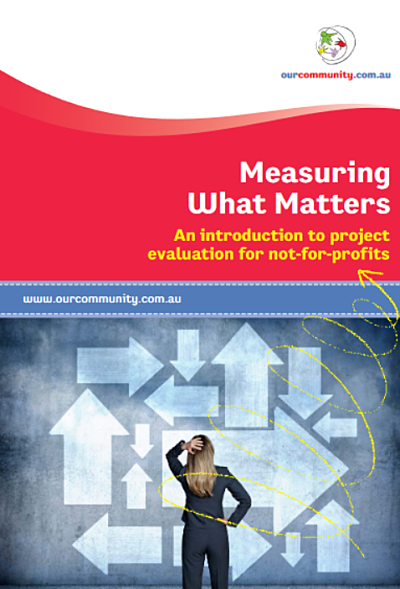
If your board is not sure where to start, get hold of Community Directors’ free guide Measuring What Matters: An introduction to project evaluation for not-for-profits, which covers evaluation principles, frameworks, and the difference between process, output, outcome and impact evaluation in plain language. It is a practical starting point for boards and management teams working through this together.
Once you are ready to formalise your approach, the Monitoring and Evaluation Framework Template gives you a structured way to document your theory of change, plan how you will gather data, and identify who needs to see what and when.
For larger organisations with more data than clarity, the framework is equally useful in the other direction: not as a way to start collecting information, but as a way to audit what you are already collecting and ask whether it is actually answering the questions that matter.
Neither resource requires a big budget or a dedicated evaluation team. They require clarity of purpose and a board that is willing to ask the right questions consistently, and with genuine curiosity about the answers.
That is not a resource problem. That is a governance choice.
Download our FREE 42-page Measuring What Matters guide (mentioned above) for a quick handle on evaluation principles and frameworks, outcomes and data gathering.
Then, visit the outcomes measurement section of our website for answers to '10 questions every board member needs to ask about measuring outcomes', evaluation templates, and data and privacy policies.
Find more resources in our tools and resources section.
Posted on 17 Sep 2026
Charities reported $14.8 billion in donations and bequests last financial year, the second-highest…

Posted on 13 Aug 2026
Innovation isn't just a buzzword, and it isn't just about technology. It’s a necessary part of…

Posted on 10 Jun 2026
ICDA training lead Nina Laitala examines the governance issues facing Australian not-for-profits.

Posted on 18 May 2026
ICDA training lead Nina Laitala examines the governance issues facing Australian not-for-profits.

Posted on 12 Mar 2026
Fundraising is often parked in the operational corner. And yes, the execution of fundraising is an…

Posted on 10 Dec 2025
Stressed, overwhelmed, exhausted… if you’re on a not-for-profit board and these words sound…

Posted on 11 Nov 2025
I’ve seen what happens when fear of conflict wins out over taking a principled stand.

Posted on 15 Oct 2025
Writing grant applications is usually seen as an operational job, but that doesn’t mean the board…

Posted on 18 Sep 2025
Organisations using artificial intelligence to transcribe and summarise meetings must ensure they…

Posted on 14 Aug 2025
ICDA training lead Nina Laitala examines the governance issues facing Australian not-for-profits.

Posted on 17 Jul 2025
ICDA training lead Nina Laitala examines the governance issues facing Australian not-for-profits.

Posted on 26 Jun 2025
ICDA training lead Nina Laitala examines the governance issues facing Australian not-for-profits.