
Save Izzy: campaign calls on government to restore funding for vital services directory
Posted on 07 Oct 2026
A major public campaign launched this morning is calling on the federal government to restore…
Posted on 29 Sep 2025
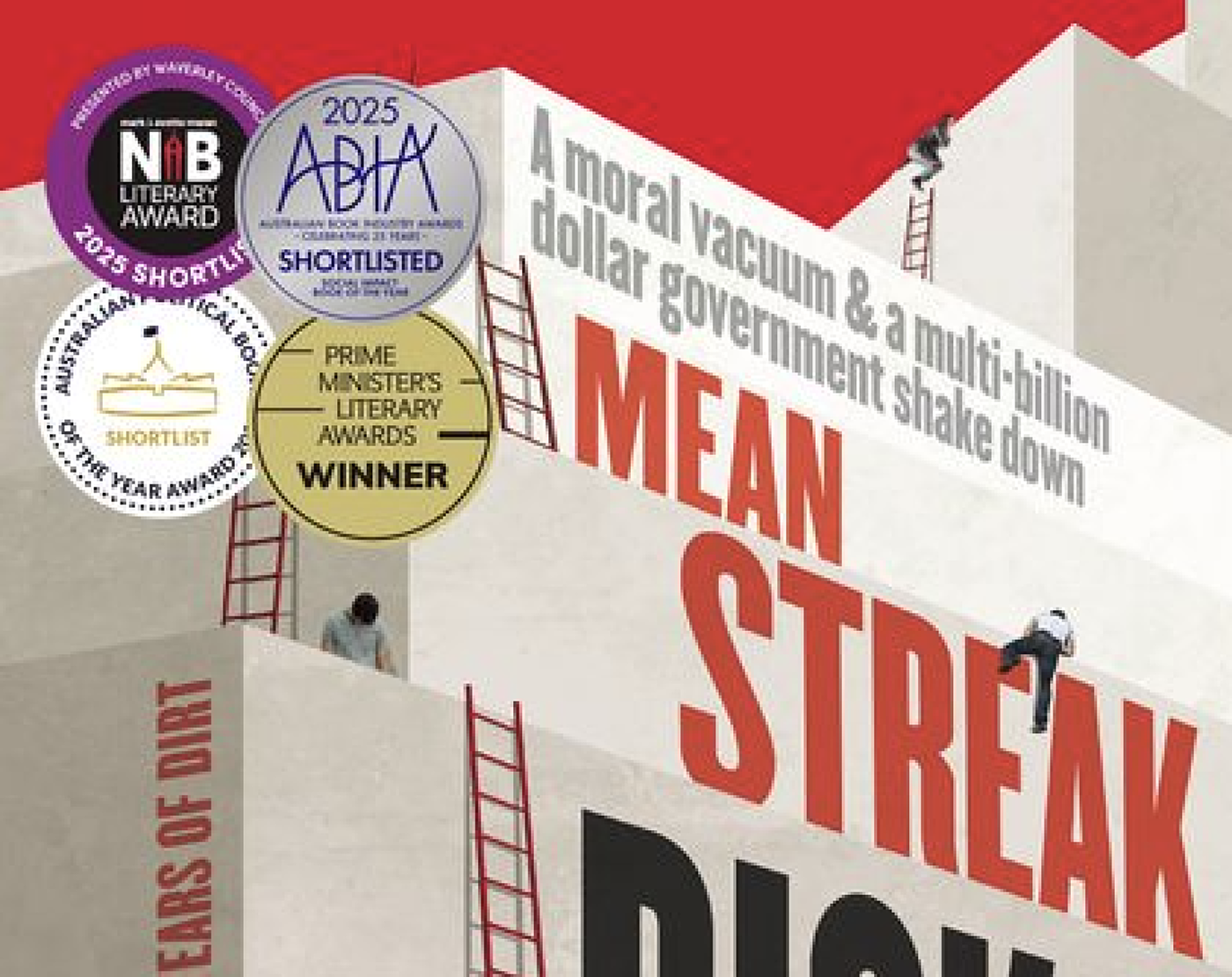
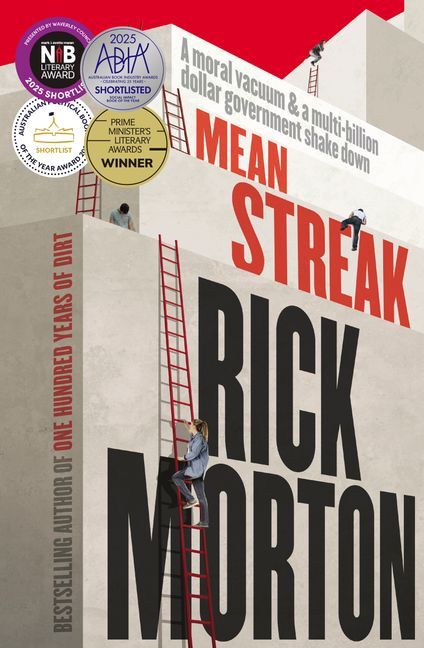
The infamous “robodebt” scandal was one of the most devastating and disturbing examples ever of government policy, or as author Rick Morton calls it, “one of the worst episodes of government fraud in Australian history.” Morton’s forensic account of the scandal, Mean Streak, was this week awarded the Prime Minister’s Literary Award for Non-fiction. The judges described it as “a scouring cautionary tale of morality in public life gone badly awry – a story that is bigger than robodebt, and far from over”.
The following excerpt is from the prologue to the book, which is published by 4th Estate (HarperCollins). A docudrama based on the scandal, The People vs Robodebt, is now screening on SBS and SBS on Demand.
The letters were sent by the thousand and arrived in mailboxes and at addresses across Australia, beginning in 2015. Many of these addresses were long since abandoned by the people the government thought were living there. It was something of a lottery, the whole thing; whether the letters would ever get to the person they were meant to get to, whether that person would understand what they were looking at and, ultimately, whether the Australian government could spook enough people to scam them out of billions of dollars.
Rhys Cauzzo received his first letter, dated 12 May 2016. ‘We are writing to you about your employment income,’ it read. ‘We have received information from the Australian Taxation Office (ATO) that shows your employment income recorded with the ATO is not the same as the amount of employment income declared for Centrelink purposes.’
The letter showed four separate employment earnings amounts across more than three years, totalling $47,169. When he was on an unemployment benefit, Cauzzo was required to report any income he earned in each fortnight to Centrelink, which he did. Nobody had to report income when not in receipt of a benefit, and so Rhys didn’t. Now the government was saying the numbers didn’t match.

In the trial of this new welfare compliance system, people like Rhys had a clear direction in their letter. They were to call Centrelink and ‘confirm’ their income details. In later versions of this scheme, there was no phone call; it all had to be done online, without the help of a human being.
For Rhys, the letter said: ‘If you do not call us by 2 June 2016 we will update your details based on the information we have received from the ATO. This may result in a debt that you will need to repay. If this occurs, we will send you a letter to let you know.’
Rhys must have phoned Centrelink to see what on earth this letter even meant, because when he rang his mum, Jenny Miller, he told her he had a $10,000 debt.
‘He was extremely stressed and scared of his suicidal thoughts,’ Miller told an eventual Royal Commission.
Miller wouldn’t find out until after her son had killed himself, more than half a year later, that he had already made an attempt after receiving the Centrelink letters, by cutting his throat. The pressure on Rhys was enormous.
Moments as big as this and as small as bureaucratic frustration were being repeated across the country. Though we now understand the vast design of the scheme created to bilk people for debts they never actually owed, this was all brand new at the time. Each person who opened a letter, or discovered too late that a letter had been sent to an old address, did so alone.
Their instinct would either be that something had gone wrong and it would be an administrative nightmare to fix it, or that the government knew what it was doing and that they as an individual must have made some kind of mistake. In any case, the unequalled might of government say-so met people one by one, found them alone and resolved to keep them that way. Confusion was a key element of the system. The as-yet anonymous crafters of this debt rattle had counted – quite literally, as they did the sums for savings to the budget – on people giving up without a fight.
And so, the letters found people alone and funnelled them individually into the gaping mouth of government machinery. Infrequently, they found their way to people who might have understood the perversity of what was being asked. But not even these chaperones were capable of much help.
Administrative law lecturer and La Trobe University academic Darren O’Donovan was teaching students about the very foundational, and no doubt equally thrilling, principles of admin law when a real-world case study came to see him.
‘When I walked into my office, it boiled down to one of my students upset, looking for an extension on an assignment just before Christmas 2016,’ Dr O’Donovan says. ‘And that’s the first time I had come across what had been let loose, which is astonishing. And it was remarkable. The student just had the initial letter, the “21 days to reply or we do this” letter.
‘It was a pretty astonishing letter to such an extent that my initial reaction was it was a head fake.’
O’Donovan tried to ‘big up’ his subject by walking his student through the basic principles of admin law they’d just finished studying. The lecturer knew the government needed to figure out the student’s fortnightly income in order to correctly raise a debt and, based on the information they’d provided, they seemed to have just plucked a figure out of nowhere.
‘They don’t have it,’ he says recalling that realisation, ‘they just don’t have it.’
The letters were a luxury by some standards.
If a person was still receiving welfare and hadn’t seen the original ‘initiation’ letters advising them of an apparent discrepancy between tax office records and their Centrelink reporting, the government just started taking money from their below-poverty-line income support. One person, in and out of homelessness at the time, discovered this was happening when $150 a fortnight started coming out of their $700 a fortnight payment. When they were able to find a place to live, the rent was $450 a fortnight, leaving them ‘with next to nothing for food/bills to survive’.
Others would find out when they lodged annual tax returns and had the entire amount – thousands of dollars in most cases – taken by the government to pay a debt about which they had never been informed.
Then the government added family tax benefit lump sum payments to the list of things it could requisition in service of a fake debt. In 2015 a mother with a one-year-old baby got one of the rare Centrelink telephone calls to tell her she owed $25,000 relating to an Austudy payment she received three years earlier while also working casually as an executive assistant. She had sent in her payslips to Centrelink at the time, to avoid precisely this problem.
“What seemed a simple government mistake slowly revealed itself to be a sick game invented by a cash-strapped government department and callous, greedy ministers.”
‘The calls were almost daily from Dun & Bradstreet [debt collectors] demanding payment. I was an absolute mess,’ she says. ‘My husband worked away from home so I was dealing with these constant calls of harassment and a one-year-old baby. I was threatened with jail time and my daughter being put into care if I didn’t start paying back the money. I cried on each phone call I had with them, pleading for more information.’
Gareth Morgan didn’t get his letter until he logged into the MyGov platform to lodge a tax return and found it sitting there, glowing with radioactive threat.
‘I was blocked from completing the online form as I disputed the calculation of my gross income by Centrelink,’ he says. ‘The online form misled me into reporting income to Centrelink for periods that I was not claiming payments.’
Some people received their letters by registered mail, a belated attempt by government to track who was opening the post and, by proxy, if it never arrived. None of it mattered much. The symphony of first contact was a discordant one. You can almost hear the dissonance. Envelopes being torn open, or unzipped in registered post; the vibrating or ring tones of mobile phones; the rarer interlude of the landline telephone. Emails arrived silently in the night, or occasionally with a soft and undistinguished ‘ding’. Ding. Rip. Ring. Buzz. Buzz. Ring. Rip. Ding. Contact, contact, contact.
Tens of thousands of shattering notes created an unnerving, inchoate sense of something being out of place, the way the human eye and ear are trained on the environmental level to recognise violation.
These methods of contact were all sold by the Department of Human Services in precisely the same way: they were an ‘opportunity’ to confirm income or correct the information provided to welfare recipients.
One problem with this approach is that DHS did not actually show the discrepancy figures to people, only the tax office numbers. These were perfectly correct as lump sums, but wildly inaccurate when used in the way that the department secretly intended. In this fashion, many people stumbled into the trap and agreed that the figures were right.
The letters were an invitation to one of the worst episodes of government fraud in Australian history. Current and former welfare recipients were ushered into strange new worlds characterised by the deliberate distortion of the law, of standards and of ordinary human decency. To survive in this scheme, they were forced to provide evidence of actual earnings from years earlier, from many different employers, to fight a claim that relied on mathematical fictions.
It was a farce, but a deadly one. From discordant notes a vast disharmony emerged, one of all-consuming anguish as the departmental invitations arrived, divorced of context and even, eventually, phone numbers. If some managed to figure out that a mathematical absurdity sat at the heart of this ‘discrepancy’, this only served to heighten the sense of madness that settled upon them. Others never made it that far.
In all cases, what seemed a simple government mistake slowly revealed itself to be a sick game invented by a cash-strapped government department and callous, greedy ministers. The game we now call robodebt.
By the time anyone realised they were in this labyrinth, it was too late. They were already being hunted.
Posted on 07 Oct 2026
A major public campaign launched this morning is calling on the federal government to restore…
Posted on 07 Oct 2026
The Australian Literacy & Numeracy Foundation (ALNF) has announced a partnership with mining…

Posted on 07 Oct 2026
A conference in Darwin will this morning hear detailed, strategic plans for how Australia could…

Posted on 30 Sep 2026
Not-for-profit leaders have been warned to be wary of approaches from potential “funding partners”…

Posted on 30 Sep 2026
More than 200 fully funded Centre for Social Impact (CSI) scholarships will help equip for-purpose…

Posted on 30 Sep 2026
Personal stories are among the most powerful tools a charity can have to raise funds and awareness,…

Posted on 23 Sep 2026
A just-released major global survey of charities has found that demand for charity assistance has…

Posted on 23 Sep 2026
Fresh from welcoming delegates to last week’s Philanthropy Australia conference in Brisbane,…

Posted on 23 Sep 2026
A national strategy to develop Australia's regional cities is needed to break the housing…

Posted on 23 Sep 2026
Eight years after a report to Treasury first suggested the charities regulator should be more…

Posted on 17 Sep 2026
Australia’s biggest gathering of philanthropists, which drew more than 1200 delegates to Brisbane…
Posted on 16 Sep 2026
A new partnership between Paul Ramsay Foundation (PRF) and Atlassian Foundation aims to attract…