
‘The mind boggles’: federal envoy blasts NT housing decision
Posted on 14 Oct 2026
The federal government’s special envoy for social housing and homelessness, Josh Burns MP, has…
Posted on 24 Sep 2025
By Nick Place, journalist, Institute of Community Directors Australia

Minderoo Foundation’s head of sector development and innovation, Ryan Ginard, has urged peers in the philanthropic and charity sector to stop waiting for government and get on with the job of changing the sector’s future.
Ginard said it was time for sector players to “link arms”, look collectively for ways to innovate and “move forward in abundance”.
Speaking at the Third Sector Leadership Forum in Sydney last week, Ginard said solving chronic homelessness was an example of what could be achieved if the sector worked together to make a significant impact. “Ending chronic homelessness by 2030 is achievable if we link arms. Some cities in the US have managed it, so it’s about replication. How do we find out what works, white label it and spread it across cities?”
Ginard emphasised that the sector should not wait for Canberra or state governments to get around to acting on recommendations on better sector practice, pointing to the number of government enquiries and reviews that have been tabled, with very little action taken, over the years. He said it was time philanthropy embraced its role as the research and development partner of government to drive change.
Ginard was referring to work by Professor Myles McGregor-Lowndes that recently counted 160 recommendations from five key reports over the decade before 2023, of which 21 had been implemented, 33 had been partially implemented or lapsed, and 114 had not been implemented. That research did not include the Not-for-profit Sector Development Blueprint or the Productivity Commission’s Future Foundations for Giving report, which have since been tabled.
As Community Council for Australia CEO David Crosbie wrote in the Advocate in June, McGregor-Lowndes counted “more than 200 carefully considered recommendations to improve productivity and effectiveness in the charities and not-for-profit sector that remain dormant”.
Ginard said the philanthropic sector should look to the sector development blueprint, and work from there. The blueprint, he said, “is pretty rich, informative research. A lot of organisations will pay hundreds of thousands of dollars to get something of that quality, and it comes with all these really great recommendations, and then we just wait for government to act on it.
“Sometimes I just feel that if philanthropy is going to be more of that R & D of government or a bit more entrepreneurial, then it will take those recommendations that haven’t been adopted and prove them out. Sometimes we just need to rally around what it means for us, what counts, and advance that accordingly.
“We’ve got everything we need. I always say that the solution to every societal ill is being put on the table, every idea is being put out there, but the innovation comes around the execution, and sometimes, something that didn’t work five years ago probably just didn’t have the right ecosystem around it. So we should learn from a lot of our investments and keep sharing that, realising sometimes we are just the stalking horses of change, and if we are systems focused, we’ll keep on trying until something works.”
“I think any time that we are convening and talking about the future is a good use of time, but again, the proof is in the actions that come out of it.”
Ginard is drawing on Minderoo’s enormous clout in the philanthropic sector to push for innovation as well as transparency and cohesion, with the federal government’s goal of doubling giving by 2030 as a north star. Hoping others will follow suit, Minderoo founders Andrew and Nicola Forrest have been totally open about how much they are giving, where to and why, including details of the $5 billion donation that dwarfed all others, in June 2023. “It helps normalise the idea of major gift giving and actually shifts the culture in ways that you can’t,” Ginard said. “Giving is stagnant, so these things inspire us to give more. With us beating a steady drum, we’ll get there. Generosity is going to kick in.”
Ginard was enthused by the recent giving sector roundtable in Canberra, but emphasised that it was up to the sector to make it meaningful.
“I think any time that we are convening and talking about the future is a good use of time, but again, the proof is in the actions that come out of it,” he said. “When you convene and you’ve got the inquiry on the table, you’ve got the blueprint on the table, you should be talking about what the contents are in there and what the government’s plans are to adopt those in the future. It’s a good open dialogue.”
Buoyed by the federal government’s appointment of Andrew Leigh as Charities Minister and Tanya Plibersek as Social Services Minister, Ginard said he believed the government wanted to see results in the sector, “but it's also up to us to prove that making those regulatory changes are in the benefits of society”.
“Take DGR reform,” he said. “We’re supporting work to build a national coalition of all of those that will benefit – and society benefits – from expanding the pie. When DGR was set up, and you can look at the interpretations of public benevolence and various things, but it’s not fit for purpose right now.”
“How do we reset it, so the sector is fit for purpose for the next 10 to 20 years, because if it’s a generational review into the space, then we've only got one more chance to get it right,” he said. “It’s like the community charities category. We supported Community Foundations Australia during that public submission phase to get it right because it’s not going to be tinkered with for another decade. So we are funding advocacy. We are funding, again, a lot of the policy work, the research, just so we can see where the gaps are and accordingly co-design how we fill them.”
Posted on 14 Oct 2026
The federal government’s special envoy for social housing and homelessness, Josh Burns MP, has…

Posted on 14 Oct 2026
The Reserve Bank’s move to ban card payment surcharges has led to complications for charities and…
Posted on 14 Oct 2026
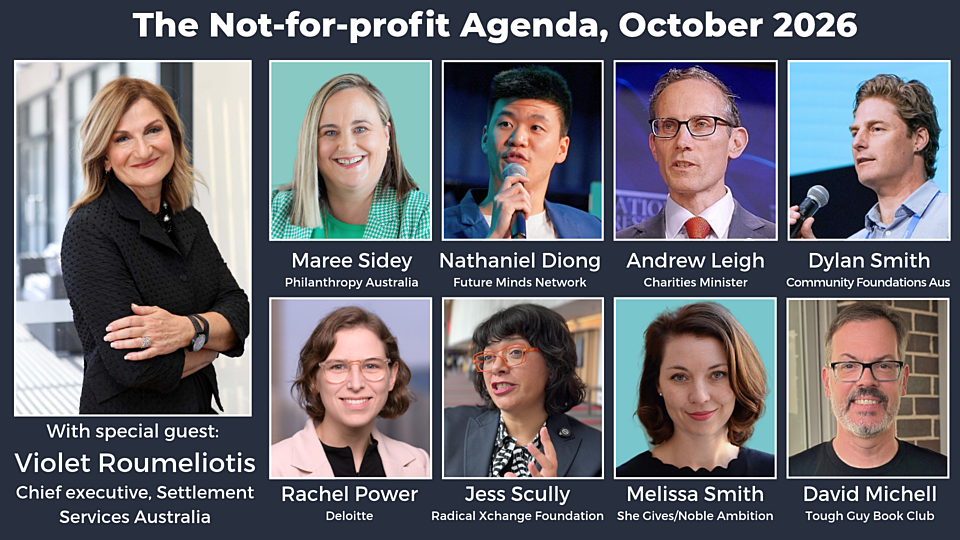
A special guest with her finger on the pulse of one of the biggest issues facing Australia –…

Posted on 07 Oct 2026
A major public campaign launched this morning is calling on the federal government to restore…

Posted on 07 Oct 2026
The Australian Literacy & Numeracy Foundation (ALNF) has announced a partnership with mining…

Posted on 07 Oct 2026
A conference in Darwin will this morning hear detailed, strategic plans for how Australia could…

Posted on 30 Sep 2026
Not-for-profit leaders have been warned to be wary of approaches from potential “funding partners”…
Posted on 30 Sep 2026
More than 200 fully funded Centre for Social Impact (CSI) scholarships will help equip for-purpose…

Posted on 30 Sep 2026
Personal stories are among the most powerful tools a charity can have to raise funds and awareness,…

Posted on 23 Sep 2026
A just-released major global survey of charities has found that demand for charity assistance has…
Posted on 23 Sep 2026
Fresh from welcoming delegates to last week’s Philanthropy Australia conference in Brisbane,…

Posted on 23 Sep 2026
A national strategy to develop Australia's regional cities is needed to break the housing…