
Save Izzy: campaign calls on government to restore funding for vital services directory
Posted on 07 Oct 2026
A major public campaign launched this morning is calling on the federal government to restore…
Posted on 04 Mar 2026
By Nick Place, journalist, Community Directors

The federal government has announced its decision on the percentage of assets that giving funds will be required to distribute each year, unlocking an estimated $100 million in extra funding to charities. Philanthropic industry bodies are unimpressed.
Charities Minister Andrew Leigh announced late last week that the government is setting a new minimum annual distribution rate of six per cent of net assets, for both public and private giving funds (previously known as ancillary funds).
The new percentage is up from the previous minimum of four to five per cent of assets per year, with Leigh saying Treasury forecasting suggested the percentage increase would release more than $100 million in additional funds for Australian charities.
He also claimed the rise was conservative enough that it “ensures more benefits flow to charities now to help them to provide their services, while still allowing giving funds to invest and provide benefits into the future.”

“Treasury analysis shows that a fund receiving market returns that distributed six per cent of its net assets each year could last for decades even without further contributions to its assets,” he said. “Of those giving funds that have made a distribution in recent years, around two-thirds of public giving funds and around half of private giving funds distributed more than six per cent of net assets.”
“Giving funds, in the government's view, shouldn’t be set up in perpetuity,” he said. “But even under these changes, it will still be possible for a giving fund to exist for a very long time without putting in additional resources.”
Another change will allow giving funds to smooth distributions to a large project over three years, avoiding excessive immediate drawdowns on their capital, he said.
“The new rate will apply from the first financial year following amendments to the giving fund guidelines, and existing giving funds will not need to meet the new distribution rate for two years,” the Minister said, adding: “These changes are a further step in responding to recommendations of the Productivity Commission’s Future Foundations for Giving report and the charity-led Not-for-profit Sector Development Blueprint.”
The announcement was not warmly received by major philanthropy industry bodies.
Philanthropy Australia CEO Maree Sidey said the announcement was a lost opportunity for genuine system reform.
“The demands on charities are immense and giving funds are vital sources of funding for their work across the community. Increasing mandatory distributions for giving funds without addressing wider system reform is like turning up the water pressure without checking the plumbing,” Sidey said.
Philanthropy Australia has been among those supporting Justice Connect’s campaign for major changes to the DGR (deductible gift recipient) status system that determines which charities can receive tax deductible donations and grants from giving funds. Sidey said around half of Australian charities remained ineligible for or faced unnecessary barriers to achieving DGR status.
“Increasing mandatory distributions for giving funds without addressing wider system reform is like turning up the water pressure without checking the plumbing.”
“The system is complex, confusing and hard to navigate for donors and charities,” Sidey said. “This change to giving funds’ minimum distribution is unlikely to significantly increase support for charities because, as the government notes, around two-thirds of public giving funds, and around half of private giving funds, already distributed more than six per cent of net assets in recent years. It could also disincentivise giving by introducing regulatory instability.”
Justice Connect agreed.
“We welcome the increase in the minimum distribution rate for giving funds, but we are disappointed the government hasn’t taken this opportunity to commit to more substantial reform of the DGR system,” Justice Connect CEO Chris Povey said. “More than half of Australia’s charities will see no benefit from this change because they are locked out of DGR by an outdated, overly complex and unfair system.”
Povey said giving funds could only distribute grants to organisations with DGR endorsement, for which fewer than half of Australia’s registered charities are currently eligible. As a result, many community-based organisations – including neighbourhood houses, community gardens, charities focused on disaster resilience and climate adaptation, and organisations working to build social connection and community cohesion – are excluded from accessing philanthropic capital held in these structures, he said.
While lifting the mandatory distribution rate by one percentage point will modestly increase annual grantmaking, it does not address the underlying inequity embedded in the DGR system, he said.
“If we are serious about strengthening the charitable sector – particularly at a time when charities are grappling with increased demand and constrained funding – we need to ensure more charities can access philanthropic support.”

Philanthropy Australia said that five major inquiries and reviews, including the Productivity Commission’s Future Foundations for Giving and the Not-for-profit Sector Development Blueprint reports released in 2024, have recommended DGR reform as a priority, with the Productivity Commission’s report stating that the system is “not fit for purpose and should be reformed”.
Australian Philanthropic Services (APS) has also criticised the new rate, saying it runs counter to the government’s stated aim of building the giving culture in Australia.
APS CEO Judith Fiander said the existing five per cent rate was high by international standards and “represented a minimum, not a ceiling, with many APS clients already distributing well above the requirement.”
She said a Treasury discussion paper from June last year argued: “Higher distribution rates see aggregate distributions to deductible gift recipients (DGRs) maximised over the short term. [However,] in the longer term, distributions are maximised when the distribution rate is set at its current rate of 5 per cent.”
Fiander was bemused that the government’s own future funds, such as the recently created Housing Australia Future Fund (HAFF) and the Medical Research Future Fund (MRFF), continued to have a five per cent distribution target, with the MRFF not even achieving that figure.
“If the government is serious about increasing the flow of funds to charities, why are they applying a different standard to philanthropists than they are to themselves?” Fiander asked.
“Since their inception PAFs have provided more than $6.7 billion to charities, while preserving long-term capital and encouraging generosity by Australians in a structured context. The system does not need changing,” she said.
Fiander added that APS endorsed parts of Leigh’s announcement. “The two-year lead time for application of the new minimum distribution level for existing ancillary funds is sensible, and aligning distribution rates across all ancillary funds is sensible,” she said. “Further, the provision of smoothing of distributions levels over three years will support large charitable projects.”
A second part of Minister Leigh’s announcement was more warmly greeted by all.
The government announced that it was adding 34 organisations to the ministerial declaration for community charities, meaning they become eligible for the prized DGR status, once ratified by the Australian Taxation Office. Leigh said it was the biggest update to the list of eligible charities since the locally led, place-based category was established in 2024.
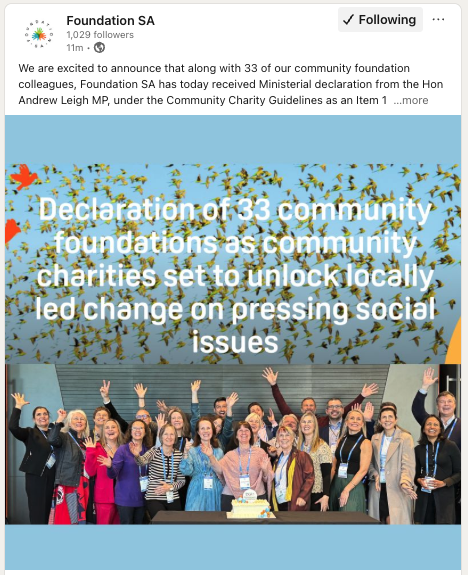
“Community charities are embedded in communities across Australia and support a wide range of initiatives, including education, mental health, social inclusion, environmental sustainability, disaster recovery and other local priorities and community needs,” he said.
“By fostering local giving and collaboration, community foundations strengthen social cohesion and drive longterm, placebased change.
“The government’s ongoing support for community charities is part of our goal to double philanthropic giving by 2030.”
At APS, Fiander said, “The government increasing the number of new community charities is welcome.”
Philanthropy Australia’s CEO, Maree Sidey, said more reform was needed.
“We have been assured that more reform opportunities are being considered by the government. We urge them to move swiftly and to work with stakeholders to deliver real and tangible outcomes that will boost giving and strengthen our communities,” she said.
Community Charity Trusts
Community Charity Corporations
Posted on 07 Oct 2026
A major public campaign launched this morning is calling on the federal government to restore…

Posted on 07 Oct 2026
The Australian Literacy & Numeracy Foundation (ALNF) has announced a partnership with mining…

Posted on 07 Oct 2026
A conference in Darwin will this morning hear detailed, strategic plans for how Australia could…

Posted on 30 Sep 2026
Not-for-profit leaders have been warned to be wary of approaches from potential “funding partners”…

Posted on 30 Sep 2026
More than 200 fully funded Centre for Social Impact (CSI) scholarships will help equip for-purpose…

Posted on 30 Sep 2026
Personal stories are among the most powerful tools a charity can have to raise funds and awareness,…

Posted on 23 Sep 2026
A just-released major global survey of charities has found that demand for charity assistance has…

Posted on 23 Sep 2026
Fresh from welcoming delegates to last week’s Philanthropy Australia conference in Brisbane,…

Posted on 23 Sep 2026
A national strategy to develop Australia's regional cities is needed to break the housing…

Posted on 23 Sep 2026
Eight years after a report to Treasury first suggested the charities regulator should be more…

Posted on 17 Sep 2026
Australia’s biggest gathering of philanthropists, which drew more than 1200 delegates to Brisbane…

Posted on 16 Sep 2026
A new partnership between Paul Ramsay Foundation (PRF) and Atlassian Foundation aims to attract…