
‘The mind boggles’: federal envoy blasts NT housing decision
Posted on 14 Oct 2026
The federal government’s special envoy for social housing and homelessness, Josh Burns MP, has…
Posted on 27 May 2026
By Nick Place, journalist, Community Directors
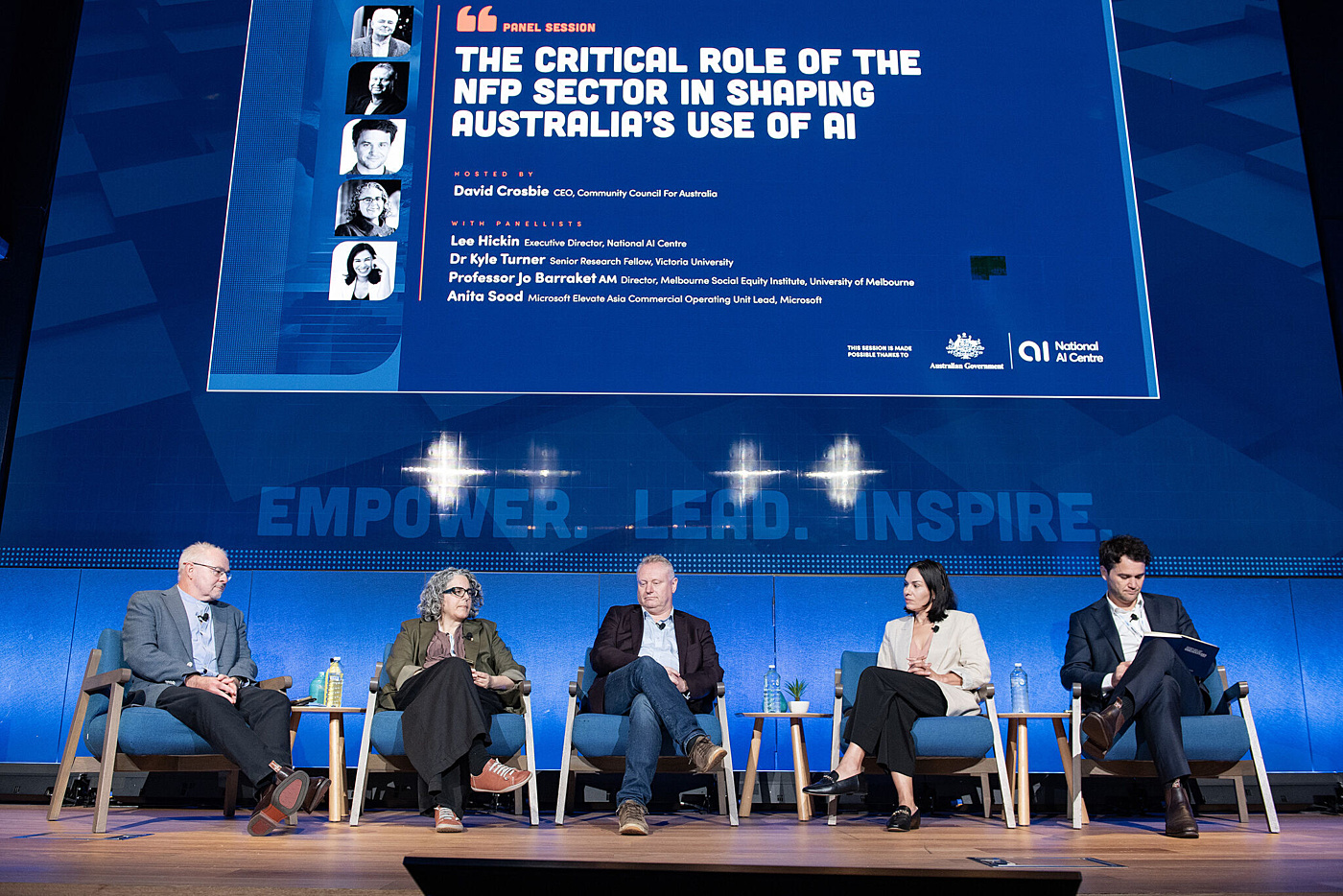
The executive director of the National Artificial Intelligence Centre (NAIC), Lee Hickin, says he has been inspired and fascinated by the for-purpose sector’s engagement with new technology.
Speaking after attending Infoxchange’s recent Technology for Social Justice conference in Melbourne, Hickin said he was struck by the diversity of the people and organisations in the room, as well as their fearlessness in exploring how AI could help their mission.
A veteran of 35 years at Microsoft, among other corporate work, before taking on the role of leading the NAIC, Hickin said the not-for-profit sector may even have an edge over corporate users of AI because of its commitment to the cause.

Speaking on introducing AI to the workplace, he said, “In the private sector and economically driven organisations, there can be this sense of fear of losing your job, or fear of getting it wrong, or fear of damage that you can do through that process.
“Whereas you get a sense in the not-for-profit sector that there is just so much to be done, so many people to be helped, that frankly, that fear sort of falls to the wayside. Because if you don’t do something, if you don’t use technology, if you don’t find ways of optimising the work you do, you’re not worried about losing your job. You’re worried about letting somebody down or leaving somebody behind.”
Hickin spent time as Microsoft’s artificial intelligence policy lead for the Asia region before making the move to the NAIC, so has seen the large language models being developed from the ground up. He describes himself as a “tech optimist” and is working to give Australians the information they need to feel confident to manage the risks and potential rewards of using AI in their work and lives. He said the Infoxchange tech conference had opened his eyes to the scale of the NFP sector, in terms of the problems to be solved, the work to be done and the opportunities for AI to help.
“You don't really see it until you either find yourself in a room full of those kinds of people, or you have the time to really listen to and talk to people that spend their day trying to pursue what I frame as that most purist of human pursuits: the desire to help another human being, without expectation of reward in return,” he said.
“What you get a sense of is just how much work there is to be done, how difficult it is to get it done, and how diverse the types of work are to be done. My single biggest takeaway [from the conference] was an understanding that there’s not a one-size-fits-all, and that applies to everything most not-for-profits seem to do. In the context of bringing technology to the table and saying, here’s some technology that can help you, there are parts of it that are one-size-fits-all, but the way in which it works is so diverse.”
The NAIC began as a division of the CSIRO and became a standalone government entity in 2024. Hickin was appointed midway through last year. “The National AI Centre’s role is about supporting the safe and effective adoption of AI for Australian industry, Australian organisations, not-for-profits, NGOs, First Nations businesses, and our SME economy,” he explained. “It leans into all of those.”
“I took the job is because I felt like Australia had a big opportunity that it was not leaning into. I felt that we had this entity called the National AI Centre, but it wasn’t really communicating with Australians about AI. It was focused on risks and rules, but wasn’t focused on opportunity and potential. My intention coming in was to say, we need to rebalance that conversation. We need to be about recognising the risks, but bringing proportionality to those risks and also framing that risk with the reward of managing risk. If you manage it, this is what you’ll get.
“That’s been the work of the last year: to kind of reframe this and make it more public.”
“If you (NFPs) don’t do something, if you don’t use technology, if you don’t find ways of optimising the work you do, you’re not worried about losing your job. You’re worried about letting somebody down or leaving somebody behind.”
Hickin introduced the AI6, shorthand for six essential AI practices, reducing the complexity of governance for the safe use of AI to a more streamlined, simplified version, and he has now launched ai.gov.au, which he calls “a new front door for AI in Australia”.
It offers guidance, tools, resources and advice for all manner of Australians and organisations working to understand where AI may fit into their work, how to use it well, and what to consider before starting. Infoxchange is the lead partner for the not-for-profit sector.
“I wanted to create a home for all Australians to go to as their sort of centre of gravity,” he said. “What I was sensing was that Australians were inquisitive or interested or fearful of AI. But where were they going? To their social media feeds, to vendor websites, or to these intermediary players that were trying to sell them a product solution or a capability to learn. There’s nothing wrong with having that ecosystem, but it’s unbalanced. The intention was to build this ai.gov.au platform, which explains how to make sure you’re kind of doing all the right things to be safe. It’s also about showing how to bring opportunity to the front of the conversation. How do you bring people along on that journey? How do you bring your business on that journey? How do you make sure it happens in the right environment?”
The National AI Centre will also work with the new AI Safety Institute to educate Australians about navigating AI risks and implementing safety measures. Hickin acknowledges the risks of AI but thinks they can be overblown.
He also acknowledged that data sovereignty for First Nations organisations was one key area that needed to be resolved. “We talk a lot from the viewpoint of existential risk, globally wiping out humanity, all the way down to these more visceral but probably more real concerns about bias and harm to disadvantaged communities, or just sort of AI dismissing a culture or flattening out, through a modernisation of the Americanisation of everything a bit. I see that.
“But I think there’s a proportionality, which is if you’re a farmer, and you’re trying to figure out how much feed you need, how much water you need, and how to help roster on backpacker resources to manage your farm through the season, you don’t really have an existential risk of causing harm to people. You don’t have a critical risk of your data leakage causing a national security incident.”
The key was for organisations to be transparent about where and how they were using AI, he said, especially NFPs. “Of course there is risk in doing these things, but there’s probably a bigger risk in not embracing the opportunity to do it better and faster and with more scale,” he said.
The final part of the NAIC’s work is the one Hickin is most passionate about: urging Australia – the country that invented WIFI and airplane black boxes among other scientific wonders – to regain its place as a technically innovative, daring nation.
“We want to develop the National AI Centre into a forward-leaning, future-looking voice and set of eyes and ears for Australia,” he said. “Instead of reporting the news, how do we start making the news? How do we start leading the way and telling people what’s coming, what’s next?”
“‘Positive adoption of AI’ sounds really trite when I say it that way, but it’s about capturing this moment that is happening in the world, and making sure we get not just our fair share, but we excel at it, that we become as good as we’ve always been when it comes to tech adoption. Australia has always been a great tech adopting country, and we’re not yet on this one, and I think we can be,” he said.
AI.gov.au resources can be found here.
National Device Bank, an initiative to enable people across Australia to gain access to the basic hardware required for digital advancement, was also launched at Infoxchange’s technology for Social Justice conference.
Posted on 14 Oct 2026
The federal government’s special envoy for social housing and homelessness, Josh Burns MP, has…

Posted on 14 Oct 2026
The Reserve Bank’s move to ban card payment surcharges has led to complications for charities and…

Posted on 14 Oct 2026
A special guest with her finger on the pulse of one of the biggest issues facing Australia –…

Posted on 07 Oct 2026
A major public campaign launched this morning is calling on the federal government to restore…

Posted on 07 Oct 2026
The Australian Literacy & Numeracy Foundation (ALNF) has announced a partnership with mining…

Posted on 07 Oct 2026
A conference in Darwin will this morning hear detailed, strategic plans for how Australia could…

Posted on 30 Sep 2026
Not-for-profit leaders have been warned to be wary of approaches from potential “funding partners”…
Posted on 30 Sep 2026
More than 200 fully funded Centre for Social Impact (CSI) scholarships will help equip for-purpose…

Posted on 30 Sep 2026
Personal stories are among the most powerful tools a charity can have to raise funds and awareness,…

Posted on 23 Sep 2026
A just-released major global survey of charities has found that demand for charity assistance has…

Posted on 23 Sep 2026
Fresh from welcoming delegates to last week’s Philanthropy Australia conference in Brisbane,…

Posted on 23 Sep 2026
A national strategy to develop Australia's regional cities is needed to break the housing…