
Save Izzy: campaign calls on government to restore funding for vital services directory
Posted on 07 Oct 2026
A major public campaign launched this morning is calling on the federal government to restore…
Posted on 05 Aug 2026
By Matthew Schulz, journalist, Community Directors

Australia may be living through an erosion of trust in institutions and a breakdown in social cohesion, but charities have emerged largely unscathed from the turmoil – and could use that position to press for a better deal from their funders and donors, according to Australia’s peak fundraising body.
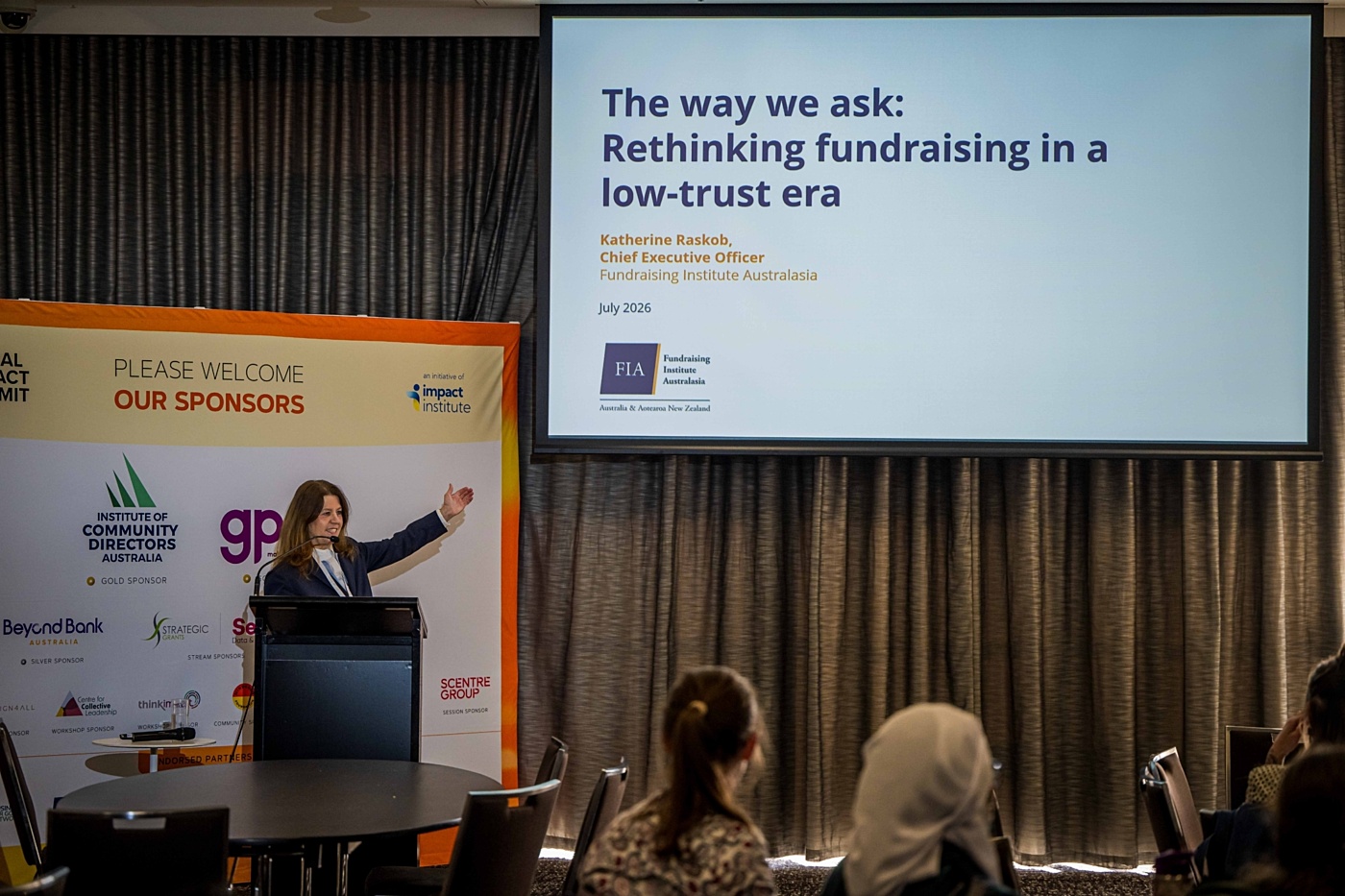
Speaking at the recent Social Impact Summit in Sydney, the CEO of Fundraising Institute Australasia (FIA), Katherine Raskob, said charities and not-for-profits continued to enjoy consistent levels of public trust.
"We don't need to rescue the reputation of our sector," Raskob said.
But the sector still faced challenges in maintaining that position, she said, and funders and donors, not content to accept that an organisation was doing a good job, wanted evidence of social impact.
In Raskob's presentation, “The Way We Ask: Rethinking fundraising in a low-trust era”, she argued that the growing demand for evidence represented an opportunity, not a burden. For example, better social impact measurement would help build the case for flexible funding, in which trusted charities were given greater financial freedom to achieve their goals.
She also addressed the issue of the different expectations of younger donors, who she said extended trust more conditionally than older generations, who were more likely to give habitually in return for occasional updates about how their money was spent.
This represented a change in what earning trust required. Rather than assuming a charity would do good work, donors expected the charity to demonstrate it, and they made transparency and evidence of impact a condition of support. Donors also wanted assurances that the charities they supported were "well governed, effective, and honest about what it takes to create that impact," she said.
"They want to know how that change is happening and whether it's creating systemic impact rather than just funding one program after another," Raskob told Community Directors after the presentation. Funders – including those in government – were making similar demands, she said.
Reporting, too, should consist of more than the defence of a promise – “I said I would do that, and I did” – and should show how things had changed for the better, what had been learned, and what programs could be adapted or scaled up, Raskob said.
Raskob drew attention to several studies that showed people were still highly trusting of charities.
Roy Morgan's research showed net trust in charities rising, although it remained below a peak reached in mid-2020.
The Charities Aid Foundation's (CAF’s) World Giving Index put the Australian public's trust in charities at 8.7 out of 15, a bit lower than the global average of 9.22.
“(Donors) want to know how that change is happening and whether it's creating systemic impact rather than just funding one program after another.”
The Edelman Trust Barometer, which tracks trust in business, government, media and NGOs in Australia, found NGOs the most trusted of the four sectors in 2025, although trust in business matched trust in NGOs in the most recent study.
Actual giving behaviour told a similar story, Raskob said. Research conducted by FIA with More Strategic found Australians worried about their capacity to keep giving amid inflation and cost-of-living pressure, but it also found that they largely kept giving anyway. She said donation amounts stayed steady even as donors' own expectations of themselves grew more pessimistic.
Raskob argued that funders should apply the “impact” standard to themselves. If evidence of impact was now the basis on which charities earned support, she said, funders should reward that evidence with more flexible funding, rather than continuing to attach narrow conditions regardless of an organisation's track record.
Short-term restricted grants, government service contracts and competitive grant rounds could drive urgency and accountability, but they also tended to make reporting an exercise in proving compliance with the original promise, rather than evidence of what had actually been achieved, she said.
"In charitable fundraising, the central issue is that money carries instructions about how we move forward, even when those instructions are not written down," she said. Multi-year, unrestricted and trust-based funding, by contrast, gave organisations greater capacity to plan, retain staff, invest in infrastructure and adapt to changing circumstances.
She said charities should make an equivalent case to individual donors: rather than framing a gift as having bought a defined output, organisations should ask donors to fund the ongoing capability and resilience of the organisation itself.
Raskob called this a shift away from "purchase logic” (what did a donation buy?) and towards a partnership arrangement in which a donor looks for the increased capabilities made possible by funding or giving. A charity could not collaborate or innovate, she said, if every dollar was tied to a narrow deliverable.
This argument is tied to the ongoing “Pay what it takes” campaign, which argues that charities should be funded for the full cost of delivering impact, including the costs of finance, technology, governance, human resources, fundraising, evaluation, compliance and leadership.
The campaign challenges the "overhead myth", in which low administration and fundraising costs are regarded as a proxy for organisational effectiveness, and it attacks the "starvation cycle", in which funders underestimate real costs, charities understate them to remain competitive, and organisations become less resilient over time.
"The starvation cycle is demoralising and soul-destroying because of the way it perpetuates itself," Raskob said.
She said individual charities could rarely demonstrate or prove social impact entirely on their own, making collaboration a sector-wide imperative rather than simply a way to cut costs. Pooled funds and shared infrastructure could reduce duplication between organisations working toward similar goals, she said, provided the collaboration itself was properly resourced.
She pointed to examples of collaboration – or even mergers – between charities as a model for how this could work in practice. She cited the case of Dolly's Dream, a children's mental health campaign, which brought its legal, governance and charity registration functions under the Alannah and Madeline Foundation umbrella. And she said Orange Sky's partnerships with First Nations organisations had extended its remote laundry services into wraparound community support.
Raskob said professional fundraisers remained crucial to sustaining charity income, with 85 per cent of all charity revenue in Australia coming from fundraising “asks”. "If you don't have enough trained, professional fundraisers building relationships, making those asks, and showing donors the impact of their support, it will become much harder to sustain fundraising into the future," she said.
Posted on 07 Oct 2026
A major public campaign launched this morning is calling on the federal government to restore…

Posted on 07 Oct 2026
The Australian Literacy & Numeracy Foundation (ALNF) has announced a partnership with mining…

Posted on 07 Oct 2026
A conference in Darwin will this morning hear detailed, strategic plans for how Australia could…

Posted on 30 Sep 2026
Not-for-profit leaders have been warned to be wary of approaches from potential “funding partners”…
Posted on 30 Sep 2026
More than 200 fully funded Centre for Social Impact (CSI) scholarships will help equip for-purpose…

Posted on 30 Sep 2026
Personal stories are among the most powerful tools a charity can have to raise funds and awareness,…
Posted on 23 Sep 2026
A just-released major global survey of charities has found that demand for charity assistance has…
Posted on 23 Sep 2026
Fresh from welcoming delegates to last week’s Philanthropy Australia conference in Brisbane,…

Posted on 23 Sep 2026
A national strategy to develop Australia's regional cities is needed to break the housing…

Posted on 23 Sep 2026
Eight years after a report to Treasury first suggested the charities regulator should be more…
Posted on 17 Sep 2026
Australia’s biggest gathering of philanthropists, which drew more than 1200 delegates to Brisbane…

Posted on 16 Sep 2026
A new partnership between Paul Ramsay Foundation (PRF) and Atlassian Foundation aims to attract…