
Save Izzy: campaign calls on government to restore funding for vital services directory
Posted on 07 Oct 2026
A major public campaign launched this morning is calling on the federal government to restore…
Posted on 23 Sep 2026
By Matthew Schulz, journalist, Community Directors

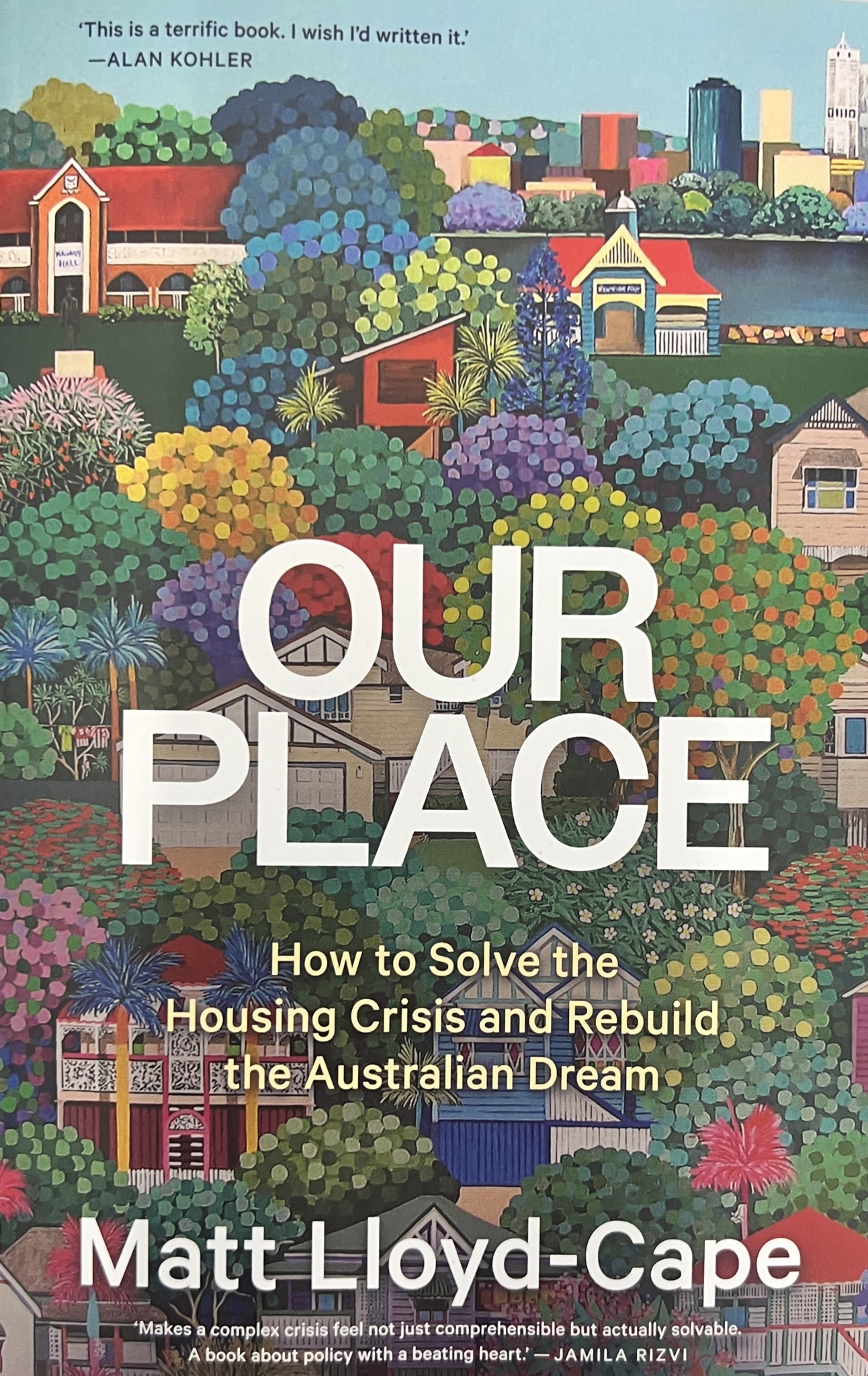
A national strategy to develop Australia's regional cities is needed to break the housing affordability crisis, according to housing policy expert Matt Lloyd-Cape, whose new book Our Place argues that not-for-profit leaders have a central role to play in pushing for the change.
The book, to be published late this month, challenges the idea that jamming more houses into cities – known as “upzoning” – can fix the problem, and instead calls for a return to the kind of national urban development strategy last seen in the 1970s under the Whitlam government.
Upzoning allows denser development through rezoning to allow more townhouses or apartments, and in recent decades governments have relied on the policy to lift housing supply in established suburbs without expanding a city's outer boundary. Lloyd-Cape's argument is that the approach has physical limits: rezoning a neighbourhood for more density does not create more primary schools, sewer capacity or train services to match.

"What we haven't had since Whitlam is a national strategy for urban development – where you say, 'Let's try and get Albury–Wodonga to a city of 300,000,’" Lloyd-Cape said. Australia was unusual in having 60 per cent of its population concentrated in just four cities, he said. By comparison, the population of the United States is spread across a much larger number of urban centres.
Lloyd-Cape said that while the last serious push for a national urban strategy ended when the Whitlam government was dismissed in 1975, his vision was not a partisan one, and both Coalition and Labor governments had treated housing as core federal policy in the decades after the Second World War.
"This is as much a conservative project as a left-wing one," Lloyd-Cape said. He pointed to former prime minister Robert Menzies, who he said had warned in the post-war period that failing to fix housing risked pushing people towards communism. Lloyd-Cape said unaffordable housing was fuelling the rise of far-right politics and causing people to delay having children. The resulting decline in traditional family formation should concern family-values conservatives as much as anyone on the left, he said.
He said Australia was unusual in its lack of a of a tier of “second cities”, which were common overseas and included Marseille in France, Birmingham in the United Kingdom, and Dallas in the United States. He and argued that regional centres such as Orange, Albury–Wodonga and Shepparton could be developed as climate-resilient growth areas, connected to Sydney and Melbourne by high-speed rail.
Asked why not-for-profit and charity leaders should engage with the book's arguments, Lloyd-Cape pointed to housing's role as a foundation of social stability.
"There's an equity issue across all of this – we want our kids to be able to buy a house, to live somewhere nice, walkable, with a local school,” he said.
Family violence, Indigenous housing disadvantage, and outcomes for working-class Australians were all tied to the retreat of federal government from housing policy, he said.
"We've basically cut off the legs of social mobility by scrapping so much of our federal approach to housing," Lloyd-Cape said. "A constant pipeline of social housing reduces rents, because people have an alternative to the market."
“We've basically cut off the legs of social mobility by scrapping so much of our federal approach to housing.”
He said the instability caused by unaffordable housing fed into other problems the sector regularly dealt with, including the rise of far-right politics that blamed migrants for the crisis.
The high cost of housing also delayed people’s ability to start a family as people struggled to buy homes into their thirties.
Lloyd-Cape stressed that pressure for reform needed to be applied federally. He said most successful models across the globe had required sustained national commitment, funding, and planning over decades, all of which he said not-for-profit and service organisations were well placed to advocate for.
Lloyd-Cape rejected the idea that housing supply was the core problem, citing a Financial Times ranking that placed Australia second only to Switzerland for homes built per 1,000 citizens over the past decade. Dwellings per household – a key indicator of supply and demand used by policymakers – had also risen over 30 years, he said, meaning the country was not short of houses overall.
Instead, he pointed to a pattern of demolishing older homes and rebuilding on the same site, which he said inflated construction figures without meaningfully lifting the number of dwellings. "When you look at the ABS [Australian Bureau of Statistics] numbers on how many dwellings are built every year, we need to lop off at least 10 per cent of that because of knockdown rebuilds that are just one-for-one," he said.
The book also examines what Lloyd-Cape calls "mortgage farming" – the concentration of Australian bank assets in mortgage lending. He said five of the six largest companies in Australia were banks, which together earned about $10 billion a year in mortgage interest, relying on rising asset values as a low-risk method of earning money.
He described the model as “the laziest form of banking in the world” but also one that carried a big risk to the nation’s economy.
Lloyd-Cape said both the International Monetary Fund (IMF) and the Organisation for Economic Co-operation and Development (OECD) had identified the concentration of Australian bank balance sheets in household mortgage debt as a risk to financial stability. He argued for a return to policies that preferenced not-for-profit mortgage providers such as credit unions, which he said had historically been a “sharper tool” for stopping house-price inflation from spiralling up, given their lower imperative to chase shareholder returns.
Lloyd-Cape said Australia's migration mix was also wrong, with the number of tradespeople arriving failing to keep pace with population growth. He said this was happening at the same time as competition for construction workers was intensifying, and the mining sector and data centre projects could pay tradespeople more than home building could.
That competition for labour was pushing up construction costs generally, he said, adding further pressure to the price of building new homes. Lloyd-Cape argued for dedicated visa programs to boost the migration of tradespeople specifically, which he said would help ease the bottleneck.
Lloyd-Cape linked the housing debate directly to climate change, warning that homes were still being approved in flood-prone and bushfire-exposed areas, including on the Gold Coast, and these would likely become uninsurable within a decade. He said the Insurance Council of Australia had raised the alarm over continued building approvals in flood zones.
He argued that a national urban strategy should deliberately direct growth towards higher-altitude, climate-resilient inland centres rather than continuing to concentrate development along the vulnerable eastern seaboard.
Lloyd-Cape pointed to Canberra – a planned city he said was named the world's most liveable by the Economist last year – as an underused model of what deliberately built, well-connected regional cities could achieve, particularly if linked to Sydney and Melbourne by high-speed rail.
He acknowledged that previous attempts to build satellite cities, such as South Australia's Monarto, had failed, but said the scale of today's housing and climate pressures meant the approach deserved renewed consideration as part of a long-term, federally led plan.
Lloyd-Cape is speaking about his book at independent think tank Per Capita’s monthly John Cain lunch on Wednesday, October 21 in Melbourne. Tickets start at $35.
Read our exclusive extract of Our Place here.
Posted on 07 Oct 2026
A major public campaign launched this morning is calling on the federal government to restore…

Posted on 07 Oct 2026
The Australian Literacy & Numeracy Foundation (ALNF) has announced a partnership with mining…

Posted on 07 Oct 2026
A conference in Darwin will this morning hear detailed, strategic plans for how Australia could…

Posted on 30 Sep 2026
Not-for-profit leaders have been warned to be wary of approaches from potential “funding partners”…
Posted on 30 Sep 2026
More than 200 fully funded Centre for Social Impact (CSI) scholarships will help equip for-purpose…

Posted on 30 Sep 2026
Personal stories are among the most powerful tools a charity can have to raise funds and awareness,…

Posted on 23 Sep 2026
A just-released major global survey of charities has found that demand for charity assistance has…

Posted on 23 Sep 2026
Fresh from welcoming delegates to last week’s Philanthropy Australia conference in Brisbane,…

Posted on 23 Sep 2026
Eight years after a report to Treasury first suggested the charities regulator should be more…

Posted on 17 Sep 2026
Australia’s biggest gathering of philanthropists, which drew more than 1200 delegates to Brisbane…

Posted on 16 Sep 2026
A new partnership between Paul Ramsay Foundation (PRF) and Atlassian Foundation aims to attract…

Posted on 16 Sep 2026
While there is no shortage of studies examining not-for-profits from every angle, a new research…