
Save Izzy: campaign calls on government to restore funding for vital services directory
Posted on 07 Oct 2026
A major public campaign launched this morning is calling on the federal government to restore…
Posted on 23 Sep 2026
By Nick Place, journalist, Community Directors
A just-released major global survey of charities has found that demand for charity assistance has ballooned across the planet. Two-thirds of charities say they have seen an increase in need, and most are finding it hard to cope.
The extra burden comes as fewer than two in five charities feel they are financially and operationally set up for success over the next three years, while less than one in ten feel “very well set up”.
These are among the key findings of the latest Charities Aid Foundation’s World Giving Report: Charity Insights, published yesterday.
The report shows the strain charities across the world are operating under, as well as common concerns, potential solutions and pressing needs. While charities’ experiences vary according to the economic health of the countries where they operate, many of the same challenges emerge across countries and cultures.
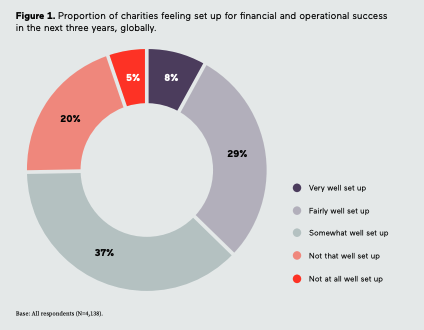
Larger charities (50 employees or more) felt most secure, while those working on the frontline, providing essential services, were among the most pessimistic. Charities working on arts and culture, environmental, human rights and mental health causes were less confident they were set up for ongoing success.
In high income countries, 74 per cent of charity leaders said they felt their country depended on the charity sector, yet only 37 per cent felt the role of charities was celebrated. In lower income countries, charities felt more recognised.
Likewise, 66 per cent of charities across the globe felt that governments rely on them to deliver services, yet only one quarter (27 per cent) of charity leaders felt those governments championed their work or encouraged people to donate. In Asia, 40 per cent of charities felt their government encouraged people to donate, while in South America, that figure fell to only 9 per cent.
There was no continent where the majority of charities felt “well set up” for longevity and impact. North America, Oceania and Asia were the most positive, with more than 40 per cent of charities feeling well set up, but in South America, only 26 per cent felt the same – meaning almost three-quarters of charities there were unsure of their future.
Although many charities felt their own future was uncertain, the majority felt the wider charity sector in their country was in good shape. Overall, 56 per cent of charities believed their country’s charity sector was “very or fairly healthy”, while 34 per cent believed theirs was not. Ten per cent said they didn’t know.
Of those who did not believe their country’s charity sector was healthy, funding shortages and financial instability were the main reasons, along with “government hostility, political interference, and shrinking civic space”, and then low public trust, poor reputation and a lack of recognition.
When it comes to the increase in need for services, charities across the globe are struggling to manage the demand.
Almost seven out of ten charities (67 per cent) say they have seen greater need for their services in the past year, and 36 per cent of charities said demand had increased “a lot”.
“Most charities who have seen an increase in demand have found it difficult to cope, and the vast majority of them are expecting a further increase,” the report said. “Overall, almost two in five charities (38 per cent) are in this challenging position.”
“Most charities who have seen an increase in demand have found it difficult to cope, and the vast majority of them are expecting a further increase.”
Globally, homelessness charities have faced the greatest increased demand, with a whopping 77 per cent experiencing an increase in need and 83 per cent of those struggling to cope.
The survey found that faced with this challenge, the majority of charities have honed their focus, prioritising services based on the severity of need, and in the past year, one in five frontline charities has been forced to create a waitlist.
In response to these findings, the authors of the report, Charities Aid Foundation, called on funders and policy-makers to do more to increase the resilience of charities and civil society.

“Charities are increasingly aware of the need to invest in themselves to build their organisational resilience and be prepared for future challenges and opportunities. However, finding funds for resilience work is difficult as this is often labelled as 'overheads' and can be a harder sell than direct delivery work with communities and people. Funders investing in resilience are giving charities the capacity to strengthen and drive their impact,” said Charities Aid Foundation’s head of impact, Ashling Cashmore.
Charities Aid Foundation said its research had identified six key pillars for building resilience: having strong and clear purpose; being financially and operationally fit; seeing evidence of impact; having strong people and culture; enjoying strong networks for support; and having an awareness of the external world, including threats and opportunities, for effective and controlled planning.
While the survey showed many charities around the world struggling for funding, resources or people, it also identified that many charities are underestimating what potential donors are looking for when engaging with the charities.
Only 19 per cent of charities nominated “measuring impact” and only 6 per cent nominated “winning trust” as key challenges facing them, yet the data suggests that for donors, both these things weigh heavily in their decision on whether to support a charity.
In the Charities Aid Foundation’s sister report Donor Insights, published in June, 63 per cent of people named transparency and impact communications as ways charities could encourage them to donate.
Not surprisingly, charities nominated financial sustainability (61 per cent), increased competition for funding (39 per cent) and increased costs (28 per cent) as their greatest challenges.
As a way of adapting to the tough economic conditions and funding shortfalls, many charities have looked to diversify their income, the survey found, with 37 per cent broadening their income streams in the past year and 21 per cent looking to generate income through investments.
But the struggle remains very real. One third (33 per cent) of charities reported using savings or reserves to cover shortfalls in funding within the last year, 25 per cent had to reduce staff numbers, and charities in lower-income countries were found to be three times as likely to have merged with another organisation in their fight for survival (12 per cent, versus 4 per cent elsewhere).
This battle has also seen charity leaders forced to spend the majority of their time on operational matters, rather than strategy, in the past year. More than 60 per cent of charity leaders’ time, on average, was spent on day-to-day issues.
There was common ground among the world’s charities when it came to recognising the importance of strong networks, with 70 per cent saying they enjoyed being connected with others in the sector and 91 per cent saying it was essential to their impact.
Clear purpose was also considered vital, with those who felt they had a clear mission statement advising other charities to keep their message brief, simple, easy to understand, and consistent across all communication channels, and to engage stakeholders and communities in shaping, sharing and taking responsibility for that mission.
The survey identifies “charities” as non-government organisations, not-for-profits, community organisations, social purpose organisations and associations.
Posted on 07 Oct 2026
A major public campaign launched this morning is calling on the federal government to restore…
Posted on 07 Oct 2026
The Australian Literacy & Numeracy Foundation (ALNF) has announced a partnership with mining…

Posted on 07 Oct 2026
A conference in Darwin will this morning hear detailed, strategic plans for how Australia could…

Posted on 30 Sep 2026
Not-for-profit leaders have been warned to be wary of approaches from potential “funding partners”…
Posted on 30 Sep 2026
More than 200 fully funded Centre for Social Impact (CSI) scholarships will help equip for-purpose…

Posted on 30 Sep 2026
Personal stories are among the most powerful tools a charity can have to raise funds and awareness,…

Posted on 23 Sep 2026
Fresh from welcoming delegates to last week’s Philanthropy Australia conference in Brisbane,…

Posted on 23 Sep 2026
A national strategy to develop Australia's regional cities is needed to break the housing…

Posted on 23 Sep 2026
Eight years after a report to Treasury first suggested the charities regulator should be more…

Posted on 17 Sep 2026
Australia’s biggest gathering of philanthropists, which drew more than 1200 delegates to Brisbane…
Posted on 16 Sep 2026
A new partnership between Paul Ramsay Foundation (PRF) and Atlassian Foundation aims to attract…

Posted on 16 Sep 2026
While there is no shortage of studies examining not-for-profits from every angle, a new research…