
Save Izzy: campaign calls on government to restore funding for vital services directory
Posted on 07 Oct 2026
A major public campaign launched this morning is calling on the federal government to restore…
Posted on 15 Jul 2026
By Matthew Schulz, journalist, Community Directors
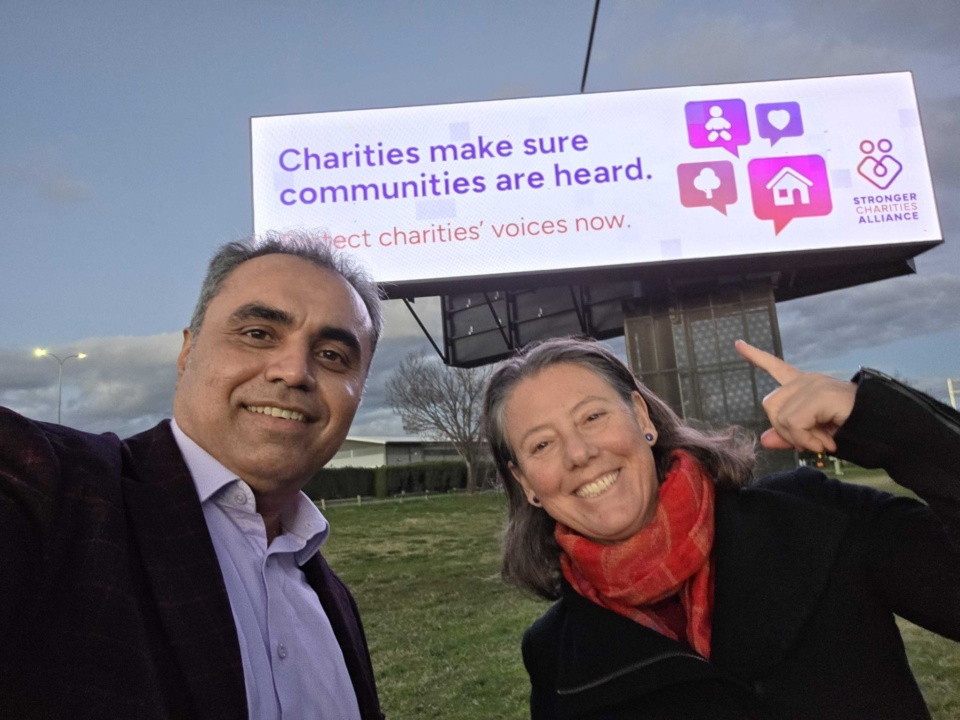
The Stronger Charities Alliance has signalled it could escalate its public campaigning if last month's blitz of MPs' offices, social media and Canberra billboards fails to win enough traction to bring about federal laws protecting charities' right to advocate.
The alliance, a coalition of 170 charities, escalated its “Let Charities Speak” campaign during last month's parliamentary sitting week, combining airport billboards, postcards to Labor MPs and senators, social media posts and news media.
It has been pushing back against laws and regulations that silence charities for more than nine years.

Stronger Charities Alliance (SCA) campaign manager Hassan Nasir Mirbahar said the reforms would protect an important democratic function of charities that should not depend on the goodwill of the government of the day.
"Not every voice has a lobbyist," Mirbahar said.
"Charities' advocacy brings the experience of people without privileged access into the decisions that shape their lives. That democratic role should be protected by law, not left to the goodwill of the government of the day."
Mirbahar said charities worked directly with people affected by decisions on housing, poverty, disability, aged care and family violence, and they saw early where systems were working and where they were failing. Those people had no lobbyists or government-relations advisers to represent them and relied on the charity sector to stand up for them.
“We don't want Australia to become like the US where if you're seen as critical, your survival is put under pressure.”
The alliance wants the government – in its current term – to confirm in law that legitimate charity advocacy serves the public benefit, to establish a transparent, merit-based process for appointing the ACNC commissioner, and to ensure that government funding arrangements cannot discourage charities from speaking out.
Mirbahar said the sector had responded positively to the campaign, with coordinated social media posts from charities, peak bodies and sector leaders driving much of its reach. He said the "Not every voice has a lobbyist" message and the advertising had drawn a positive response.
Several of the alliance’s members helped produce a video pitch in support of the campaign, and representatives met several politicians in the nation's capital.
Community Council for Australia chief executive David Crosbie said that “charities are at the heart of most communities in Australia”, but the sector needed to protect this position.
“We don't want Australia to become like the US where if you're seen as critical, your survival is put under pressure.”
Anglicare Australia CEO Kasy Chambers put it simply: “Many charities still believe that they can’t speak out.”

The Community Impact Foundation’s Blair Palese said the work of charities protected the country.
“If we're not in there really lobbying and pushing for what's best for society as a whole, a lot of things that we count on, nature, a safe climate, health … they will be undone.
“The need to protect charities and the right to advocate is absolutely critical in any democracy right now.”
The campaign follows comments from charity law scholar Professor Matthew Harding, who told Community Directors last month there was "only now" for charities to secure legislative protection for advocacy.

Harding, a barrister at the Victorian Bar and professorial fellow at the University of Melbourne, said governments of all political stripes had shown they could "reach for the levers" against charities with advocacy agendas when it suited them.
He said the underlying law – built up over centuries of judge-made rulings, legislation and regulation – remained so complex that navigating it imposed real costs on the sector.
"It's far too complicated, and trying to navigate what it requires costs time and money," Harding said. "That's time and money many organisations don't have because they're operating on tight budgets and trying to direct their efforts towards helping the people they serve."
Mirbahar agreed that the time for reform was now.
"The policy work has been done," Mirbahar said. "This is the moment to fix the roof while the sun is shining. Otherwise, the risk is that a broadly supported, budget-neutral reform that would strengthen our democracy is lost, not because anyone rejected it, but because the parliamentary window simply closed without action."
Posted on 07 Oct 2026
A major public campaign launched this morning is calling on the federal government to restore…

Posted on 07 Oct 2026
The Australian Literacy & Numeracy Foundation (ALNF) has announced a partnership with mining…

Posted on 07 Oct 2026
A conference in Darwin will this morning hear detailed, strategic plans for how Australia could…

Posted on 30 Sep 2026
Not-for-profit leaders have been warned to be wary of approaches from potential “funding partners”…

Posted on 30 Sep 2026
More than 200 fully funded Centre for Social Impact (CSI) scholarships will help equip for-purpose…

Posted on 30 Sep 2026
Personal stories are among the most powerful tools a charity can have to raise funds and awareness,…

Posted on 23 Sep 2026
A just-released major global survey of charities has found that demand for charity assistance has…
Posted on 23 Sep 2026
Fresh from welcoming delegates to last week’s Philanthropy Australia conference in Brisbane,…

Posted on 23 Sep 2026
A national strategy to develop Australia's regional cities is needed to break the housing…

Posted on 23 Sep 2026
Eight years after a report to Treasury first suggested the charities regulator should be more…

Posted on 17 Sep 2026
Australia’s biggest gathering of philanthropists, which drew more than 1200 delegates to Brisbane…
Posted on 16 Sep 2026
A new partnership between Paul Ramsay Foundation (PRF) and Atlassian Foundation aims to attract…