
Save Izzy: campaign calls on government to restore funding for vital services directory
Posted on 07 Oct 2026
A major public campaign launched this morning is calling on the federal government to restore…
Posted on 30 Jun 2026
By Nick Place, journalist, Community Directors

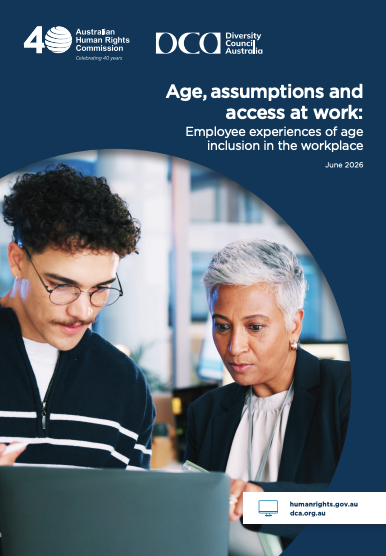
Age discrimination is happening at both ends of the age spectrum and is intensified by other social factors, according to a new report by the Diversity Council Australia and the Australian Human Rights Commission.
Data in the Age, Assumptions and Access at Work: Employee Experiences of Age Inclusion in the Workplace report, released yesterday, suggests young workers (18-29 years old) have it worst, with a disturbing 39 per cent reporting that they experienced discrimination and/or harassment in the workplace during the previous 12 months.
That compared to 27 per cent of middle-aged workers (30-54 years old), and 19 per cent of older workers (55-plus) saying they had experienced discrimination or harassment in the same period.
All this before you get to young workers juggling work with children or others to care for. Young workers with caring responsibilities felt the highest level of exclusion and discrimination, with 59 per cent reporting discrimination or harassment, compared to 32 per cent without caring responsibilities, as well as higher levels of social exclusion in the workplace, more negative assumptions about their abilities, and feelings of being ignored by their workmates and managers.
The report has been extracted from previously unreleased data from Diversity Council Australia’s wider 2025-26 Inclusion@Work Index, based on a representative survey of 3000 workers from across Australia.
Across the wider young workers cohort, the report suggests they suffered the most sexual harassment, with 36 per reporting experiences of such dodgy behaviour, compared to 24 per cent of middle-aged workers, and 10 per cent of older workers.
It didn’t end there, either. Young people were most likely to report feeling excluded in the workplace, feeling ignored or as though they didn’t exist in the workplace (36 per cent), left out of social activities (37 per cent) and feeling that they had suffered negative assumptions about their abilities based on their identity (42 per cent).
All these figures were higher than middle-aged or older workers, and the sense of exclusion was felt most of all by younger women, with only 52 per cent saying their team was inclusive, compared to 61 per cent of young men.
However, the under 30 cohort were not the only ones doing it hard, according to the report.
“What’s clear is that age does not operate in isolation – factors like gender and caring responsibilities can shape how these barriers are felt.”
Older workers said they felt excluded from access to career development and support, or mentoring. While workers over 55 felt most at ease in their own skin, and didn’t feel a need to hide their true selves in the workplace, only 50 per cent felt they had access to career development, compared to 66 per cent of middle-aged workers, and 75 per cent of those under 30.

While 53 per cent of younger workers and 41 per cent of middle-aged workers had access to mentors or sponsors, that figure dropped to only 18 per cent of older workers.
Older women felt that they received the least recognition for their work, with only 69 per cent feeling appreciated, compared to 81 per cent of older men.
Only 41 per cent of older women felt they had access to career development resources, 16 per cent less than their male equivalents, and only 13 per cent of older women had access to mentoring or sponsors.
Age Discrimination Commissioner Robert Fitzgerald said the findings highlight that bias is not confined to either end of the workplace age spectrum.
“One of the most striking things we learned is the gap between what people experience and what they report,” he said.
“Ageism – whether against younger or older workers – is so deeply normalised many simply accept it as the status quo. It is woven into the fabric of workplace culture, and people are rarely empowered to call it out.
“Ageism is not a tug-of-war between generations; an opportunity for one cohort does not come at the expense of another’s. Exclusion presents differently for younger workers compared to their older counterparts, but the impact is just as damaging.
“We must draw on these insights and create workplaces where people of all ages are valued, respected and given the chance to do their best work and succeed.”
Diversity Council Australia CEO Catherine Hunter said there were nuanced lessons within the survey results.
“This report shows age continues to play a quiet but powerful role in shaping workplace experiences. Too often, assumptions about someone being too young, too old, not ready, or past their prime influence access to opportunity, recognition and support,” she said.
“What’s also clear is that age does not operate in isolation – factors like gender and caring responsibilities can shape how these barriers are felt. Genuine age inclusion requires an intersectional approach that recognises how workplace policies and practices can compound disadvantage.
“As Australia continues to navigate skills shortages, demographic shifts, and longer working lives, the ability to attract, retain and support people of all ages is not just a matter of fairness, it is essential to organisational resilience and performance.”
Happily, the report reacts to the reported harassment and discrimination by offering practical steps that employers can attempt to build age-inclusive workplaces.
Improving access to career development for all, supporting flexible workers, strengthening complaint processes, building leadership capacity and challenging age stereotypes were all actions that could improve the workplace experience for all age groups, it said.
The full report is here.
Posted on 07 Oct 2026
A major public campaign launched this morning is calling on the federal government to restore…
Posted on 07 Oct 2026
The Australian Literacy & Numeracy Foundation (ALNF) has announced a partnership with mining…

Posted on 07 Oct 2026
A conference in Darwin will this morning hear detailed, strategic plans for how Australia could…

Posted on 30 Sep 2026
Not-for-profit leaders have been warned to be wary of approaches from potential “funding partners”…
Posted on 30 Sep 2026
More than 200 fully funded Centre for Social Impact (CSI) scholarships will help equip for-purpose…

Posted on 30 Sep 2026
Personal stories are among the most powerful tools a charity can have to raise funds and awareness,…

Posted on 23 Sep 2026
A just-released major global survey of charities has found that demand for charity assistance has…
Posted on 23 Sep 2026
Fresh from welcoming delegates to last week’s Philanthropy Australia conference in Brisbane,…

Posted on 23 Sep 2026
A national strategy to develop Australia's regional cities is needed to break the housing…

Posted on 23 Sep 2026
Eight years after a report to Treasury first suggested the charities regulator should be more…

Posted on 17 Sep 2026
Australia’s biggest gathering of philanthropists, which drew more than 1200 delegates to Brisbane…

Posted on 16 Sep 2026
A new partnership between Paul Ramsay Foundation (PRF) and Atlassian Foundation aims to attract…