
Save Izzy: campaign calls on government to restore funding for vital services directory
Posted on 07 Oct 2026
A major public campaign launched this morning is calling on the federal government to restore…
Posted on 12 Aug 2026
By Nick Place, journalist, Community Directors

A report being released in Canberra this morning calls for urgent changes in the way online hate campaigns are recognised, monitored, shut down and prosecuted.
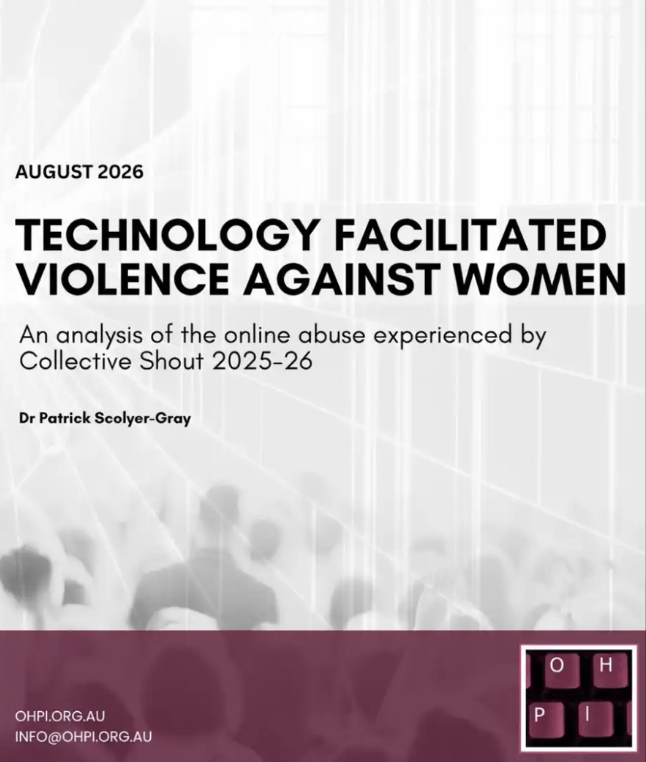
The report, from the Online Hate Prevention Institute, details a year-long campaign of hate against Collective Shout, an all-female organisation that challenges the objectification of women and the sexualisation of girls in media, advertising and popular culture. The group has suffered continual misogynistic online abuse, threats and misinformation since 2025.
The report suggests that the structures supposed to protect people online from this type of organised, anonymous, global campaign, including police, the eSafety Commission, social platforms and other gatekeepers, are inadequate.

In April 2025, Collective Shout campaigned to have a 3D pornographic rape and incest simulation game called No Mercy, and hundreds of similar games, removed from online gaming platforms such as Steam and Valve. Backed by female gamers and sexual assault survivors, the collective started a change.org petition calling on Steam to remove the game, and calling on payment platforms to recognise that purchasing the game with a credit card was a breach of terms and conditions.
In response, online abusers launched a huge, co-ordinated campaign against the Australian women, initially attempting to position Collective Shout as anti-free-speech zealots. They then changed tack and humiliated and physically threatened the Collective Shout workforce.
“What the reaction illustrates is that there’s very little room for civil discourse, especially on X,” Collective Shout’s Melinda Tankard Reist told the Community Advocate in the lead-up to today's event. “We don’t mind people disagreeing with us. People have been disagreeing with us for 16 years, but it is the nature of the way the disagreement is executed, the way disagreement is framed. There was very little civil argument, rational debate,” she said.
“What we experienced was not even close to that because our hostile actors could say whatever they wanted and for the most part get away with it, especially on X, so there was a deluge of rape and death threats, morphed into graphic violent pornography turned into gore, such as images of us being hung, skinned alive, machetes in our body parts. Then there was doxxing of personal information released publicly, which put individual members at grave risk when their home address circulated, and there were also attacks on our financial systems. We had to shut down every portal, every entry point to our website, to our personal social media pages. We had to cut off every contact form.
“For weeks, even our supporters couldn’t contact us because we had to shut down all of the entry points for the abuse and the aggression and the menacing and harassment,” she said.
“If we’re looking big picture, we want women to be able to engage in the digital public square without being abused and facing harassment and violence and menacing.”
Being subjected to AI-generated fake headlines and sexually violent imagery took a toll on the mental health of the collective’s members in different ways. Tankard Reist chose to focus on the hypocrisy of the offenders. “The whole irony is that the so-called free-speech libertarian gamers would liked to have shut down our speech in an instant, including by ending our lives. These are the moral defenders of civil civilization? I don’t think so.”
Against this backdrop, in 2025 Collective Shout was successful in 42 campaigns against advertisers, marketers or corporates in Australia and internationally. “We’re still here,” she said.
Today’s report launch in Canberra is aimed at raising awareness of the need to support people who find themselves targeted by hate campaigns.
“We are seasoned campaigners,” Tankard Reist said. “Some of us have been doing this a long time, but this was like nothing we’ve ever experienced. It was volumetric, but also they had new tools that our past opponents didn’t have, like AI to be able to generate false accusations, to be able to generate false photographs, false newspaper headlines about us being in court for interfering with minors. X still hasn’t removed claims that I’m a paedophile.
“They were able to harness AI in a way we’d never experienced, where you’re dealing with volumetric mass lies, character assassination and defamation, which they could produce within seconds. In the past, that would have been a bit harder to do; you’d have to mock something up and take a bit more work and it wouldn’t look accurate. But now people believe it and they share it by the thousands, retweeting by the thousands, getting these lies out there. It points to something that is beyond our individual experience.”
At the height of the abuse, Collective Shout realised there was no feasible way to report it or to have authorities recognise that individual instances of abuse were part of a much larger, coordinated, multi-platform campaign.
“We actually gave up reporting at complaint number 55, which we were told was a very large volume of complaints, but we stopped because the reporting process is onerous and difficult,” Tankard Reist said. “One individual report needed five pieces of evidence per tweet. You couldn’t do a big bulk report, it had to be one by one.
“For one tweet, you had to provide a screenshot of the tweet,” she said. “You had to provide the URL of the tweet. You had to provide the URL of the user’s profile. You had to provide evidence that you’d reported to the platform, and you had to provide the evidence of the platform’s response before you could make a complaint. That’s just for one tweet.”

Various departments within the eSafety Commission, the Australian Federal Police and state police dealt with different alleged online crimes but did not communicate, so that people targeting Collective Shout on a multitude of platforms and under a variety of account names weren’t cross-referenced, among other issues.
It added up to the all-female team feeling they were on their own and extremely vulnerable to the misogynistic violence, especially on X, where, far from cracking down on perpetrators or agreeing to release ISP details of offenders, owner Elon Musk retweeted a petition against Collective Shout.
“The system is too siloed, it’s too onerous, and we are experienced people,” Tankard Reist said. “What is the average punter to do? We know the system and we still found it so difficult and it was re-traumatising. We could have been reporting 24 hours a day and still not captured all of the data. Not enough happened in our view, which is why we’re calling for reform.”
As well as now working with the eSafety Commission and police on how the response could have been more effective, Collective Shout is calling for a global ban on apps and web programs that artificially “nudify” and undress girls and women – something they’ve been campaigning for since 2019.
“Grok is just the latest iteration but we’ve looked into 120 others, I think,” Tankard Reist said. “We think there should be a global ban. They serve no good purpose.
“We also want to see a ban on ‘Doxbin’ and other doxing sites. They serve no good purpose. They are only designed to menace and harass and cause fear in their victims by posting personal information about individuals, including home addresses,” she said. “Surely UN member states should agree to banning those sites? Why are they allowed?”
The Online Hate Prevention Institute’s methodical report detailing all the abuse Collective Shout suffered runs to 129 pages and contains many recommendations for how authorities could prevent or at least minimise a future global hate campaign. Collective Shout members have also released their own, more personal recommendations, based on their experience as the targets of hatred and violence.
“If we’re looking big picture, we want women to be able to engage in the digital public square without being abused and facing harassment and violence and menacing,” Tankard Reist said. “We believe that it’s good for democracy and civil society for women to be able to engage in the digital public square.
“Because if we step out, and a lot of women are, what voices are left? They may not be the voices that are best for civil society, for democratic processes, for healthy discourse.”
Collective Shout: website
The Online Hate Prevention Institute report (Warning: Distressing content)
The Collective Shout personal experience and recommendations. (Warning: Distressing content)
Posted on 07 Oct 2026
A major public campaign launched this morning is calling on the federal government to restore…

Posted on 07 Oct 2026
The Australian Literacy & Numeracy Foundation (ALNF) has announced a partnership with mining…

Posted on 07 Oct 2026
A conference in Darwin will this morning hear detailed, strategic plans for how Australia could…

Posted on 30 Sep 2026
Not-for-profit leaders have been warned to be wary of approaches from potential “funding partners”…

Posted on 30 Sep 2026
More than 200 fully funded Centre for Social Impact (CSI) scholarships will help equip for-purpose…

Posted on 30 Sep 2026
Personal stories are among the most powerful tools a charity can have to raise funds and awareness,…

Posted on 23 Sep 2026
A just-released major global survey of charities has found that demand for charity assistance has…

Posted on 23 Sep 2026
Fresh from welcoming delegates to last week’s Philanthropy Australia conference in Brisbane,…

Posted on 23 Sep 2026
A national strategy to develop Australia's regional cities is needed to break the housing…

Posted on 23 Sep 2026
Eight years after a report to Treasury first suggested the charities regulator should be more…

Posted on 17 Sep 2026
Australia’s biggest gathering of philanthropists, which drew more than 1200 delegates to Brisbane…
Posted on 16 Sep 2026
A new partnership between Paul Ramsay Foundation (PRF) and Atlassian Foundation aims to attract…