
Human rights advocate urges Australia to adopt National Anti-Racism Framework to drive social cohesion
Posted on 04 Nov 2026
Leading lawyer and anti-racism advocate Mariam Veiszadeh has told a Human Rights Commission…
Posted on 05 Nov 2026
By Nick Place, journalist, Community Directors

Mapping Social Cohesion 2026, published today, has found that 48 per cent of Australian adults are “pessimistic or very pessimistic” about Australia’s future and has attributed the increase in pessimism to one group.
“These declines have been driven by One Nation supporters, creating a more socially and politically divided Australia in 2026,” said a video summarising the survey’s findings.
The report, now in its 19th edition, is based on a complex and sophisticated annual social cohesion survey driven by the Scanlon Foundation Research Institute with the Australian National University. The survey asked 100 questions of more than 10,000 respondents, as the institute’s CEO, Anthea Hancocks, explained yesterday in the Community Advocate.
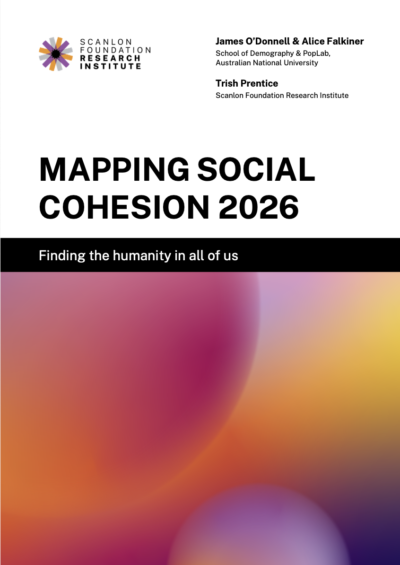
Australia’s overall social cohesion rating remained at 78 for the fourth year in a row, and the five underlying social cohesion domains held more or less steady too – those domains are social justice and inclusion (−1); acceptance (steady); worth (steady); belonging (+1); and participation (−3). However, the findings behind these headlines spoke of more disturbing long-term downward trends.
The negative and divisive views of people aligned with One Nation are prominent throughout the report, however It would be unhelpful to adopt an “us” and “them” stance off the back of the survey. In fact, the report’s sub-heading is: “Finding the humanity in all of us”, and a take-out from the nuanced data could be that people who have been attracted to One Nation’s brand need to feel heard, and given reason to believe government and institutions are working for their welfare.
The report found that, “Australians have been reporting a weaker sense of belonging, social justice and personal wellbeing and less active involvement in their communities over the last 15 to 20 years, coupled with weaker support for immigration and diversity in the last one to three years, greater animosity toward people of different faiths and immigrant backgrounds, declining and highly polarised trust in government and institutions and increasing discontent with Australia’s current trajectory.
“Much of the recent deterioration has been driven by One Nation supporters,” the report said. “One Nation supporters are also reporting somewhat weaker connections in their neighbourhoods and local communities, less happiness and trust in others, greater financial stress and increasing pessimism for their own futures. Although this does not explain everything, it does point to one way in which long-run strains on social cohesion and personal wellbeing are potentially providing the conditions for growing division now.”
One Nation supporters consistently reported lower levels of happiness, belonging and trust in civil infrastructure in the 2026 survey. Distrust in government and other institutions was growing, and was increasingly polarised along party lines, the report found, while attitudes to migrants, immigration and diversity are also politically divided and increasingly negative, especially among survey respondents aligned with One Nation.
The report found that Australians are more pessimistic about the future, less happy, less active in their communities and feeling longer-term financial stress. Sixty-two per cent of Australians said they felt the nation was less cohesive than three to four years ago, and only 58 per cent believed hard work would lead to a better life in this country – down from 63 per cent in 2025, and down from 80 per cent in the early 2010s.
While the Scanlon index of social cohesion produced the overall rating of 78 for the fourth straight year, the report notes that this is 15 percentage points lower than the overall rating in 2007, the first and benchmark year of mapping social cohesion. It’s also 14 percentage points lower than its Covid-related peak in November 2020.
Sixty-two per cent of Australians said they felt the nation was less cohesive than three to four years ago, and only 58 per cent believed hard work would lead to a better life in this country.
The report notes that the year since the last Mapping Social Cohesion study has been a “shocking” one for Australia, a year that has seen the Bondi terrorist event, continued global conflicts, a rising incidence of antisemitism, Islamophobia, and other racism, the creation of “March for Australia” rallies, and record support for Pauline Hanson’s One Nation amid the party’s calls for an end to multiculturalism.
“While immigration is a legitimate area for democratic debate, racial hatred, violence, stereotyping, othering and general ill-will have been common,” the report says, noting that Muslims, Jewish people and immigrants from Asia and Africa have faced increased levels of negative attitudes.
Despite all of this, most Australians (79 per cent) report feeling happy or very happy in the past 12 months, even if they fear for the future.
Local and community connections and cohesion have remained resilient, which is good for personal wellbeing as well as national-level cohesion. Four out of five adults surveyed agreed their neighbours were willing to help each other and get on well, regardless of national and ethnic backgrounds.
A hefty 87 per cent agreed that immigrants can make “just as good a citizen as the Australian born” and 90 per cent did not agree that it was very important to be born in Australia to be “truly” Australian.
Even respondents identifying as One Nation supporters “were much more likely [than not] to say that happiness, safety, belonging and respect despite our differences were important to social cohesion,” the report said.
“The fact that three quarters of Australians still believe that multiculturalism has been good for the country even after three years of decline is perhaps testament to the symbolic value of multiculturalism in Australia and its potential – alongside community bonds – to hold social cohesion together during difficult times,” it said.
When people were asked what things they believed were important for living in a cohesive society, 43 per cent said it was greatly important that “people respect others despite their different beliefs and cultures”. Eighty per cent said it was at least moderately important that “people are safe and communities are protected from harm”.
Mapping Social Cohesion 2026 was launched to begin the Scanlon Foundation Research Institute’s summit in Melbourne this week (Thursday, November 5 and Friday, November 6).
A video summary of the report.
The Mapping Social Cohesion 2026 report is here.
Posted on 04 Nov 2026
Leading lawyer and anti-racism advocate Mariam Veiszadeh has told a Human Rights Commission…

Posted on 04 Nov 2026
A leading advocate and service provider for new arrivals in Australia has urged the nation’s…

Posted on 04 Nov 2026
As the Scanlon Foundation Research Institute prepared to release its annual social cohesion report…

Posted on 28 Oct 2026
Violet Roumeliotis, the chief executive of Australia’s biggest migrant support organisation, will…
Posted on 21 Oct 2026
Backed by tangible successes and government support, community foundations are gaining momentum as…
Posted on 21 Oct 2026
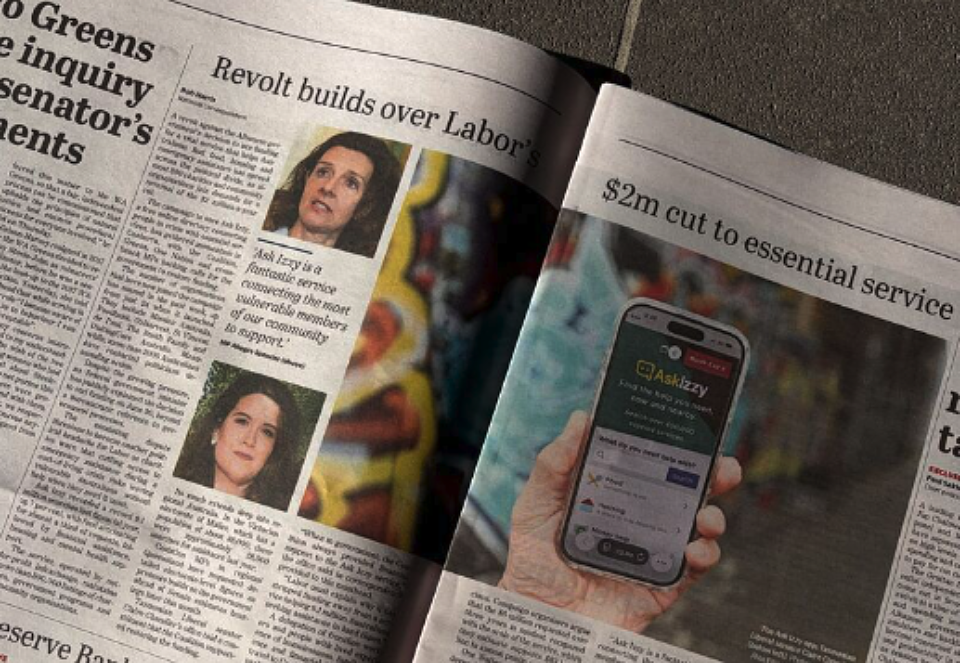
A national campaign to restore federal funding for Ask Izzy has attracted such strong grassroots…
Posted on 21 Oct 2026
In the wake of an act of violence against federal independent MP Helen Haines, Charities Minister…

Posted on 21 Oct 2026
If your charity takes a stance that happens to align with a political party’s stance in a public…

Posted on 14 Oct 2026
The federal government’s special envoy for social housing and homelessness, Josh Burns MP, has…

Posted on 14 Oct 2026
The Reserve Bank’s move to ban card payment surcharges has led to complications for charities and…

Posted on 07 Oct 2026
A major public campaign launched this morning is calling on the federal government to restore…
Posted on 07 Oct 2026
The Australian Literacy & Numeracy Foundation (ALNF) has announced a partnership with mining…