
Thousands download ‘Roadmap 2030’ study of NFP governance
Posted on 25 Nov 2026
Community Directors’ wide-ranging investigation into governance challenges for the not-for-profit…
Posted on 25 Nov 2026
By Nick Place, journalist, Community Directors

Not-for-profits have become more adept, sophisticated and confident in their use of technology and artificial intelligence in 2026, but resource-challenged small and volunteer-run organisations are being left behind.
That’s the headline finding of Infoxchange’s latest Digital Technology in the Not-For-Profit Sector Report. Driven by a survey of 966 charities and not-for-profits across Australia (which accounted for 75 per cent of respondents) and New Zealand (25 per cent), the report found that many of the previous barriers to digital participation, including access to devices, cloud collaboration tools and reliable infrastructure, were being overcome across the sector.

But tiny and volunteer-run charities are being hampered by their inability to keep pace. Half the respondents to the survey were either volunteer-run or employed no more than five staff members, and their struggle was clear in the findings. In terms of having appropriate technical foundations for their work, 53 per cent of volunteer-run organisations considered themselves “at risk”, compared with only six per cent of organisations with 21 staff or more.
Infoxchange chief executive officer David Spriggs said the ramifications went far beyond inefficient administration.
“Many organisations, especially small and volunteer-run organisations, continue to operate without the resources, skilled staff and long-term funding they need to realise the benefits of digital transformation,” he wrote in introducing the report.
“The consequences reach well beyond day-to-day operations. Nearly half of [these] organisations told us their technology challenges limit their ability to reach new, underserved or urgent community needs, and more than a third said these challenges limit their capacity to meet demand.
“Without sustained investment in technology, people and capability, many risk being left behind at a time when digital resilience has become essential,” he said.
For the fourth year in a row, the survey found that budgeting for and funding technology requirements was the major challenge cited by the majority of charities, with 63 per cent – across all charity sizes and revenue bands – saying they struggled in this area. It’s the highest such figure in the history of the report and runs parallel to the finding that cost-of-living pressures are hitting charities from both sides. As more people struggle financially and require assistance, the cost to charities of providing such services, in terms of wages, rent and other bills, continues to rise, while income doesn’t.
Digital capability can improve service delivery, but only for charities with the resources and know-how to embrace it. Infoxchange warned that the growing gap between well-resourced and under-resourced charities could lead to increasingly unequal services for the communities they support.
In more encouraging results, 80 per cent of organisations reported having essential technology in place, including cloud collaboration tools such as Microsoft365, Google Workspace, Dropbox and Slack. However, financial constraints continued to hamper progress. Almost a third of NFPs (31 per cent) identified implementation costs as a major barrier to system improvements, while 27 per cent cited licensing and ongoing maintenance costs. A further 15 per cent reported that a lack of capacity was holding them back.
“Nearly half of (these) organisations told us their technology challenges limit their ability to reach new, underserved or urgent community needs.”
Asked to assess their digital capability, only 29 per cent of NFPs considered themselves “progressive” or “transformative”, while the vast majority (71 per cent) put themselves in the lower-ranked “essential” or “at risk” categories. Of most concern was the rise in “at risk” organisations, alongside the fall in progressive and transformative organisations, with Kiwi NFPs trailing their Australian counterparts in digital capability.
Exactly half of respondents said they operate without an IT plan, the survey found, with that figure rising to 81 per cent for volunteer-led organisations and 66 per cent for those with five or fewer staff members.
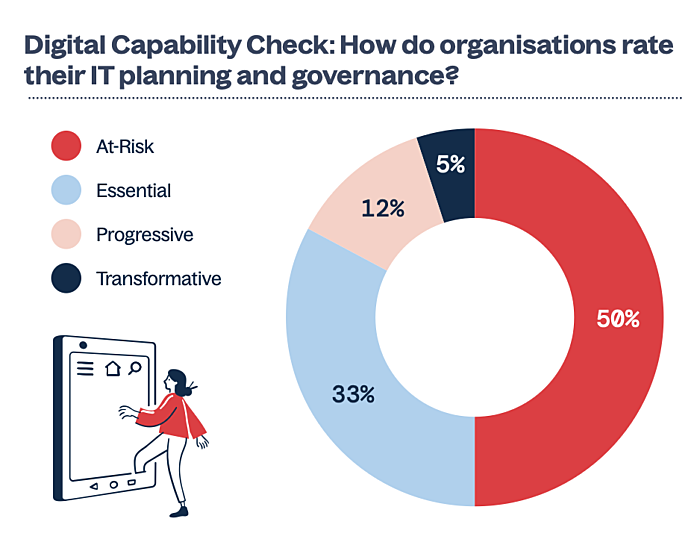
When asked how they rated their IT planning and governance, 50 per cent of respondents fell into the “at risk” category and 33 per cent into the baseline minimum “essential” bracket.
In 2026, the 11th time the survey has been conducted, the survey examined for the first time whether tech barriers were affecting communities and not just NFPs themselves.
Almost half of organisations surveyed (49 per cent) confirmed that technology challenges were limiting their ability to reach new, underserved or urgent community needs. 39 per cent said tech challenges affected service quality, while 35 per cent said they also limited their capacity to meet demand. Three in four NFPs said tech barriers ate into staff time by creating extra admin and workarounds.
Only 19 per cent of the surveyed organisations reported little or no impact.
In announcing the findings, Infoxchange’s Sophie Souchon marvelled that only two years ago, after launching the 2024 report, she had gone straight into a webinar that asked “What does AI mean for not-for-profits?”
Now, 82 per cent of NFPs regularly use generative AI in their daily work, although only 28 per cent have an AI policy or AI guidelines in place. While this figure is up from 14 per cent last year, it still leaves a concerning number of charities using AI without adequate, if any, governance oversight in place.

“I was really surprised to see the amount of organisations that are paying for AI licences but don’t have the governance in place,” Souchon said. “Of the 34 per cent paying for it, we see 44 per cent have no policy, and I’m not even saying it needs to be a policy. It could be sort of guidelines for staff and volunteers to understand how to use AI, but it’s that bit around thinking about why and how we’re using it responsibly.”
NFPs were receiving budget approval for licences without talking about organisational change, she said.
Souchon said she was encouraged by the number of charities looking to push further into machine learning and data analytics in the next 12 months (43 per cent, up from 19 per cent in 2025), or considering using AI agents and automation (39 per cent). However, she said she could see a clear need for Infoxchange to help charities with using their data for impact reporting or evidence-based decision-making.
Charities Minister Dr Andrew Leigh told the report’s launch webinar that cyber security must remain a priority for charities. He urged charities to use two-factor authentication wherever possible and to be relentless in their efforts to protect clients’ private information.
Leigh predicted that the growing threat of cyberattacks would soon force organisations to install security patches as soon as they became available, rather than waiting until outside business hours. Hackers were increasingly quick to exploit vulnerabilities, he warned.
“Good use of AI, where you’ve got appropriate permissions and, with appropriate protections, you’re able to upload your own data, does allow organisations to find new insights. But of course, organisations need to work through very carefully the appropriate privacy and confidentiality requirements before uploading any confidential data to AI engines,” the minister said. “It’s got a lot of potential, but a long way to go yet.”
Posted on 25 Nov 2026
Community Directors’ wide-ranging investigation into governance challenges for the not-for-profit…

Posted on 25 Nov 2026
Almost 80 charities and peak bodies have accused the Albanese government of breaking a promise to…

Posted on 18 Nov 2026
Charity and not-for-profit workers across six countries, including Australia, are being asked to…

Posted on 18 Nov 2026
A commitment to creating conditions in which philanthropy and charities can thrive is behind…

Posted on 18 Nov 2026
What do Lifeline WA, 7-Eleven’s support office, Paramount Australia and New Zealand, the Port of…

Posted on 18 Nov 2026
A new and free-to-join Not-for-profit Cyber Uplift community forum created by the federal…

Posted on 11 Nov 2026
The persistent cost-of-living crisis is affecting Australians in many ways, but two charities have…
Posted on 11 Nov 2026
The question of what Australia might look like in 2046 – only 20 years away – can cause anxiety and…

Posted on 11 Nov 2026
The Paul Ramsay Foundation has announced $24 million in funding for programs aimed at helping…

Posted on 11 Nov 2026
As Australia faces a record-breaking “super” El Niño weather system that has arrived ahead of…

Posted on 05 Nov 2026
Mapping Social Cohesion 2026, published today, has found that 48 per cent of Australian adults are…

Posted on 04 Nov 2026
Leading lawyer and anti-racism advocate Mariam Veiszadeh has told a Human Rights Commission…