
The data is in: to rebuild Australian social cohesion, we need to repair political and community connections
Posted on 05 Nov 2026
Mapping Social Cohesion 2026, published today, has found that 48 per cent of Australian adults are…
Posted on 21 Oct 2026
By Nick Place, journalist, Community Directors
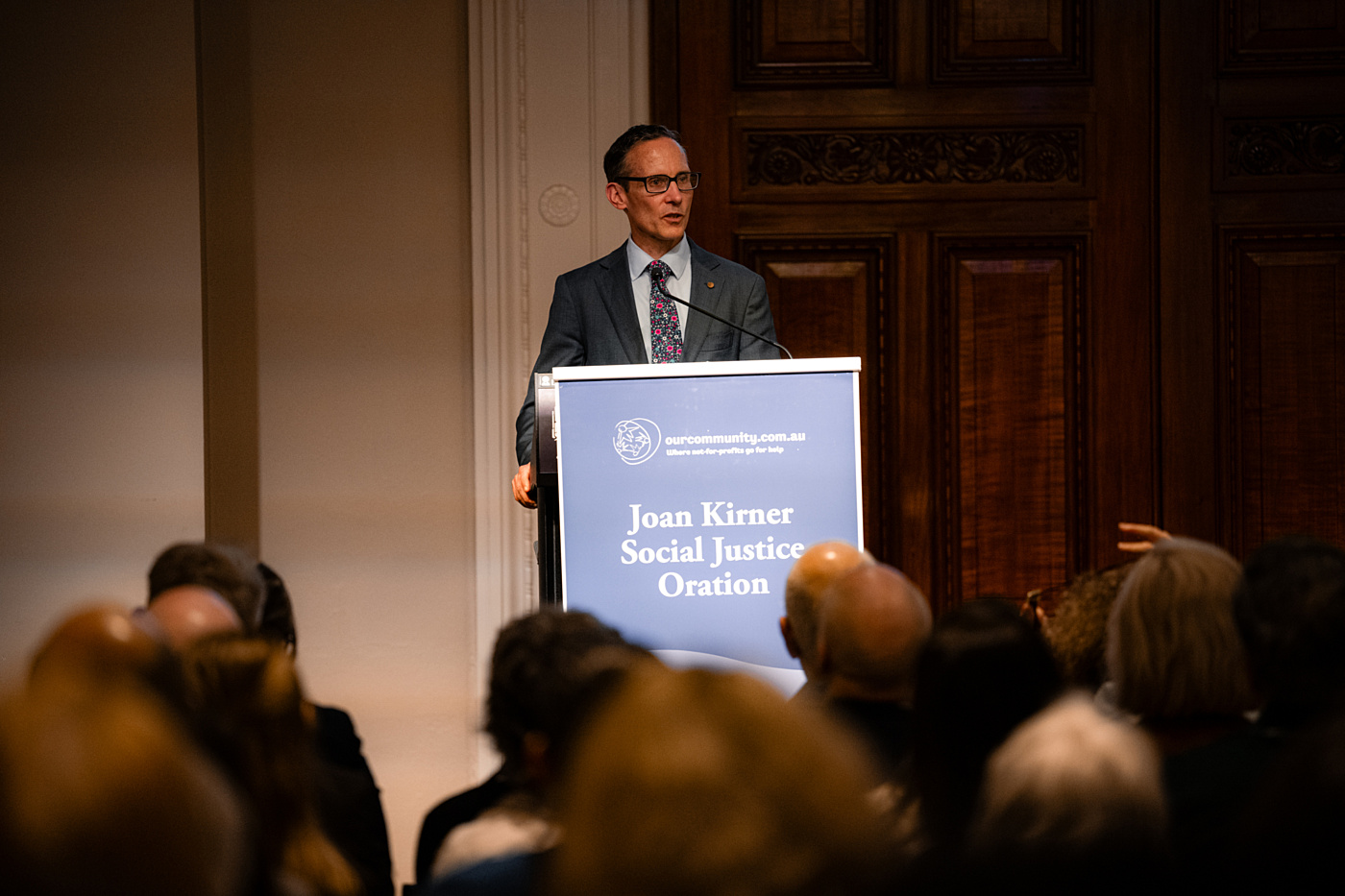
In the wake of an act of violence against federal independent MP Helen Haines, Charities Minister Dr Andrew Leigh has delivered an impassioned plea for Australians to see social media harm for what it is and to work harder, collectively, to protect democracy and one another.
The text of Leigh’s Joan Kirner Social Justice Oration, delivered in the evening of Wednesday, October 21, was written before the attack on Haines, but it centred on what is required to prevent and reject such violence.
“The Anger Machine: Rebuilding community in the age of outrage” was delivered at the State Library in Melbourne, and live streamed on YouTube.
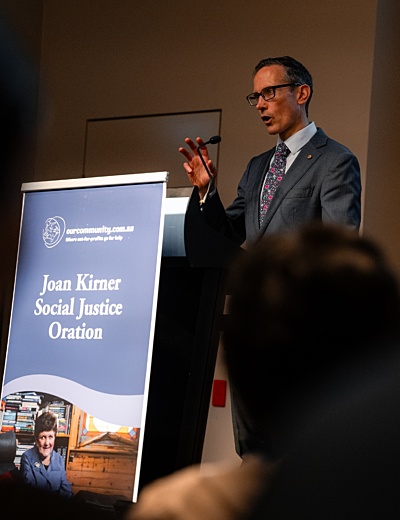
“My argument is that social media has turbocharged anger,” Leigh told the audience. “Online news is more likely to paint the world as a zero-sum contest, rather than a chance to work together. Changing that requires safer platforms and more opportunities to experience other people as neighbours, friends and fellow citizens.”
Delivered as the city of Paris burned from protests, and Haines lay in hospital, along with an alarming rise in political assassinations, physical attacks, and threats to politicians in many countries, as well as violence against religious and multicultural groups, Leigh’s speech was unflinching in drawing a line from the ruthless business model of social media companies to the rise in hate crimes.
Even before the attack on Helen Haines, Leigh pointed to the risk of violence faced by Australian politicians: the Australian Federal Police record about 1000 threats against federal politicians each year, while nine out of ten women standing for parliament report receiving online abuse or threats. Leigh said one of his female parliamentary colleagues endured 19 death threats in a single week.
“Democracy is more than free and fair elections; it also asks of us that we engage with other people,” he told the Community Directors event. “It asks that our solidarity transcends whatever dislike we have of the politics of our opponents. In gender, race relations and politics, zero-sum thinking risks taking us to a poorer, narrow future. Positive-sum thinking is the path to a future of abundance and engagement.”
Leigh’s speech attacked the harmful and deliberate evolution of social media over time, saying it has moved from a way for people to catch up on what their friends are up to, to a sophisticated algorithm-based method of exposing people to often hateful, divisive posts from strangers, designed to provoke outrage.
Drawing a distinction between anger that is directed towards finding a remedy and anger as a force aimed at making somebody suffer, Leigh argued that social media is very much designed as a destructive force.
“While righteous anger seeks to repair an injury, manufactured anger keeps finding reasons to renew outrage,” he said. “Its business depends on keeping an audience aggrieved. Many content creators coldly and deliberately craft videos designed to provoke white-hot rage. Almost as disturbing as the volume of online anger is how much of it is confected and performative.
“We know that social media companies have been exploiting the connection between anger and attention. As an internal Facebook presentation warned, ‘Our algorithms exploit the human brain’s attraction to divisiveness’.
“In the early days of social media, this wasn’t much of a problem. Feeds were largely chronological, and you only saw what your friends posted. So, if your friend posted something outrageous, you’d see it, but not much more often than you’d be exposed to an angry rant from a mate over a beer at the pub.
“Then the big online platforms began to see that they could increase viewing time – and hence advertising revenue – by showing you a selection of your friends’ posts, chosen by an algorithm trained on how other people responded. That meant that if people were more likely to like or share a particular kind of content (say, a vicious takedown), then the algorithm was more likely to put that kind of content into your feed if your friends posted it,” he said.
The final step was to move away from prioritising people you follow and instead funnel whatever was drawing the strongest reactions, which was often divisive material, he explained. “Increasingly, it doesn’t matter who you follow, because the default feed is based on what the algorithm thinks you will click on. We’ve moved from social media to antisocial media; from a platform that gave you the best of your friends’ content to one based around the worst of the internet’s content.”
“We’ve moved from social media to antisocial media; from a platform that gave you the best of your friends’ content to one based around the worst of the internet’s content.”
Leigh argued that the term “social media” is no longer fit for purpose. “It’s not a modern telephone; it’s the most addictive television we’ve ever created. What kind of content gets prioritised by a recommendation feed? Researchers have shown that moral-emotional language is particularly effective at capturing attention. For example, a post saying ‘This policy is wrong’ may attract less attention than one declaring ‘This cruel policy is a disgrace’, even if both are criticising the same decision. Words that combine a moral judgement with emotion can draw the eye. Experiments found that such words could interrupt people already concentrating on something else,” he said.
The answer to challenges to democracy, such as algorithms designed to drive people apart and see political opponents as enemies, is to re-engage in the real world, the Charities Minister said.
Drawing on the legacy of the late Joan Kirner, Victoria’s first female premier and a giant of Australian politics, Leigh observed that Kirner worked across politics and with ideological opponents for the common good.
“In 1986, she [Kirner] and Victorian Farmers Federation president Heather Mitchell helped establish Landcare in Victoria. People approaching the environment from different directions found work they could do together. They showed that people can disagree about politics while restoring the same creek.”
Leigh shared deep global research and anecdotes on how hostility to others and hardline views dissipate quickly when online exposure is limited or removed: across anti-multiculturalism, sexism and other anti-social arguments, stepping away from the social platforms has profound effects.
He used his speech to champion the work of Australia’s eSafety commissioner in holding platforms and online brands to account when it comes to running such content.
“As UK social activist Beeban Kidron puts it, ‘We are at tech’s tobacco moment,’” Leigh said. “Governments must change the conditions under which platforms operate. We can also strengthen the relationships that make it more attractive to stop scrolling.”
The alternatives, for a healthy, positive view of the world, are engagement with real issues among real people, including volunteering, donating and becoming involved in communities, he said.
“Friendship can also help to tamp down anger. A friend’s foolish opinion sits alongside everything else we know about them. A stranger’s foolish post can become all we know. Protecting friendships gives us practice in seeing a whole person, and in remaining connected through disagreement.
“Switching off our devices can help us reconnect with one another. Go out to dinner with a friend, and agree that the first person to touch their phone pays the bill. Start a book club where the reading is optional, but the conversation is compulsory. Invite friends over for a potluck dinner, with everyone bringing a dish and a stranger. Organise a summer get-together on your street.”
Such a coming together and willingness to reengage with those who may have different views, opinions or even cultures is the way forward, according to Leigh.
“Our democracy and our society require us to find what we have in common and build on it,” he said. “Multiculturalism isn’t just about multiple groups, but how we interact together. As my colleague Tony Burke puts it, a successful multicultural society resembles an orchestra: each instrument has its own distinctive sound, but together they produce music that none could make alone.”
To watch the oration, as it was delivered by Dr Andrew Leigh, click here.
Watch or listen to past orations here
The Joan Kirner Social Justice Oration is an initiative of the Institute of Community Directors Australia, publisher of the Community Advocate. The oration has been held each year as a living legacy of the late Joan Kirner, Victoria’s first female premier and a champion of social inclusion, women’s equality, the environment and the community.
Charities Minister Dr Andrew Leigh is well versed in the complex challenges facing the not-for-profit sector. The former ANU economics professor has written books on inequality, innovation, economics, politics, sport and the future.
Most notably, his book Reconnected: A community builder’s handbook examines how technology can be used to build community, not divide it. In it, Leigh calls on every volunteer, donor, policymaker and charity leader to help create a more connected society, and lays out some of the tools to do that.
Leigh continues to explore community initiatives such as conversation groups, community gardens, park-run groups and pub choirs to see what works best in building community.
Posted on 05 Nov 2026
Mapping Social Cohesion 2026, published today, has found that 48 per cent of Australian adults are…

Posted on 04 Nov 2026
Leading lawyer and anti-racism advocate Mariam Veiszadeh has told a Human Rights Commission…

Posted on 04 Nov 2026
A leading advocate and service provider for new arrivals in Australia has urged the nation’s…

Posted on 04 Nov 2026
As the Scanlon Foundation Research Institute prepared to release its annual social cohesion report…
Posted on 28 Oct 2026
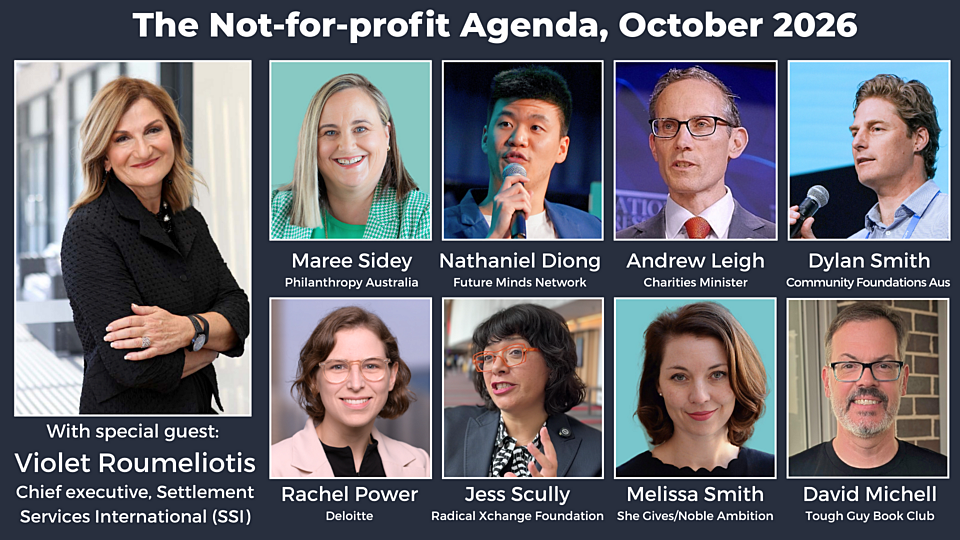
Violet Roumeliotis, the chief executive of Australia’s biggest migrant support organisation, will…

Posted on 21 Oct 2026
Backed by tangible successes and government support, community foundations are gaining momentum as…
Posted on 21 Oct 2026
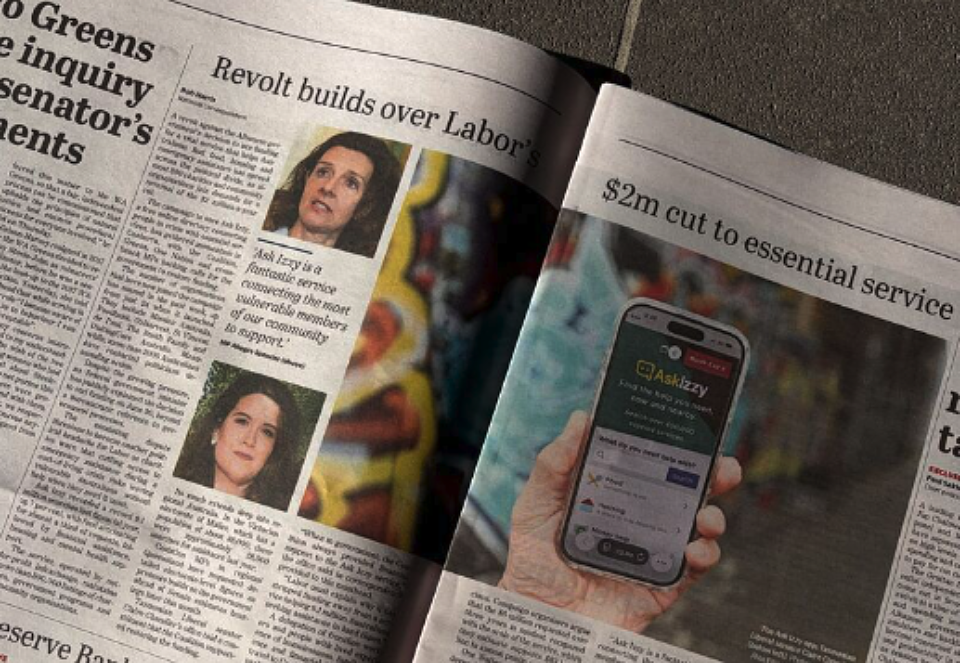
A national campaign to restore federal funding for Ask Izzy has attracted such strong grassroots…

Posted on 21 Oct 2026
If your charity takes a stance that happens to align with a political party’s stance in a public…

Posted on 14 Oct 2026
The federal government’s special envoy for social housing and homelessness, Josh Burns MP, has…

Posted on 14 Oct 2026
The Reserve Bank’s move to ban card payment surcharges has led to complications for charities and…

Posted on 07 Oct 2026
A major public campaign launched this morning is calling on the federal government to restore…

Posted on 07 Oct 2026
The Australian Literacy & Numeracy Foundation (ALNF) has announced a partnership with mining…