
Human rights advocate urges Australia to adopt National Anti-Racism Framework to drive social cohesion
Posted on 04 Nov 2026
Leading lawyer and anti-racism advocate Mariam Veiszadeh has told a Human Rights Commission…
Posted on 04 Nov 2026
By Matthew Schulz, journalist, Community Directors

A leading advocate and service provider for new arrivals in Australia has urged the nation’s not-for-profits to back a push for a national migration summit.
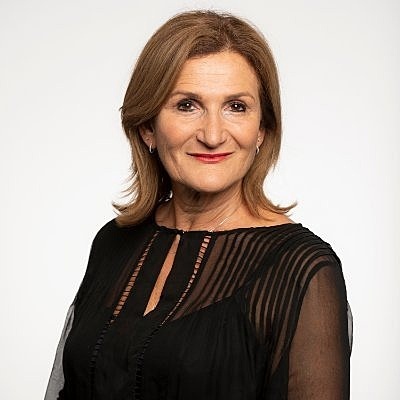
Speaking on the Not-for-profit Agenda last week, Settlement Services International (SSI) chief executive Violet Roumeliotis said the current migration debates were missing the point.
“I think we’re having a debate that is too narrow, short-term and politically driven,” Roumeliotis said.
“I think we’ve become fixated on a single number, the famous NOM, or Net Overseas Migration, where the bigger question should be about what we want the migration system to achieve for Australia”.
She said past reviews had offered guidance and recommendations – the 2023 Parkinson Review, for example, had found the current migration program was “not fit for purpose”.
Roumeliotis said a national summit should be sensible, evidence-based and respectful, and she also acknowledged that “the pressures Australians are experiencing, we know, are real”.
“Housing affordability and instability, infrastructure constraints because of skill shortages, and cost-of-living pressures are legitimate concerns that do deserve serious responses from government. But simply cutting migration won’t fix our housing shortage. It won’t build infrastructure: we won’t get one new house built or address the underlying causes of these challenges. We need to shift from short-term political fixes to long-term national strategy,” she said.
In response to claims that reductions to migration would protect Australia’s culture, Roumeliotis pointed out that the nation’s post-settlement culture was founded on multiculturalism, including nearly a million humanitarian entrants since WWII.
“My parents themselves arrived as migrants of their generation, full of ability and aspiration and a fierce determination to contribute,” she said.
“So we had different waves, different communities, and each time people said, ‘These people don't fit in, they’re not part of Australia,' but they’ve integrated and they’ve maintained elements of their culture that many of us enjoy.”
She argued that “research tells us that migrants, refugees, once they come, whether they’re Anglo-Irish, Celtic backgrounds, from the Pacific Islands, or anywhere that they come from, they contribute, and we’re the better for it.”
She said any summit would need to address economic and workforce needs, regional development, which had an oversized role to play in migration, demographic change including ageing, and the impact on social cohesion.
The population, she said, should be able to have greater confidence in the migration system.
An essential area of related work for SSI was in promoting greater social cohesion, she said, especially in the wake of the Bondi terror attack and concerns about politically motivated violence. SSI made submissions to the Royal Commission into Antisemitism and Social Cohesion, highlighting not-for-profits' vital role in strengthening communities.
Roumeliotis told the Not-for-profit Agenda, “Social cohesion is about more than peaceful coexistence."
“It’s about belonging, collective belonging, and it’s about participation. And it’s about whether people feel that they are part of Australia’s story, that their voices matter, and that they have a genuine and equal opportunity to participate in our economic, social, civic, and cultural life. It’s not simply enough for people to live alongside one another. We need to create the conditions for everyone to contribute and thrive.”
She said she was proud to have seen across Australia “neighbourhoods of diversity and people living side by side and curious about each other, not fearful, because our leadership has spoken in a way that encourages that”.
Not-for-profits had a critical role to play in promoting great social cohesion, she said, “because social cohesion is built from the ground up, and we [NFPs] have deep connections with communities that are often uniquely placed to bring people together across differences, amplify their voices that might otherwise go unheard, which is a huge issue, and break down barriers to participation”.
She said society must shift “from crisis response to prevention”, instead of acting only “when tensions escalate”.
“The message SSI took to the Royal Commission was that social cohesion requires sustained investment in the institutions, relationships, and opportunities that help people feel safe, included, and that they belong.”
This could include “giving communities a genuine voice in the decisions that affect them”, and she said SSI had proposed a national advisory council with a direct line to the Prime Minister.
“SSI and many of our organisations that we work closely with are calling for local listening roundtables with diaspora, faith, and community groups, particularly those whose voices are too often missing from national conversations, in the local areas, inviting local members, local governments, and others to come and listen.”
“Sometimes I think some of our politicians wake up and think, ‘What can I say today to divide people and make them feel scared or fearful’?”
She said NFPs could “reach out to your local organisations and collaborators and politicians and talk about how you can … bring people together”.
She cited a recent example of one local council that hosted a “barbecue for peace and for multiculturalism” that attracted thousands, but she said there were many opportunities to create cultural exchange and “simple and lovely dialogue and conversations”.
Such events would be valuable in the coming months, she said, “because I think we’re going into a really difficult time”.
“Sometimes I think some of our politicians wake up and think, ‘What can I say today to divide people and make them feel scared or fearful’?”
“We want our politicians to wake up and say, ‘What can I say to Australians that’s going to make them feel better?’ I think the things that they could say is, you know, we’ve got a common vision and goal. We’re a lucky country, let’s make the most of that. Let’s talk about what we’ve got in common. Come together at your local neighbourhoods and have fun. Things are tough but also find time to enjoy each other’s company.”
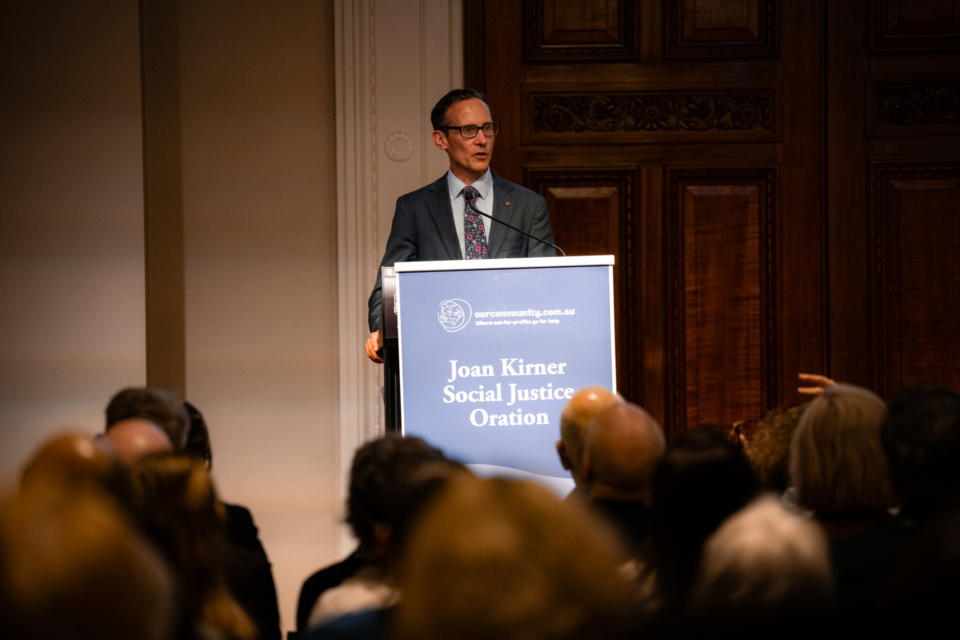
Revisiting key points from her oration at the recent Amplify Alliance national NFP summit, Roumeliotis said a weakness of not-for-profits was their tendency to be too humble in their dealings with government and funders,
“I think that we are really fierce advocates for the people and communities we serve, but often much less comfortable advocating for ourselves, for our organisations, our workforces and our constituencies,” she said.
She said that created a trap for organisations, in which “government has become accustomed to not-for-profits stretching further, absorbing more risk, finding another efficiency, and continuing to deliver, even when the arrangements are not sustainable”.
“Our willingness to make broken systems work cannot become the reason those systems never get fixed,” Roumeliotis said.
Instead, organisations should “stand firm” and seek to shape those systems.
“Yes, we are service providers … but not-for-profits see firsthand where policies work, where they fail, and where they create barriers, and we see it in real time. We should use that expertise to help shape policy, rather than just seeing ourselves simply as delivery partners.”
She said organisations working together were in a good position to develop that “collective power” and to take advantage of their position as trusted organisations that “understand how policy lands in people’s lives”.
Roumeliotis argued that NFPs should not always accept being co-opted to act by government “after decisions have been made”, but should demand a greater say in those decisions.
She said organisations needed greater confidence to call out funders for failing to invest in the true cost of services.
“We are in a time of polycrisis. We have change galore. We need to have the resources to keep our workforce robust and confident that they have the skills they need. We need technology … and we need to stay grounded in community. That is our greatest strength.
“That lived experience should inform not only how we deliver our services, but how we actually advocate solutions to government.
“Genuine consultation means being prepared to change the decision. If there’s no opportunity to influence the outcome, it is not consultation or co-design.”
She accepted that some NFP leaders and CEOs might be nervous about standing up to funders.
“Even my own board grapples with that, on constructive advocacy, and how much, and how little,” she said. “I know it’s something that a lot of boards worry about. But we frame it in the context that you don’t need to treat government as an enemy. Strong relationships should be able to accommodate respect for disagreement.
“Leaders can challenge a policy while remaining evidence-based,” she said.
“You don’t just raise a problem, you talk about solutions, and [be] willing to work in partnership, collaborate with others, and bring something to government [that will] be a good outcome. It’s a win-win for everybody.
“Because ultimately, not-for-profit leaders, our boards, our executive, and our workers at the coalface need to ask what their purpose requires of them. If the organisations closest to communities are unwilling to contribute their expertise to difficult debates, important perspectives can be missing when decisions are made.
“Good governance is not just about managing our risk and compliance. Good governance is also about running a responsible and sustainable organisation that … is a means to an end. We have a mission, and that’s what we’re there to do. We’re there to say, ‘This is working, this isn’t, and this is what we need to do.'”
Hear more of what Roumeliotis had to say on the Not-for-profit Agenda
SSI’s campaign for a national migration summit
Balancing tradition and progress: Radical moderation in faith and cultural groups
NFP leader calls time on ‘master–servant’ relationship with funders
Posted on 04 Nov 2026
Leading lawyer and anti-racism advocate Mariam Veiszadeh has told a Human Rights Commission…

Posted on 04 Nov 2026
As the Scanlon Foundation Research Institute prepared to release its annual social cohesion report…
Posted on 28 Oct 2026
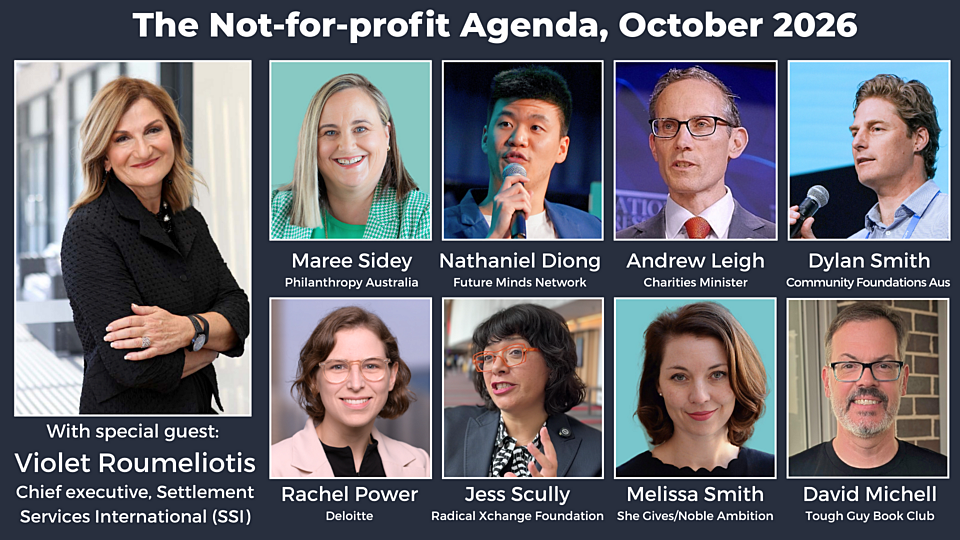
Violet Roumeliotis, the chief executive of Australia’s biggest migrant support organisation, will…
Posted on 21 Oct 2026
Backed by tangible successes and government support, community foundations are gaining momentum as…
Posted on 21 Oct 2026
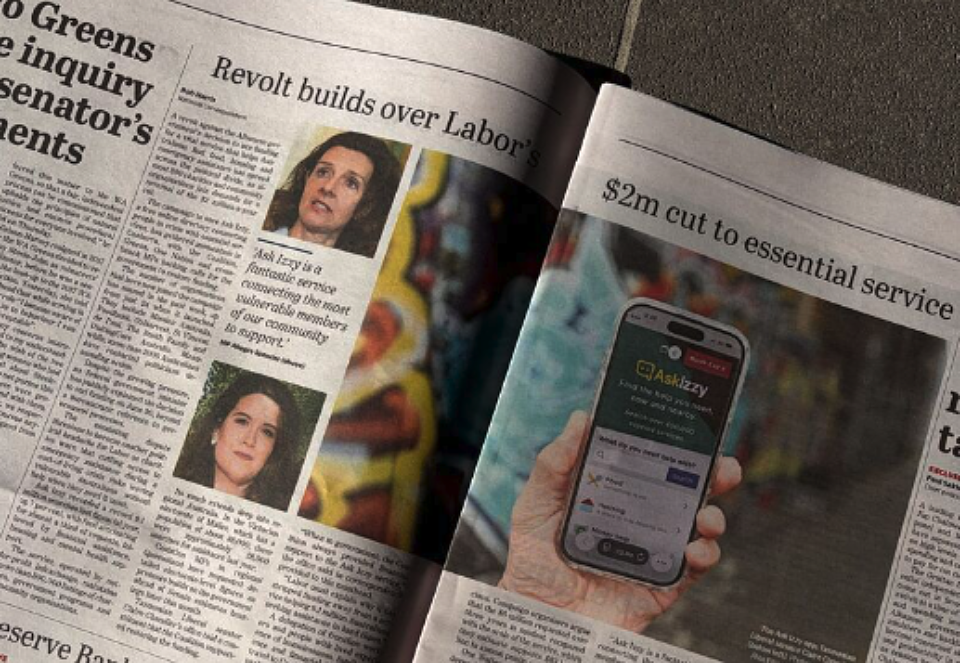
A national campaign to restore federal funding for Ask Izzy has attracted such strong grassroots…
Posted on 21 Oct 2026
In the wake of an act of violence against federal independent MP Helen Haines, Charities Minister…

Posted on 21 Oct 2026
If your charity takes a stance that happens to align with a political party’s stance in a public…

Posted on 14 Oct 2026
The federal government’s special envoy for social housing and homelessness, Josh Burns MP, has…

Posted on 14 Oct 2026
The Reserve Bank’s move to ban card payment surcharges has led to complications for charities and…

Posted on 07 Oct 2026
A major public campaign launched this morning is calling on the federal government to restore…

Posted on 07 Oct 2026
The Australian Literacy & Numeracy Foundation (ALNF) has announced a partnership with mining…
Posted on 07 Oct 2026
A conference in Darwin will this morning hear detailed, strategic plans for how Australia could…