
‘The mind boggles’: federal envoy blasts NT housing decision
Posted on 14 Oct 2026
The federal government’s special envoy for social housing and homelessness, Josh Burns MP, has…
Posted on 11 Nov 2025
By Nick Place, journalist, Community Directors
A new Understanding, Measurement, Evaluation and Learning (UMEL) digital platform that allows Indigenous Australian communities, organisations and charities to retain control of their sovereign data is enjoying a strong uptake.
Wathaga is the creation of Kowa Collaboration, an innovative and highly successful organisation offering UMEL advisory services, training, and a charity arm, all devoted to putting the power of sovereign data and evaluation into the hands of First Nations communities.
Kowa CEO Dr Skye Trudgett, a Gamilaroi woman, said Wathaga was a necessary invention because a lack of data sovereignty had been problematic within UMEL work for First Nations peoples, historically having led to worse outcomes for Indigenous Australians.
“People were finding themselves with protocols for data sovereignty but still using Microsoft or still using white organisations, who they were paying to come and do work,” Trudgett said. “We built Wathaga, which is a digital platform, for community to be able to collect their own evidence, store it, analyse it, control who sees it, tell their own story with it. It’s a full end-to-end UMEL platform and it’s grounded in Indigenous data sovereignty and governance. It’s Aboriginal-owned, Aboriginal-designed for communities and there’s the free offering there for those communities who are on a shoestring and just doing some of those light touch kind of pieces of work.
“It’s the proudest thing I think we’ve ever been able to really deliver. I feel like I could almost say my job is done now,” she said.
Trudgett said large organisations that provide data collection services are typically priced for use by government departments, not small Indigenous communities, which can be hamstrung by being forced to embrace whatever platform a funder has already chosen.
“None of these are UMEL platforms,” Trudgett said. “A lot are just data, and one of the things that we’re saying is that data without UMEL is just surveillance, and what’s actually being commissioned are tools for further surveillance and further oppression and marginalisation of community.
“It’s not supporting communities to stand up and own their data, explore their data, be able to generate narrative and story about the difference and the change they’re making. They’re just kind of being required to subscribe to quantitative-based or government data sets.”
Receiving funding from a philanthropic organisation or other financial source often comes with intense reporting demands for Indigenous communities, even down to being required to produce a theory of change.
“We’re really keen to explore how communities can have their own theory of change, collect their own evidence and acquit against grants using the knowledge that is sovereign to them,” Trudgett said.
“Communities are already gathering evidence, but it’s the translation piece, of: Okay, your photos, your videos, that conversation that you had, that collective feeling that you get when you walk into spaces or places or moments in time, that you now need to convert to a spreadsheet, convert that to an acquittal form. The richness and the truth-telling becomes lost and moved.
“What Wathaga does is allow you to have all of that evidence in its sovereign form, in its raw state, and it will support analysis of any single product of data. You can do that against a theory of change, so if you have one, that’s awesome. If you don’t, you can create it through outcomes harvesting in the platform.”
“Evaluative practice is actually grounded in all of our history and all aspects of Aboriginal and Torres Strait Islander life since time immemorial. If we think about cultural burning, if we think about ceremony, we think about times to travel; all of these things come from evaluative thinking and practice decisions.”
Launched at the start of September, a free version of the new platform has already attracted more than 150 registrations, while several Indigenous communities and a major Indigenous partnerships facilitator, Ninti One, have embraced the paid version.
Kowa Collaboration is constantly exploring better ways for Indigenous communities to control their data and information, such as training AI to translate Aboriginal dialects and to perform early-stage analysis of information sources, which can then be “sense checked” by communities.
Another part of Kowa’s work will be to attempt to educate and influence foundations and funders to move away from demanding “a 50-page polished report”. Instead, Kowa wants them to be willing to hear the truth from community, delivered in a way the community is comfortable with. “Communities get caught in this liminal space where it’s like, okay, collect all your data, you’re really good at this, you can do it, and then if the funder says, oh, that’s not what I wanted, I wanted this other thing, well that’s a real problem,” she said.
Wathaga is ultimately designed to have separate public-facing and internal capacities. “Communities and organisations can do all their evaluation and develop their reports and keep it internal, but they can also make some of it external, so they could push six or seven different funders to one external report to conduct their acquittal. I think that’s where we can work together to be able to influence that kind of way of working from funders,” she said.
For some Indigenous Australians, data is a weapon, something that has been used to justify making First Nations peoples’ lives worse for 255 years. Under these circumstances, supplying data to governments, corporations or charities can be problematic. Trudgett told the Community Advocate that quantitative data sets are associated with racist and oppressive systems, as well as a cultural disconnect over what constitutes good data.
First Nations people consider themselves to have been mastering data analysis forever, since long before colonisation, she said. “Evaluative practice is actually grounded in all of our history and all aspects of Aboriginal and Torres Strait Islander life since time immemorial. If we think about cultural burning, if we think about ceremony, we think about times to travel; all of these things come from evaluative thinking and practice decisions that are made based on the seasons.”
“Indigenous data, in its wholeness, is anything that comes from, is about, or affects Aboriginal and Torres Strait Islander people,” she said. “This is literally most things around us, and it can be history, it can be country, it can be story, so many things. But we discredit the majority of Indigenous data as not robust, and we see that what gets put forward as robust evidence is generally quantitative data sets that come from government or others.”
https://www.kowacollaboration.com/wathaga
For more on Kowa Collective, check out the Community Directors Intelligence
Posted on 14 Oct 2026
The federal government’s special envoy for social housing and homelessness, Josh Burns MP, has…

Posted on 14 Oct 2026
The Reserve Bank’s move to ban card payment surcharges has led to complications for charities and…
Posted on 14 Oct 2026
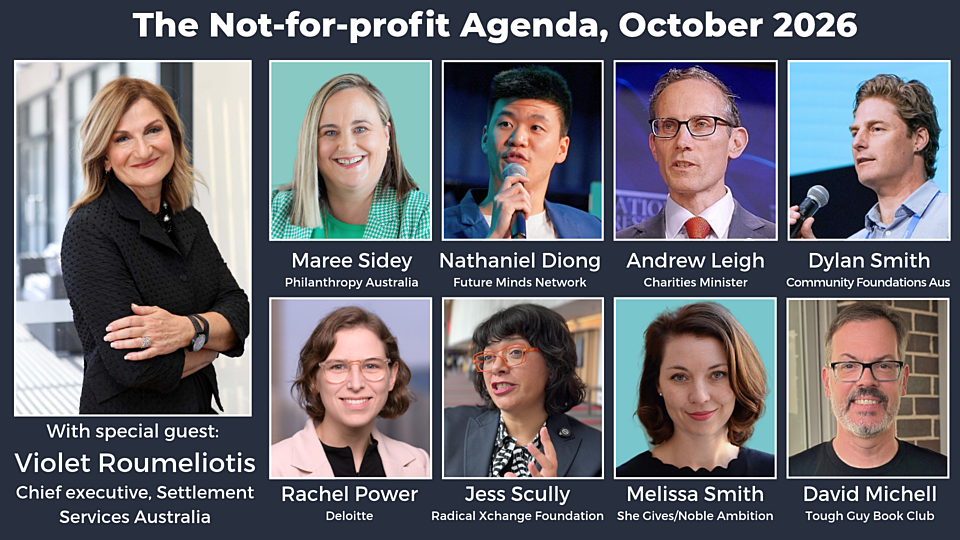
A special guest with her finger on the pulse of one of the biggest issues facing Australia –…
Posted on 07 Oct 2026
A major public campaign launched this morning is calling on the federal government to restore…
Posted on 07 Oct 2026
The Australian Literacy & Numeracy Foundation (ALNF) has announced a partnership with mining…

Posted on 07 Oct 2026
A conference in Darwin will this morning hear detailed, strategic plans for how Australia could…

Posted on 30 Sep 2026
Not-for-profit leaders have been warned to be wary of approaches from potential “funding partners”…
Posted on 30 Sep 2026
More than 200 fully funded Centre for Social Impact (CSI) scholarships will help equip for-purpose…

Posted on 30 Sep 2026
Personal stories are among the most powerful tools a charity can have to raise funds and awareness,…
Posted on 23 Sep 2026
A just-released major global survey of charities has found that demand for charity assistance has…
Posted on 23 Sep 2026
Fresh from welcoming delegates to last week’s Philanthropy Australia conference in Brisbane,…

Posted on 23 Sep 2026
A national strategy to develop Australia's regional cities is needed to break the housing…