
Don’t say nothing: why privacy is so important
Posted on 15 Oct 2026
Community Directors has a warehouse-style office filled with artworks, and if I glance up towards…
Posted on 15 Oct 2025
By Adele Stowe-Lindner

The Institute of Community Directors Australia team sits physically and figuratively between two kinds of businesses: SmartyGrants, which works with funders, and the Funding Centre and GiveNow, which work with NFPs seeking funding.
This means that we have the great benefit of eating lunch daily with colleagues from both worlds, which keeps us in touch with the issues they’re dealing with and the changing priorities they navigate.
That’s one of the benefits of sharing an office with fellow businesses under the Our Community brand: we can share stories and insights, and ask one another questions, in the in-between spaces of the working day without needing formal meetings. Ultimately, our very different teams all have the same aim: to create positive change for people and the planet.
The funding landscape is shifting fast.
Donors’ expectations of the way their money will be used and funders’ expectations of the results are always evolving. And over it all, AI poses dilemmas for everybody. The position of the Institute of Community Directors Australia in this landscape is endlessly fascinating to me.
"The need for diversification of funding sources means that board members must understand the funding strategy of the organisation they serve in order to make responsible decisions."

Working with the entire NFP ecosystem, from funders to recipients, donors, partner organisations and every other stakeholder, means that when people talk of artificial intelligence and grant writing, we hear all angles. For example, we hear from funders that they want to hear the authentic voice of each applicant and the nuances of their story, not jargon–heavy, generic, auto-generated form responses.
But does that mean AI should be banished entirely, or can we find the sweet spot where AI enhances grant applications and levels the playing field for organisations that don’t boast a grant-writing poet in their midst? Can we use AI as a collaborator, rather than being forced to choose between typewriters and robots?
Just as boards must be strategic about who they will accept money from, funders too must decide: when we receive imperfect applications, will we prioritise authenticity of voice, or clarity and completeness of information? Funding applicants, ask yourself: does this tool help us amplify our voice in pursuit of our mission, or do we risk muffling it? In short, AI should support your organisation’s strategy, not become a strategy in its own right.
Community Directors’ partner law firm, Maddocks, recently hosted a webinar with us to guide organisations making the tough decision to wind up. In that session, and in other conversations, they confirmed what we’ve also heard anecdotally – that funding is tough and the number of mergers and acquisitions in the charity sector is increasing.
Other organisations are exploring strategic mergers or shared services in response to crisis, but as a proactive way to increase effectiveness and reduce duplication. As a board, have you considered whether a partnership could help make your organisation more resilient?
Many organisations remain exposed to fluctuations in government funding, grant cycles, cost inflation and rising overheads. Others find that funding priorities have shifted substantially in their sector, so while the landscape is difficult for some organisations, others are in their heyday. Wherever you find yourself as a board director, it’s clear than strategic consideration of funding is critical.
The pressures on organisations to refuse funding from certain sources is considerable and can result from ethical concerns, reputational or branding pressures, public pressure or political sensitivity.
This means funding opportunities for some boards have shrunk. Equally, the funding priorities of donors change. According to McCrindle’s 2024 Empowering Impact report, donors are increasingly favouring causes or movements over institutions. This has been referred to as “issue-first giving” to differentiate it from long-term institution-based philanthropy. This affects the operations of organisations that once relied on the loyalty of individual donors.
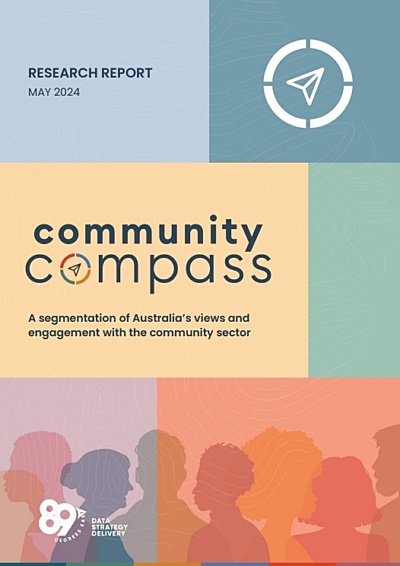
The McCrindle findings complement those of the Community Compass study commissioned by Community Directors, which shows significant differences in the way the nation perceives the community sector, with major implications for the way leaders engage with different attitudinal groups. This affects how organisations which once relied on individual donors and their loyalty, are needing to operate.
An inspiring example of an organisation that made a strategic choice at board level to review its funding and make brave and sweeping changes is that of ChildFund, whose mission is children’s rights and the alleviation of poverty. The board appointed Margaret Sheehan as CEO to lead the organisation away from its child sponsorship funding model and towards a model based on empowerment over pity, and it did so at a time of reduced funding and an increase in the cost of living. I listened intently as Sheehan and their chief development officer Corinne Habel spoke about this at the recent Third Sector Leaders Forum in Sydney last month. Seeing the alignment and solidarity between executive and non-executive leadership made clear the reason for the success of this transformation.
Diversifying funding sources is worth considering for many reasons. One of them is the looming spectre of outcomes-based funding, whereby an organisation is paid only after delivering measurable results. Some of the functions delivered by NFPs are more or less measurable than others, but none of them accounts for overheads, which must be paid for on top. To have the capacity to experiment and innovate, organisations must have flexible funding sources. Many NFPs are not yet set up for this type of funding. As a director, you should be asking: do we have the capacity (systems, staff, data) to monitor, evaluate and report robustly, and can we align our own metrics with funder priorities without losing strategic control?
Professional fundraisers know what accidental fundraisers (CEOs, board members, treasurers, secretaries, parents with kids who play sports) must quickly find out: ultimately, funding is not just about chasing the next dollar. It has always been about understanding the dynamics of where the money comes from, why it’s given, and what it asks of us in return. Those dynamics are shifting more quickly now than they have done for the past decade, as a result of AI, the difficult economy, social polarisation and the intersection of these three pressures, so it is important that directors keep up. For board directors, the most important question remains: what kind of organisation are you building, and does your funding strategy support it with integrity?
Funding acquisition is a topic many board members would prefer to duck away from. It’s hard and it sometimes feels cringy.
But the need for diversification of funding sources (and, often, a lack of paid staff to do the fundraising work) means that board members must understand the funding strategy of the organisation they serve in order to make responsible decisions.
Board members can easily cause chaos by using AI to write grant applications against organisational policy, by pushing for funding abstentions from funders they don’t like to the detriment of key programs, or by falling asleep during strategic conversations about what funders need. Alternatively, they can have lunch with the right people, keep their ears to the ground, and keep their eyes on the prize at board meetings. It’s this second set of techniques that will see the organisation flourish.
Posted on 15 Oct 2026
Community Directors has a warehouse-style office filled with artworks, and if I glance up towards…

Posted on 17 Sep 2026
My father often googles my name, and as a result, years ago, I received a surprising gift in the…

Posted on 13 Aug 2026
As a teenager, I attended summer camp for seven years, first spending two weeks at a time camping…

Posted on 22 Jul 2026
I spoke at the Social Impact Summit in Sydney this month on a topic that has been sitting with me…

Posted on 10 Jun 2026
There’s a line of thought about AI in the not-for-profit sector that goes something like this: “We…

Posted on 18 May 2026
Like your favourite T-shirt or the song you listen to when you’re feeling low, your organisation’s…

Posted on 15 Apr 2026
Lately I’ve been spending a lot of time in interview rooms.

Posted on 12 Mar 2026
I sat in a room with 1200 people at a fundraising event a few weeks ago, dressed nicely, feeling…

Posted on 10 Feb 2026
As my family dropped our teenage son off at the airport in the first week of January to embark on a…

Posted on 10 Dec 2025
The Institute of Community Directors Australia trains over 22,000 people each year, which gives us…

Posted on 12 Nov 2025
At the Institute of Community Directors Australia, we believe that stronger communities make a…
Posted on 11 Nov 2025
‘It’s not a question of enough, pal. It’s a zero-sum game. Somebody wins and somebody loses’.