
Don’t say nothing: why privacy is so important
Posted on 15 Oct 2026
Community Directors has a warehouse-style office filled with artworks, and if I glance up towards…
Posted on 12 Nov 2025
By Adele Stowe-Lindner

At the Institute of Community Directors Australia, we believe that stronger communities make a stronger Australia.
To that end, we have been exploring what happens when good people stop shouting from the sidelines and listen harder in the middle; when we choose language that aids connection and understanding.
That exploration became The Radical Moderate, a collection of 20 essays that ask how courage, listening, evidence, empathy and nuance can co-exist in leadership, journalism, education, aid and beyond, and how they can produce sustainable social change.
By “radical moderation” the contributors do not mean standing still. They conceive of the centre or of pluralism not as a safe or neutral middle ground but as a place of connection – where change is driven by inclusion and purpose, not division or blame. Similarly, those who explore civic discourse invite disagreement without cruelty. Civic discourse takes stamina because it takes time, the willingness to listen, learn, and hold tension. Those who seek a different way of thinking in journalism, for example, break from the clickbait economy of despair and seek a balance between exposing problems and exploring solutions.
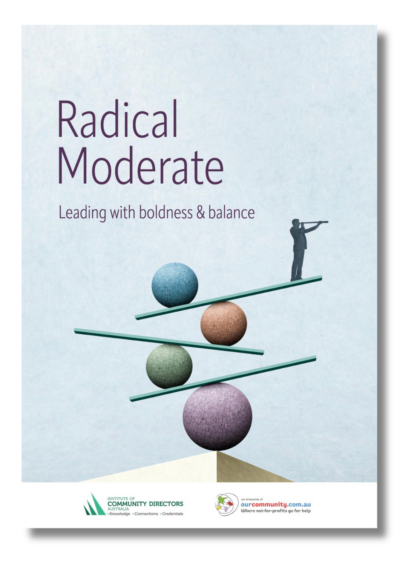
Never in my lifetime have I heard as much chat about polarisation and the idea of what the centre can represent as I have in the past few years. In Australia we have witnessed our own social divide over the issue of the Voice to Parliament. We have also seen gender, climate and conflicts in Ukraine and the Middle East become polarising topics. The issues move in and out of the spotlight, but over the past few years, many of us have become accustomed to jumping straight from what we believe or value to what we think the solution is, without discussing the in-between.
Concern about polarisation pops up everywhere, from park picnics to workplace lunches and even intergenerational dinner table discussions about taxes, whether it’s inheritance taxes, negatively geared property or marginal tax rates, and their effects on societal inequality.
Speaking of taxes, staff from the Australian Taxation Office contacted me recently to talk about social cohesion. They wanted to know whether I thought Australia today is less socially cohesive than it was in the past because young people care more about social issues today.
"The Radical Moderate argues that the centre does not ask anyone to abandon their values or identity – you can be left of centre, right of centre, up or down, in the bullseye or on the edges."
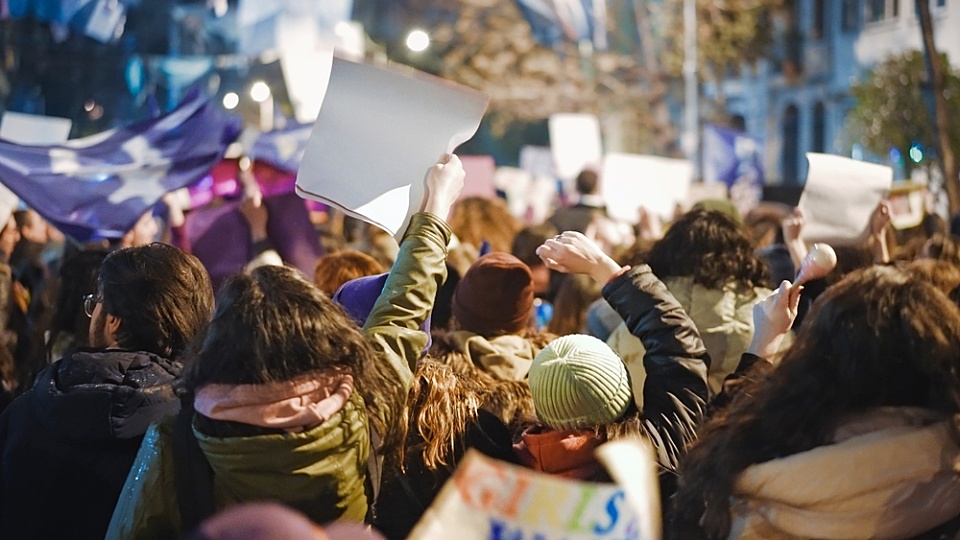
I remember being a young child sitting on my parents’ shoulders in a huge nuclear disarmament march in the mid-1980s. I also recall seeing photos of marches against conscription and the Vietnam War decades earlier. I had a pet rabbit named Gough in honour of the prime minister who was dismissed by the governor general in 1975 – the event has its 50th anniversary this month, and it’s still remembered for the great social and generational division it caused at the time.
So, though I have a lot of hope thanks to today’s youth (after all, they are my children), and I recognise that they care greatly about society, I do not grant them the medal for Most Caring Generation. They are indeed caring, as they should be – but no medals for doing the right thing!
At the same time, I do not blame young people for a decline in social cohesion. They do not carry that burden alone. It takes work by all of us to drive ourselves apart, to make others feel attacked, defensive, their values undermined, their beliefs discounted.
Similarly, it will take work by all of us to behave in ways that create cohesion. Blaming social media for all our problems tends to be code for blaming young people. But adults, including Boomer-generation adults, are glued to their phones too, and maybe need even more protection from AI slop.
Don’t get me wrong, social media plays its part in creating and stoking division. We all need to think criticially about who we want to be and whose approval we seek. We can choose to look and listen beyond our own immediate environments and apply ourselves to learning.
The Radical Moderate argues that the centre does not ask anyone to abandon their values or identity – you can be left of centre, right of centre, up or down, in the bullseye or on the edges. The centre moves as our society does. In fact, we can move it. The centre is an ambition, and not a new one – Yeats wrote about it in 1918. “Things fall apart; the centre cannot hold”.
The edges are populated with accusations, punishments, bias and social pressure used to categorise ideas and people into this or that. The centre is populated by those who try to remove barricades, reduce diatribes, and decrease binary thinking. It can be painful and exhilarating all at once.
Each writer who courageously contributed to The Radical Moderate may have put their head above the parapet in their own tribe. This shows inspiring leadership and it should be acknowledged as such. Among these essays you will find more hope than cynicism and more nuance than black-and-white. They are clear and confusing all at once.
At the back of the book, you’ll find a toolkit to help bring radical moderate ideas to life in boardrooms and executive meetings. It includes advice on making decisions based on evidence, a guide for chairs on facilitating fair discussions, a checklist on thoughtful media engagement, ways to keep meetings calm and constructive, ideas for separating values from solutions, and a guide to radical moderate language that encourages more conversation and less outrage.
Radical moderation represents both a centrist approach, grounded in balance and evidence, and also a civic discourse, grounded in listening, respect and dialogue. Radical moderation holds with it the promise of hope, change, possibility, inclusivity, creativity, respect, humanity, listening, visibility, reality, nuance and complexity. The 20 writers have brought these promises to life.
This labour of love has taken the Community Directors team many months to create and I look forward to working with many more radical moderates in our community in the future.
Posted on 15 Oct 2026
Community Directors has a warehouse-style office filled with artworks, and if I glance up towards…
Posted on 17 Sep 2026
My father often googles my name, and as a result, years ago, I received a surprising gift in the…
Posted on 13 Aug 2026
As a teenager, I attended summer camp for seven years, first spending two weeks at a time camping…

Posted on 22 Jul 2026
I spoke at the Social Impact Summit in Sydney this month on a topic that has been sitting with me…

Posted on 10 Jun 2026
There’s a line of thought about AI in the not-for-profit sector that goes something like this: “We…
Posted on 18 May 2026
Like your favourite T-shirt or the song you listen to when you’re feeling low, your organisation’s…
Posted on 15 Apr 2026
Lately I’ve been spending a lot of time in interview rooms.

Posted on 12 Mar 2026
I sat in a room with 1200 people at a fundraising event a few weeks ago, dressed nicely, feeling…
Posted on 10 Feb 2026
As my family dropped our teenage son off at the airport in the first week of January to embark on a…

Posted on 10 Dec 2025
The Institute of Community Directors Australia trains over 22,000 people each year, which gives us…
Posted on 11 Nov 2025
‘It’s not a question of enough, pal. It’s a zero-sum game. Somebody wins and somebody loses’.

Posted on 15 Oct 2025
The Institute of Community Directors Australia team sits physically and figuratively between two…