
Save Izzy: campaign calls on government to restore funding for vital services directory
Posted on 07 Oct 2026
A major public campaign launched this morning is calling on the federal government to restore…
Posted on 26 Nov 2025
By Nick Place, journalist, Community Directors

A major new report says a cohesive, national, all-governments strategy is required to ensure better life outcomes for children and young people who are falling through the gaps in support, care and education.
The State of Australia’s Children 2025 (SOAC25), released Monday, found that while Australia has all the economic, social and political conditions required for children to thrive, systemic barriers prevent equitable outcomes for all children.
Many children are doing well. Australia has accessible education and health systems, a resilient economy, and strong institutions, the report said. Yet “the data shows that because of systemic inequalities such as poverty, intergenerational trauma and racism, children in the most at-risk groups continue to fall behind – highlighting the need to further strengthen efforts geared at placing their best interests at the centre of reforms.”
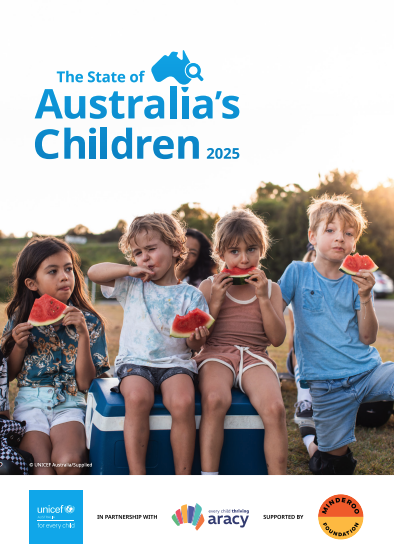
The SOAC25 report was created by UNICEF Australia and the Australian Research Alliance for Children and Youth (ARACY), with support from Minderoo Foundation. Introducing the findings and recommendations, renowned paediatrician and epidemiologist Professor Fiona Stanley said the report provided a comprehensive, evidence-based picture of how children and young people were faring across Australia.
It aimed to capture their strengths, their challenges and the environments that shaped their lives, she said.
What becomes clear in the data is that children are either supported, nurtured and doing well, or they’re not.
“Children in out-of-home care experience elevated rates of homelessness and detention, and many children with disabilities encounter discrimination and barriers to full participation,” the report said.
“Children and young people in child protection and youth justice systems continue to face systemic failures that undermine their rights and wellbeing. The data points to emerging risks that are widespread among children and young people in Australia, signalling the need for a coordinated response. Developmental vulnerability is increasing for children entering school, and mental health concerns continue to rise among young Australians. These challenges are compounded by financial strain, online risks and the growing impact of climate change on families.”
All of that is before you get to this year’s well-chronicled major failings in childcare safety, which have left children exposed to potential and actual abuse. Australian Institute of Health and Welfare figures said 2.5 per cent of children in care had been subject to substantiated abuse, and 435,400 children were the subject of maltreatment findings in 2022–23.
“The shocking extent of serious failures in safeguarding children in early learning settings which have been made public in 2025 have highlighted serious system weaknesses and provide further impetus to the findings in this report for decisive action to strengthen accountability, oversight, and the broader systems designed to keep children safe,” the report said.
Solution-oriented
SOAC25’s main purpose is to push for solutions to the problems highlighted by the data. It recommends several system changes and underlines them with a call for a cohesive national strategy to ensure all children receive what they need to thrive.
It recommends that this work should begin with an early intervention investment framework, underpinned by a national children’s data strategy – which requires a commitment from all Australian governments to acknowledge and address the significant data gaps.
It also calls for the establishment of a National Early Childhood Commission, urging that the foundations of a successful childhood must be built early in a child’s life, even before birth, with support systems for vulnerable parents.
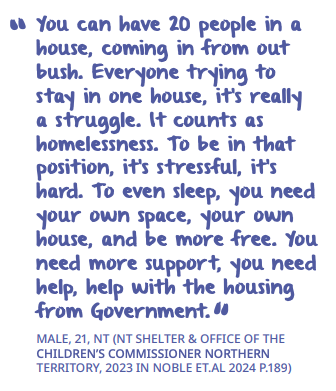
The report asks that children’s voices be embedded in decision-making, and does so itself, with input from young Australians such as Christopher Hatano, 18, a participant in ARACY’s Young & Wise roundtables.
The report highlights a need for increased mental health and wellbeing professionals to provide early and sustained wraparound support for children, and it calls for a National Children’s Act, overseen by a Ministerial Council for Children, to provide a long-term strategy at the federal level to embed the rights of children in national policies.
All these recommendations are intended to counter data showing that Australian children and young people are declining in wellbeing more than their peers in comparable OECD and EU countries. Some of the statistics are sobering.
The report found that 49 per cent of 16–17-year-olds say housing and financial stress are their biggest concerns, and less than a third feel very excited and hopeful about the next five years.
An alarming 20.2 per cent of young adults report high psychological distress, and suicide remains the leading cause of death for 15–24-year-olds.
Social cohesion is falling away. Peer connection has dropped 19 percentage points since 2020, and family connection has fallen by 13 points.
In school, the percentage of kids keeping up developmentally is at its lowest since 2009, with only 52.9 per cent on track (and only 33.9 per cent of Indigenous kids). Children are classed as developmentally vulnerable based on the results of the Australian Early Development Census, according to their physical health and wellbeing, social competence, emotional maturity, language and cognitive skills, and communication skills and general knowledge.
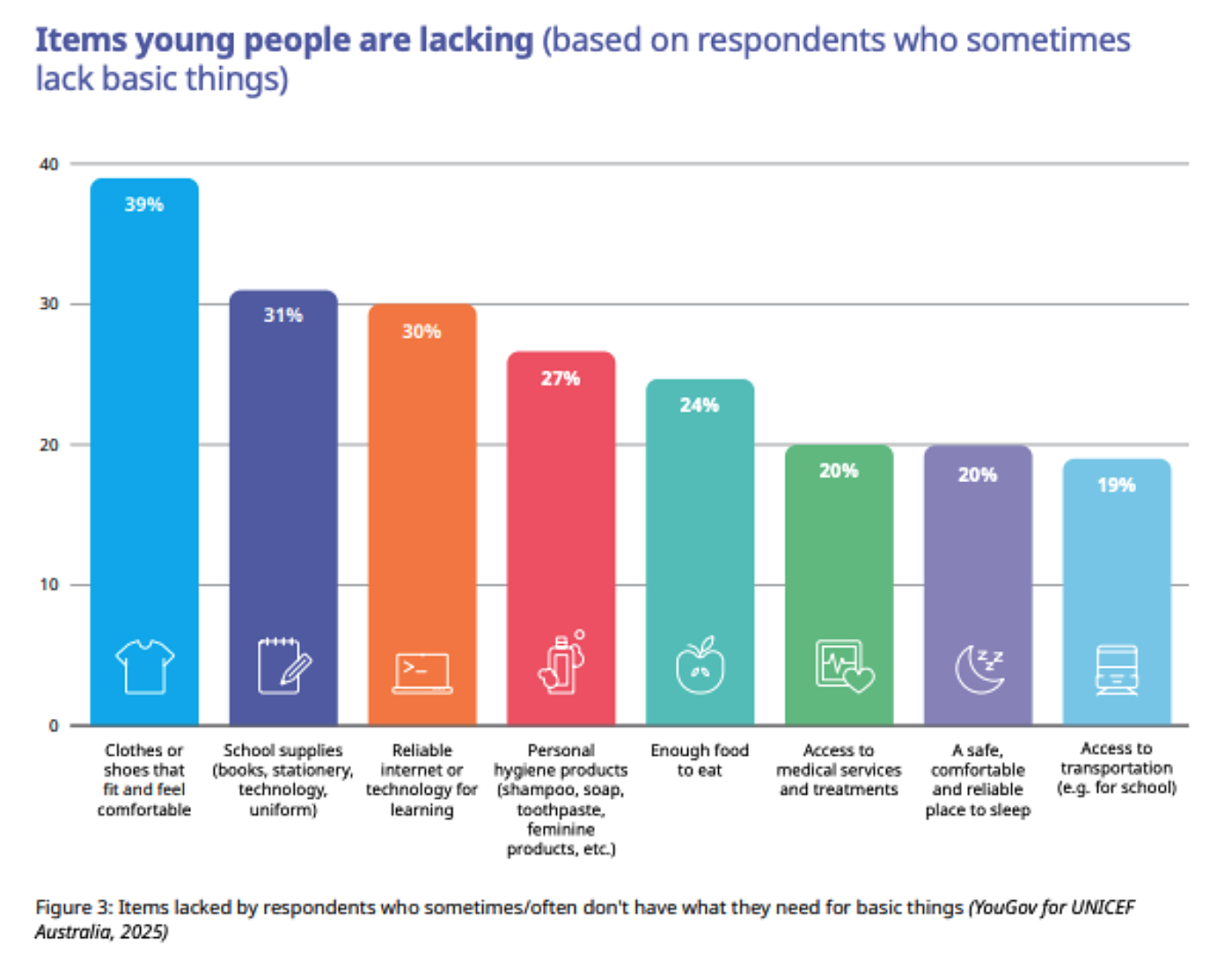
The report said the key to improving the lives of Australian children who are falling through gaps in support is to embrace ARACY and UNICEF’s “The Nest” framework, which defines six inter-connected channels for ensuring wellbeing for children and young people. These are feeling valued, loved and safe; having access to the material basics; being healthy; being able to learn; being able to participate in society; and having a positive sense of identity and culture.
“We can change the trajectory,” the report said. “A coordinated, rights-based approach that strengthens leadership, accountability and collaboration across all levels of government can improve outcomes for children. We can ensure equitable access to services, increase and sustain investment in community-led approaches, support families, prevent issues arising and ensure early intervention across the life course. We can seek and respond to the voices of children, young people and their caregivers, placing children at the heart of decision making.”
The report’s lead author, Megan O’Connell, said on LinkedIn, “I am hoping [the report] draws attention to the children and young people who fall through the gaps including the growing cohort of young carers, and the increasing numbers of children and young people who are struggling with belonging and wellbeing at school and at home.
“The report draws on the voices of children and young people and challenges us to ensure services are centred around them.
“It highlights the need for better data infrastructure. There are many questions we struggle to answer like how many young people are homeless, and how many children are experiencing mental health issues? We cannot intervene early if we aren't investing in data to know where to act.”
Regional children’s health organisation Royal Far West welcomed the report and said it made clear the disadvantage non-city children faced in their foundational years.
“This report makes it clear that where a child lives still shapes their chances to thrive,” said CEO Jacqui Emery. “Country children face barriers to health, education and safety. We cannot accept this reality as inevitable. Government initiatives such as Thriving Kids must continue to focus on the most disadvantaged communities to ensure inequity does not deepen for marginalised groups.”
Education not-for-profit The Front Project described the overall picture presented in the report as nuanced, saying, “While we have seen improvements in children having material basics, we are seeing an increase in childhood developmental vulnerability.”
THE REPORT: You can download the full report here.
WEBINAR: On December 10, from 12 noon, ARACY, UNICEF Australia and the report’s authors will present a free webinar exploring the key findings and recommendations of the report.
Posted on 07 Oct 2026
A major public campaign launched this morning is calling on the federal government to restore…

Posted on 07 Oct 2026
The Australian Literacy & Numeracy Foundation (ALNF) has announced a partnership with mining…
Posted on 07 Oct 2026
A conference in Darwin will this morning hear detailed, strategic plans for how Australia could…

Posted on 30 Sep 2026
Not-for-profit leaders have been warned to be wary of approaches from potential “funding partners”…
Posted on 30 Sep 2026
More than 200 fully funded Centre for Social Impact (CSI) scholarships will help equip for-purpose…

Posted on 30 Sep 2026
Personal stories are among the most powerful tools a charity can have to raise funds and awareness,…
Posted on 23 Sep 2026
A just-released major global survey of charities has found that demand for charity assistance has…
Posted on 23 Sep 2026
Fresh from welcoming delegates to last week’s Philanthropy Australia conference in Brisbane,…

Posted on 23 Sep 2026
A national strategy to develop Australia's regional cities is needed to break the housing…

Posted on 23 Sep 2026
Eight years after a report to Treasury first suggested the charities regulator should be more…

Posted on 17 Sep 2026
Australia’s biggest gathering of philanthropists, which drew more than 1200 delegates to Brisbane…
Posted on 16 Sep 2026
A new partnership between Paul Ramsay Foundation (PRF) and Atlassian Foundation aims to attract…