
Save Izzy: campaign calls on government to restore funding for vital services directory
Posted on 07 Oct 2026
A major public campaign launched this morning is calling on the federal government to restore…
Posted on 09 Sep 2026
By Nick Place, journalist, Community Directors
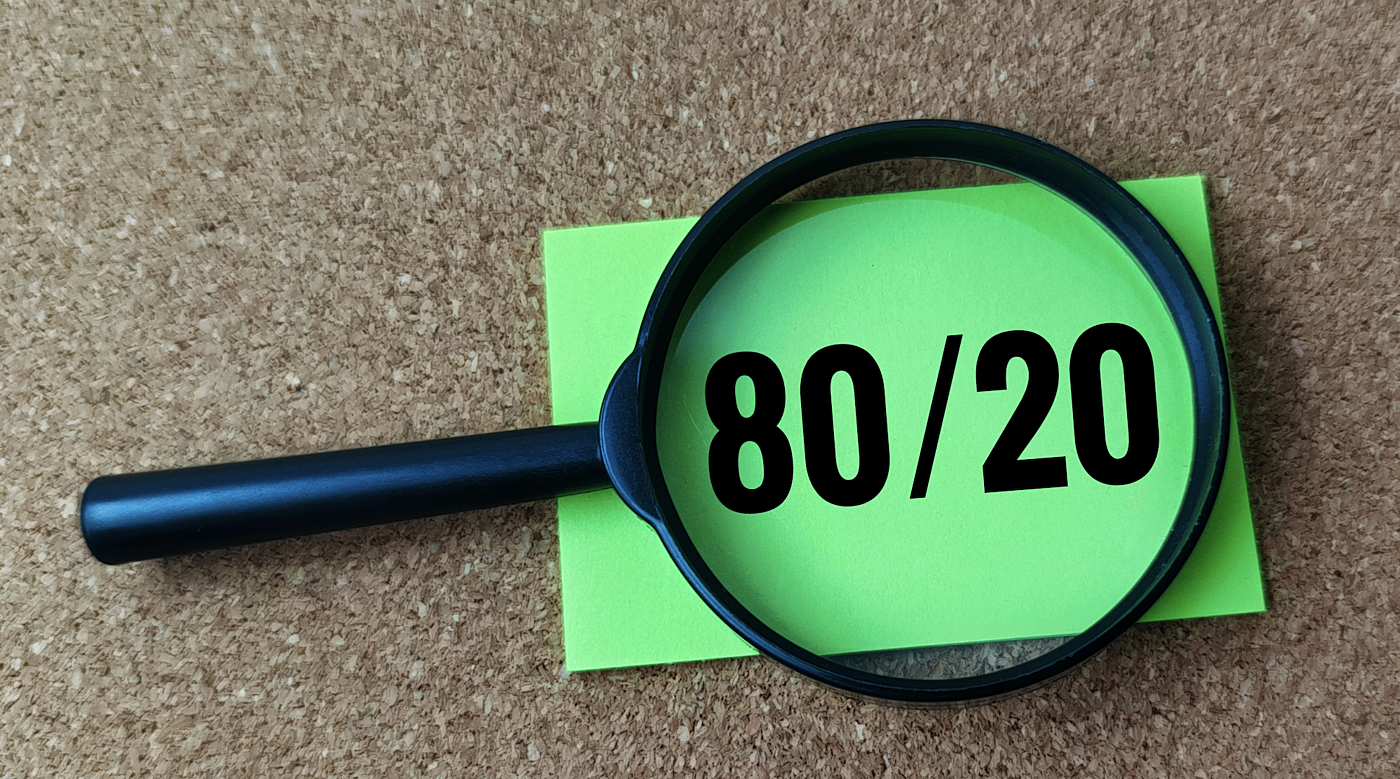
Australian giving platform GoodCompany has used artificial intelligence to examine the financial inequalities baked into the Australian charity sector.
GoodCompany used AI to see if the distribution of donations, government funding, and volunteer support in data reported to the Australian Charities and Not-for-profits Commission (ACNC) matched the Pareto principle that 80 per cent of outcomes come from 20 per cent of inputs.
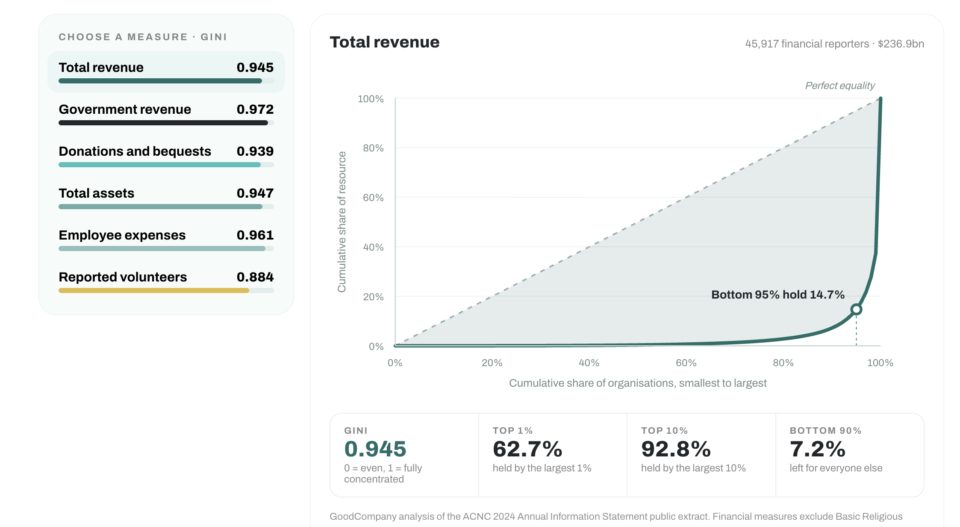
What the company found was even more confronting. The Charity Divide report revealed that 97.2 per cent of reported revenue went to the top 20 per cent of charities, including 98.7 per cent of government funding and 85 per cent of donations and bequests.
The report’s research also found that the bottom 20 per cent of charities by revenue receive no revenue (at least not enough to be statistically relevant), no government funding and only 0.1 per cent of donations. They boast a mere 0.4 per cent of assets and host only 2.7 per cent of the sector’s volunteer workforce.
A Lorenz curve (a graph that shows how wealth or income is spread among a group of people or organisations) shows that the top five per cent of charities hold 85.3 per cent of total revenue and 91.9 per cent of government funding.
Asked what surprised him in the figures, GoodCompany chief executive Ash Rosshandler said he had been pondering how all but 1.3 per cent of government funding went to the best-funded, best-resourced fifth of charity organisations.
“When you go for government funding, often one of the questions asked is, ‘Have you had government funding before?’ I don’t know how they weigh the answer to that, but I’d imagine it’s a due diligence big tick checkbox that probably gets quite a bit of weighting, as in, if you say, ‘Yes, I have received government funding before,’ they're like, okay, if you have then you’re probably good to get looked at. That sort of stuff is quite troubling,” he said.
The data raises many questions about how a small, under-funded charity can possibly hope to attract attention, funding or assistance from private donors, government or philanthropists.
“The bottom 10, 20 or 30 per cent of charities are running off what we call the smell of the smell of an oily rag. They’re not even running off the smell of a rag. It’s the smell of the smell of an oily rag. Yet many are doing a lot in terms of impact, volunteering, community building,” Rosshandler said.
Sector leaders often invoke the ACNC statistic that 53,722 registered charities employ 11 per cent of the Australian workforce and share in total sector revenue of $236.9 billion – making the NFP sector bigger than mining and manufacturing.
However, in The Charity Divide’s data breakdown, the figures show that the sector’s 16,491 extra-small charities share only $239.4 million (0.1 per cent of total) in revenue, while 308 extra-large charities enjoy $136.1 billion (57.5 per cent of total) in funding.
“The bottom 10, 20 or 30 per cent of charities are running off what we call ‘the smell of the smell of an oily rag’. They’re not even running off the smell of a rag.”
The dollar figures are not intended to be proxy measures of impact at either end of the scale.
Rosshandler said the idea to dissect the ACNC statistics was driven by Oxfam’s 2026 global inequality report, Resisting the Rule of the Rich. He has long been fascinated by how everybody loses from inequality – the have-nots suffer for obvious reasons, but Rosshandler has reflected on how the rich build bigger gates, hire more security, and suffer fear, loneliness and depression.
“We thought it would be interesting to consider inequality in the charity space,” he said. “Does it exist? And if it exists, how prevalent is it? And is it improving? Is it getting worse? That’s why we started with the Pareto effect, which is sort of the 80/20 rule, and I think it’s important we do it annually so we can keep track of it, to see whether it is getting more divided or coming together. Is it widening or narrowing?”
Rosshandler said that as a result of the Charity Divide report’s findings, GoodCompany had directed an extra $250,000 per year towards making it easier for charities to find volunteers via its website.
“We make it free for charities to list volunteering roles because we know that charities that don’t have the funds are looking for volunteers,” he said. “We also looked at how we could make it even better, so we’re creating a widget tool that will sit on GoodCompany but they can also put on their website, so they’re not spending money trying to build a volunteer system.”
The platform is also asking charities to state what it costs them to host a team activity or corporate volunteers, so companies can cover the cost, instead of potentially leaving a charity out of pocket.
Report: The Charity Divide
Posted on 07 Oct 2026
A major public campaign launched this morning is calling on the federal government to restore…
Posted on 07 Oct 2026
The Australian Literacy & Numeracy Foundation (ALNF) has announced a partnership with mining…
Posted on 07 Oct 2026
A conference in Darwin will this morning hear detailed, strategic plans for how Australia could…
Posted on 30 Sep 2026
Not-for-profit leaders have been warned to be wary of approaches from potential “funding partners”…
Posted on 30 Sep 2026
More than 200 fully funded Centre for Social Impact (CSI) scholarships will help equip for-purpose…

Posted on 30 Sep 2026
Personal stories are among the most powerful tools a charity can have to raise funds and awareness,…
Posted on 23 Sep 2026
A just-released major global survey of charities has found that demand for charity assistance has…
Posted on 23 Sep 2026
Fresh from welcoming delegates to last week’s Philanthropy Australia conference in Brisbane,…

Posted on 23 Sep 2026
A national strategy to develop Australia's regional cities is needed to break the housing…

Posted on 23 Sep 2026
Eight years after a report to Treasury first suggested the charities regulator should be more…
Posted on 17 Sep 2026
Australia’s biggest gathering of philanthropists, which drew more than 1200 delegates to Brisbane…
Posted on 16 Sep 2026
A new partnership between Paul Ramsay Foundation (PRF) and Atlassian Foundation aims to attract…