
Save Izzy: campaign calls on government to restore funding for vital services directory
Posted on 07 Oct 2026
A major public campaign launched this morning is calling on the federal government to restore…
Posted on 11 Nov 2025
By Nick Place, journalist, Community Directors

Australian charities are curious about how to use artificial intelligence and are increasingly attempting to explore the technology, but most remain underequipped to use it safely or effectively, according to Infoxchange’s 2025 Digital Technology in the Not-for-Profit Sector Report, released yesterday.
Use of AI in the sector has doubled, and early innovators are showing the benefits of the new technology, but the digital inequality gaps found within wider Australian society are also present in the charity sector, the report warned, and a lack of robust cyber security protocols is a major issue.
Infoxchange’s report provides an annual snapshot of how the not-for-profit sector is using, benefiting from or being hampered by technology.
The 2025 report is the 10th edition, and it is unsurprisingly dominated by the rise of AI, with Infoxchange CEO David Spriggs calling for greater training, tools and infrastructure to help charities master the potential of the new and rapidly evolving technology.
Launching the report, Charities Minister Andrew Leigh enthused about the potential benefits of new technologies for the charity sector, but he also observed, “We need to be intentional and ethical in how we use it.”
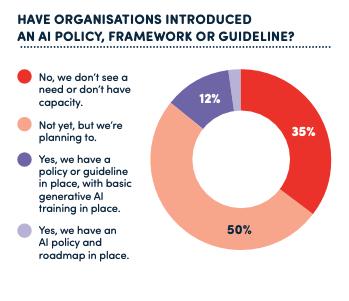
The report revealed that 67 per cent of the 800-plus surveyed organisations were using generative AI in their work, mostly for content creation, and it emphasised that data security, ethics, sovereignty and privacy remained the top barriers preventing greater leverage of AI.
Only 14 per cent of organisations surveyed had an official AI policy or guidelines in place, although 50 per cent of the others said they intended to formulate a policy.
“I’m hoping next year we’re reporting a really different statistic here,” said Infoxchange’s manager of digital transformation, Sophie Souchon.
Only about 23 per cent of not-for-profit organisations had a documented cyber security plan, the report said, and fewer than half of charities with 150 staff or less had effective processes to manage potential information security risks.
The data suggested that bigger organisations had more capacity to properly implement new technologies; for example, the majority of organisations with 20 staff or more reported using multi-factor authentication. However, only 20 per cent of volunteer-led organisations used multi-factor authentication, a key concern for Infoxchange researchers.
Spriggs said there were currently significant barriers standing in the way of the NFP sector being able to master digital advancement, and these placed even more strain on a sector already battling to meet the needs of an increasing number of Australians facing poverty, disability, mental health issues, homelessness, disaster and more.
“Digital technology and AI has the potential to improve efficiencies and outcomes for an over-burdened and resource-stretched sector, but we’re seeing a major gap in the capability levels that could help close inequality gaps in our society,” he said.
“Australia needs a unified, national approach to digital capability improvement in the not-for-profit sector. This sector delivers critical services on behalf of the community – so it should also be supported with the tools, training and infrastructure to deliver them safely in the digital age.”
“Australia needs a unified, national approach to digital capability improvement in the not-for-profit sector.”
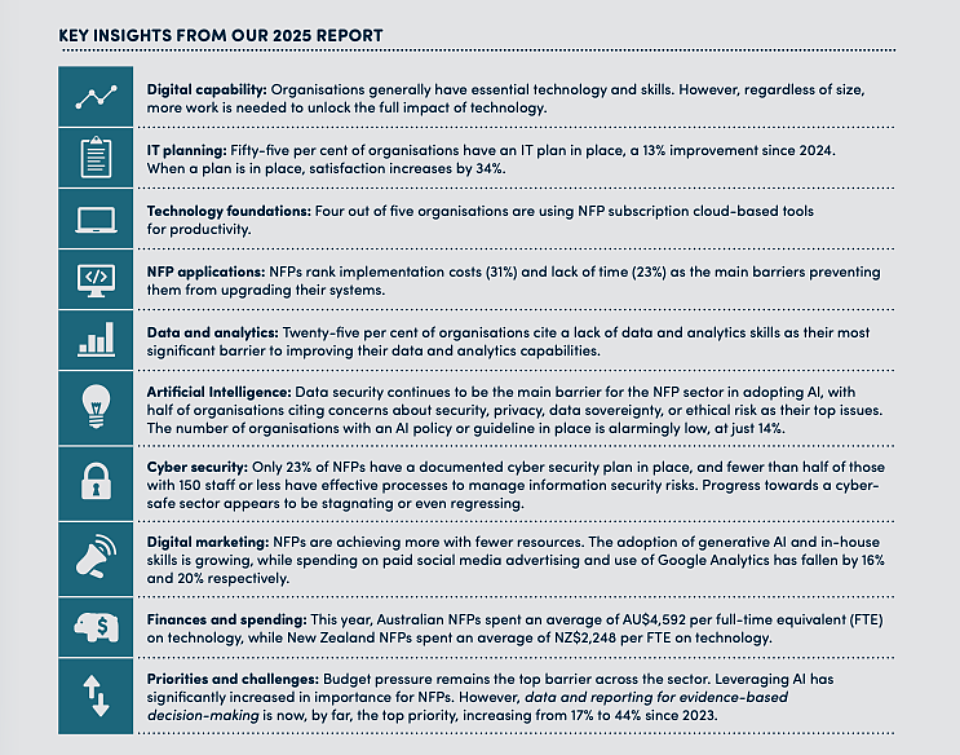
Souchon said the report showed that budgets and funding remained the top priority facing the charity sector, “with a close second being the access to affordable and skilled technical resources.”
The report showed that improvements in technological capabilities were falling behind the “digital demands of modern service delivery”, in the care sector, Spriggs said, as he joined other sector leaders calling for a co-ordinated investment into improving the sector’s ability to deliver vital services efficiently and safely.

Community Council for Australia CEO David Crosbie was part of yesterday’s report launch and said that in his many years as a CEO of charities, “I know that internally it’s often a difficult decision to decide how much to invest in IT as compared to direct services or other needs that are competing. I think one of the really positive uses of the (Infoxchange) report is to enable people to argue internally to try and get more investment into the IT area.”
The fruits of the new technology are starting to show and the report highlighted major advances in usage. It highlighted digitally advanced NFPs, where strong use of the new technology has led to “evidence-based findings through improved data and analytics, improved content, streamlined referrals, stronger evaluations through technology co-designed with those with lived experience, and more vigilant cyber security tools to protect sensitive data”.
It's also not only about artificial intelligence. Ten years ago, only 24 per cent of organisations within the survey were using cloud-based collaboration tools, while, in 2025, that figure sits at 87 per cent.
Infoxchange’s annual digital report is extensive, with this 2025 edition drawing on data from 824 organisations across Australia and New Zealand, identifying digital progress, capability, risks and opportunities in supporting the most vulnerable communities.
Read the full report here.
Resources to take action on the findings of the report.
Posted on 07 Oct 2026
A major public campaign launched this morning is calling on the federal government to restore…

Posted on 07 Oct 2026
The Australian Literacy & Numeracy Foundation (ALNF) has announced a partnership with mining…

Posted on 07 Oct 2026
A conference in Darwin will this morning hear detailed, strategic plans for how Australia could…

Posted on 30 Sep 2026
Not-for-profit leaders have been warned to be wary of approaches from potential “funding partners”…

Posted on 30 Sep 2026
More than 200 fully funded Centre for Social Impact (CSI) scholarships will help equip for-purpose…

Posted on 30 Sep 2026
Personal stories are among the most powerful tools a charity can have to raise funds and awareness,…

Posted on 23 Sep 2026
A just-released major global survey of charities has found that demand for charity assistance has…

Posted on 23 Sep 2026
Fresh from welcoming delegates to last week’s Philanthropy Australia conference in Brisbane,…

Posted on 23 Sep 2026
A national strategy to develop Australia's regional cities is needed to break the housing…

Posted on 23 Sep 2026
Eight years after a report to Treasury first suggested the charities regulator should be more…

Posted on 17 Sep 2026
Australia’s biggest gathering of philanthropists, which drew more than 1200 delegates to Brisbane…

Posted on 16 Sep 2026
A new partnership between Paul Ramsay Foundation (PRF) and Atlassian Foundation aims to attract…