
Save Izzy: campaign calls on government to restore funding for vital services directory
Posted on 07 Oct 2026
A major public campaign launched this morning is calling on the federal government to restore…
Posted on 17 Jun 2026
By Nick Place, journalist, Community Directors
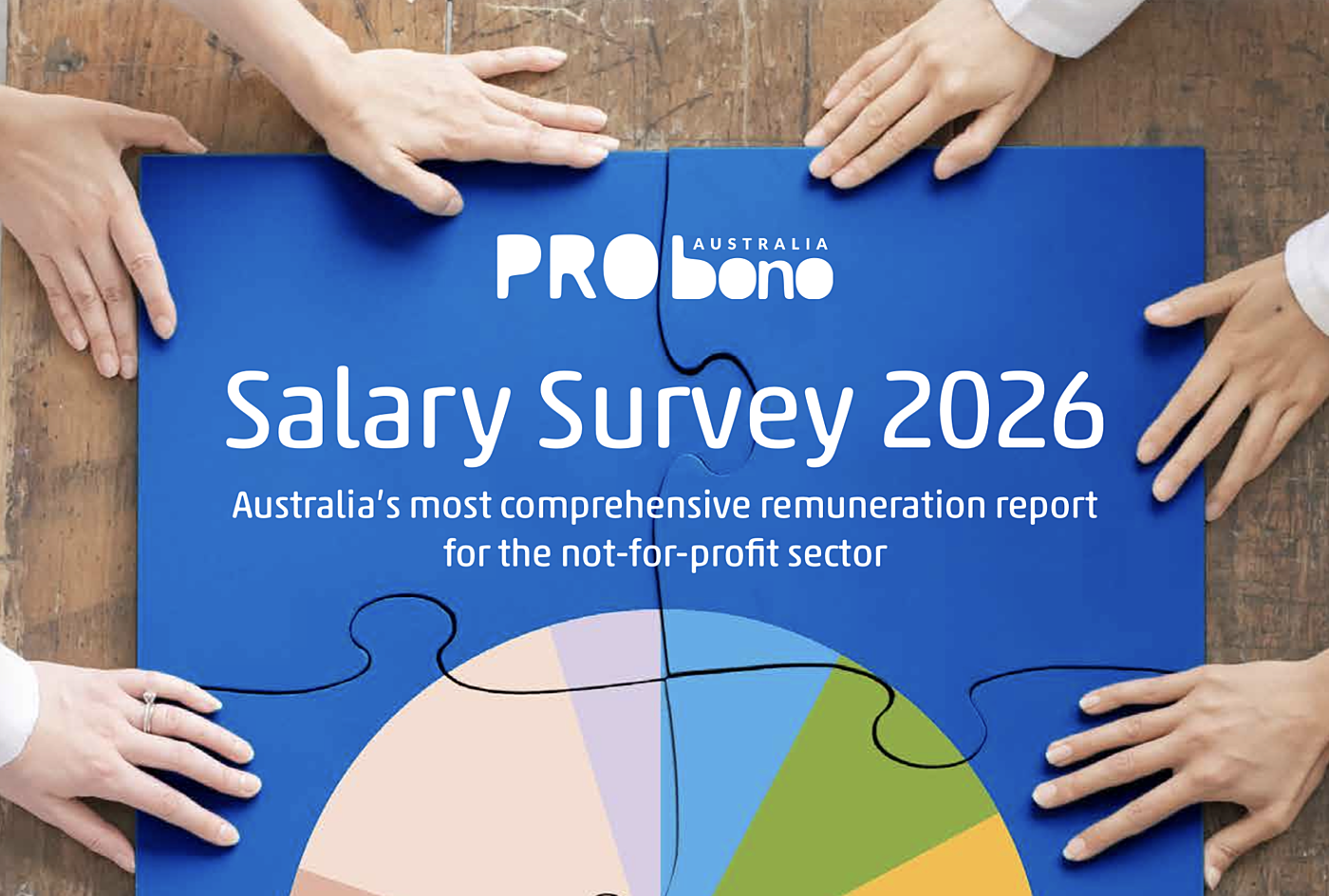
The pay cheques of charity CEOs rose significantly in the past year, according to the 2026 Pro Bono NFP Salary Survey, as charities worked to hang on to senior leaders in the face of sector challenges.
Pro Bono founder and chair Karen Mahlab admitted she was surprised by the finding, although the wider survey indicated that salaries were a significant driver of employee retention at all levels.
“Remuneration is fundamental,” Mahlab said. “It’s fundamental to retaining good staff, but it’s also fundamental to attracting good staff, so you have to get it right. The benefit of ‘purpose’ is definitely there, but it's not enough.”

The survey, which drew 1,876 responses across 41 different roles, found that many charities hope to entice employees with the notion of working for a good cause, but this only goes so far. Almost all charities are founded to tackle worthy causes, so an organisation’s purpose is less of a selling factor than many charities believe. Jobs at other NFPs are for worthy causes too, and also promise a sense of purpose.
“Purpose alone is rarely enough to attract and retain the right people,” the report found, adding that even flexibility in work hours and locations wasn’t as important as salary in this age of cost-of-living pressure.
Mahlab said the cost-of-living crisis appeared to underpin much of the sector’s salary debate. “I think, like everyone else in the world, but maybe more exacerbated in the not-for-profit sector in Australia, there’s been huge challenges, both on the revenue front and the expenses front,” she said. “It’s a big squeeze and CEOs are at the pinnacle of that change. So, while remuneration isn’t everything, it is something, and I think being remunerated well alleviates some of the cost-of-living pressures that even CEOs might be under.”
“A lot of people are pretty grateful for their jobs, especially in the not-for-profit sector where they are working for a purpose, but the culture of an organisation is key.”
Retaining senior leaders was key to a charity’s success, the report found, although retention rates were not consistent across the financially diverse sector – decreasing by 7 per cent since the 2025 survey in some parts, while rising by up to 20 per cent in others.
“CEOs and executive teams carry responsibility for organisational strategy, governance, stakeholder relationships, funding confidence and workforce culture. Frequent turnover at senior levels can create uncertainty for staff, boards, donors and service users, while also disrupting long-term planning and operational continuity,” a Pro Bono spokesperson said.

Mahlab said the survey also gave Pro Bono a chance to ask sector leaders and staff wider questions about their working world. For example, the latest survey found that burnout is driving staff turnover in many charities.
It also emphasised the importance of a strong culture at not-for-profits. “A lot comes back to culture and feeling appreciated,” Mahlab said. “I think, you know, a lot of people are pretty grateful for their jobs, especially in the not-for-profit sector where they are working for a purpose, but the culture of an organisation is key.”
The survey found strong women’s representation on boards: 45 per cent of organisations had more than 50 per cent female board members, up from 35 per cent of organisations last year. Women accounted for 76 per cent of survey respondents.
Cross-referencing the salary survey’s findings with the newly released 12th annual Australian Charities Report from the Australian Charities and Not-for-profits Commission (ACNC) suggests that the CEOs being given hefty pay rises are probably among the 0.6 per cent of Australian charities – 306 in total – that have annual revenue of $100 million or more.
Those few charities generated 57 per cent of total sector revenue and received about 21 per cent of donations and bequests. They held about half of all sector assets.
Conversely, 60 per cent of all Australian charities were small or extra small, defined as having less than $500,000 in annual revenue, and generated only 1.4 per cent of total sector revenue. They received less than nine per cent of donations and bequests and held less than five per cent of sector assets, the ACNC said.
In more than half (53 per cent) of Australia’s charities, nobody gets paid at all. Volunteers run those, while also making the work of larger charities possible, with the Australian Charities Report finding that registered charities engaged a reported 3.9 million volunteers for the year, the highest count ever reported. There were 2.5 volunteers for every employee.
The ProBonoNFP salary survey is available for purchase here.
The ACNC Australian Charities Report can be viewed here.
Posted on 07 Oct 2026
A major public campaign launched this morning is calling on the federal government to restore…

Posted on 07 Oct 2026
The Australian Literacy & Numeracy Foundation (ALNF) has announced a partnership with mining…

Posted on 07 Oct 2026
A conference in Darwin will this morning hear detailed, strategic plans for how Australia could…

Posted on 30 Sep 2026
Not-for-profit leaders have been warned to be wary of approaches from potential “funding partners”…

Posted on 30 Sep 2026
More than 200 fully funded Centre for Social Impact (CSI) scholarships will help equip for-purpose…

Posted on 30 Sep 2026
Personal stories are among the most powerful tools a charity can have to raise funds and awareness,…

Posted on 23 Sep 2026
A just-released major global survey of charities has found that demand for charity assistance has…

Posted on 23 Sep 2026
Fresh from welcoming delegates to last week’s Philanthropy Australia conference in Brisbane,…

Posted on 23 Sep 2026
A national strategy to develop Australia's regional cities is needed to break the housing…

Posted on 23 Sep 2026
Eight years after a report to Treasury first suggested the charities regulator should be more…

Posted on 17 Sep 2026
Australia’s biggest gathering of philanthropists, which drew more than 1200 delegates to Brisbane…

Posted on 16 Sep 2026
A new partnership between Paul Ramsay Foundation (PRF) and Atlassian Foundation aims to attract…