
Beyond the Binary: Fundraising isn't just 'good vs bad money'
Posted on 02 Sep 2026
CATHERINE BROOKS on "Diversity, inclusion and community engagement" in Radical Moderate.
Posted on 10 Nov 2025
By Brett de Hoedt
BRETT DE HOEDT on "Advocacy and social change" in Radical Moderate.
An impoverished media serving a diverse population weighed down by the cost and complexity of modern living, characterised by a litany of broken political promises and an eroded attention span, is not an atmosphere that welcomes big ideas or radical solutions, says communications expert BRETT DE HOEDT.
Pragmatism can easily be perceived as weakness – the death knell for anyone aspiring to office. Certainty, action and a willingness to pursue a course of action play well but sentiment in the electorate swings like a pendulum.
Globally we’ve seen a swing away from wanting strong men and bold action. Trump’s mendacity has created a new appreciation for… you know… democracy. Voters in Australia, Canada, the UK and France have swung back to seeking a more measured, democracy-as-usual approach.

Overwhelmingly it is the political class – political operatives, party members, think tankers, volunteers and those that closely follow politics and policy between elections – who yearn for fundamental reforms, big ideas and bold initiatives. That said, their concerns and solutions differ radically.
Those that care less about politics (most folk) are generally far milder and more specific with their demands – a freeway bypass here, an instant asset write off there, a childcare subsidy boost and they’re largely satisfied. They feel no need to reshape the political landscape.
It’s doubtful to me that big ideas that we take for granted – Medicare, public funding of private schools, NDIS and compulsory voting – would be adopted today. The Voice referendum failure and the lacklustre victory of the same sex marriage plebiscite (61.6 per cent support) point to this. Progress through moderation may be the unsexy way to go.
BREAKING NEWS: commercial media does not exist to report, reveal or expose. It exists to make money. In an increasingly atomised cultural and information landscape, with advertising revenues spread thinner than ever, it makes sense that media outlets chase the eyeballs that come with coverage of more extreme positions, hotter takes and less nuanced reporting.
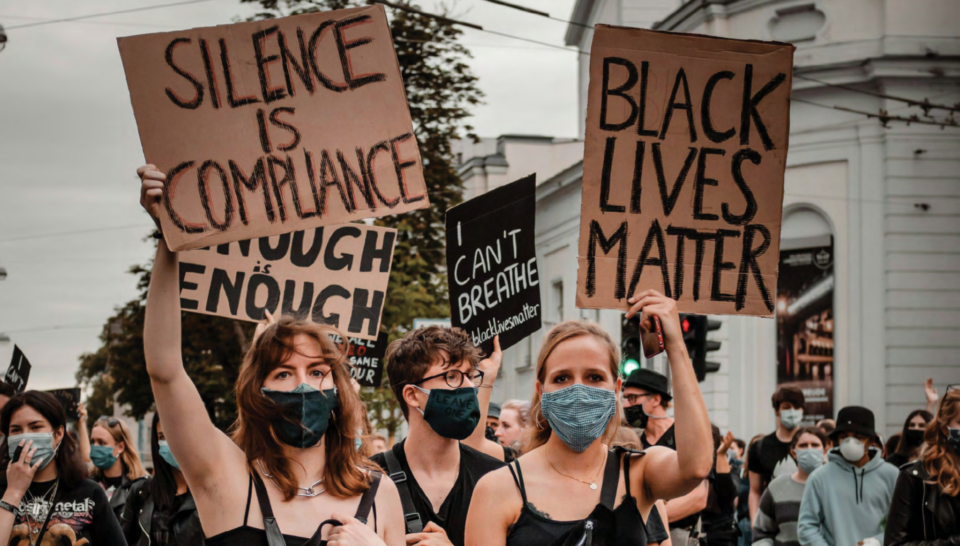
Media welcomes those with outsized personalities and radical ideas insofar as they create interest. Protestors such as Extinction Rebellion or those supporting Palestine may gain coverage for their demonstrations, but this coverage is unlikely to inspire a deeper exploration of the underpinning issues.
Media coverage characterises people, parties and ideas in the public mind. Once the dreaded word “embattled” is used to describe one’s leadership, it’s pretty much game over. Similarly hard to shake are adjectives such as “extreme”, “ultra-conservative”, “far right”, “transphobic” or “antisemitic”.
When is a change of policy weakness and when is it pragmatism? Is extending the licence of Woodside’s North-West Shelf gas mine a sign of compromise, support of business and farsightedness? Or is it a betrayal of ALP voters and our environment? Depends on who you ask and what media you consume.
Any policy idea aiming at the hip pocket nerve will see an outsized response. When affable Treasurer Jim Chalmers, fresh from a huge electoral endorsement, decided to spend his political capital on some tax reform he chose to increase taxes on superannuation balances in excess of $3 million. About 85,000 of us. This may seem like a mild reform impacting a small and privileged group. The Opposition has come down against the move and the media responded thus:
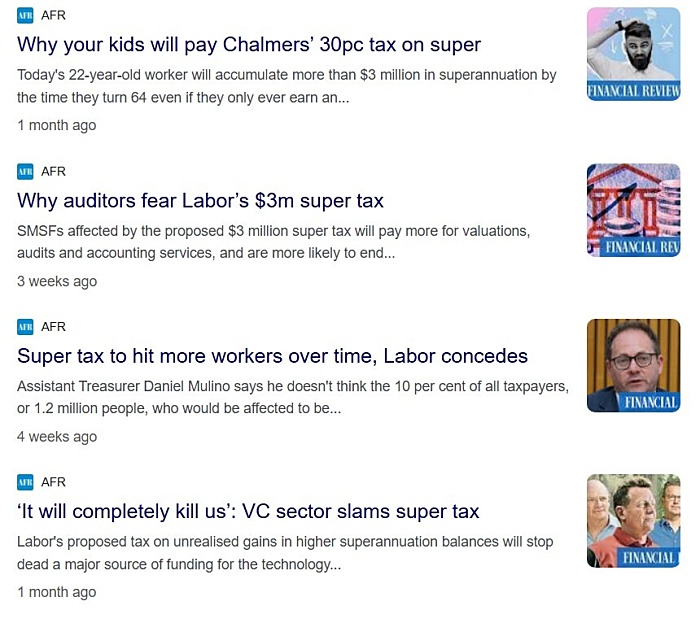
The message for those in power is clear – forget tackling franking credits, negative gearing or capital gains tax on the family home. We can’t even reduce some of the tax concessions for rich people without upheaval.
Media reveals its priorities (some might use the phrase “biases") through what it does and doesn’t cover and how it reports on the issues it deems worthy of coverage.
Sure, personal experience and social media is a factor but it’s media that still does the heavy lifting. So what issues are covered and how they are covered is key.
That’s why I’ve devoted so much of my career to assisting my clients raise their off-Broadway issues in mainstream media. Recently I had the CEO of Sexual Assault Services Victoria talking to ABC Melbourne about their work with schools to tackle the rise of sexual assault in schools by students. The issue was raised, dealt with maturely (if only briefly) and we controlled the message. I’m chalking this up as a small victory.
I’ve seen again and again how the media can be encouraged to cover a story at all and the way in which it is covered. Media wants topicality, experts, insights, data and a big dollop of humanity. It wants strong opinion but steer away from those who want to recreate the wheel.
My fellow progressives do themselves no favours when they adopt slogans such as:
These slogans are interpreted by media (and plenty of people) as extreme and binary. A case of: You’re either with us or against us. This goes quadruple for decapitation and vandalism of statues and public spaces.
Always was, always will be. “But I thought this country belonged to all of us?”
Media reveals its priorities (some might use the phrase “biases) through what it does and doesn’t cover and how it reports on the issues it deems worthy of coverage.
Defund the police. Really – “no police?”
Silence is compliance. “So, I have to speak up about everything, in a way you agree with, all the time?”
My advice for campaigners is simple: do you want to speak your mind? Or would you rather win?
As circulation and listenership shrinks, influence wanes. That’s why our politicians are increasingly likely to decline tough interviews and opt for cosy chats with commercial media outlets and their own social media channels. Why go through some pesky intermediary?
The media ain’t what it used to be. News Corp publications have wholeheartedly backed conservative politics, campaigning against the likes of Victorian Premier Dan Andrews and Chris Minns even in opposition, yet both men prevailed. Likewise, the Teal independents.
Reporters are fewer, younger and in possession of less specialist knowledge than ever before. They are less likely to challenge their boss’ editorial judgement or the responses of interviewees. They have less time and space to explain their stories than ever before.
No wonder so much ‘news’ is devoted to sport, weather and consumer stories that not only cross the border into advertising, once there, they take up citizenship.
An impoverished media, a radically diverse population weighed down by the cost and complexity of simply living in 2025. A litany of broken promises and an eroded attention span.
This is not an atmosphere that welcomes big ideas or radical solutions. A thought for my fellow progressives: a journey of a thousand miles begins with the first step.
Brett de Hoedt is the mayor of Hootville Communications, which assists not-for-profits with media, marketing and communications.
Posted on 02 Sep 2026
CATHERINE BROOKS on "Diversity, inclusion and community engagement" in Radical Moderate.

Posted on 11 Nov 2025
I’ve seen what happens when fear of conflict wins out over taking a principled stand.
Posted on 10 Nov 2025
JOEL DEANE on "The future of radical moderation" in Radical Moderate.

Posted on 10 Nov 2025
ROD MARSH on "The future of radical moderation" in Radical Moderate.

Posted on 10 Nov 2025
DR TRISH PRENTICE on "The future of radical moderation" in Radical Moderate.

Posted on 10 Nov 2025
DR SIMON LONGSTAFF AO on "The future of radical moderation" in Radical Moderate.

Posted on 10 Nov 2025
DAN LALOR on "The future of radical moderation" in Radical Moderate.

Posted on 10 Nov 2025
SIMON WALLER on "The future of radical moderation" in Radical Moderate.

Posted on 10 Nov 2025
KATE TORNEY OAM on "Navigating complexity & building resilience" in Radical Moderate.

Posted on 10 Nov 2025
KOS SAMARAS on "Navigating complexity & building resilience" in Radical Moderate.

Posted on 10 Nov 2025
JEN RILEY on "Navigating complexity & building resilience" in Radical Moderate.

Posted on 10 Nov 2025
VIOLET ROUMELIOTIS on "Diversity, inclusion and community engagement" in Radical Moderate.