
Save Izzy: campaign calls on government to restore funding for vital services directory
Posted on 07 Oct 2026
A major public campaign launched this morning is calling on the federal government to restore…
Posted on 25 Mar 2026
By Nick Place, journalist, Community Directors

A new paper challenges Australia’s philanthropists to embrace Indigenous self-determination and to recognise that respectful giving often requires a long-term view of impact.
Philanthropy, Our Way, published by the University of Newcastle and the philanthropy advisory firm Noble Ambition, was written by the country’s first Indigenous surgeon, Worimi man Kelvin Kong, the University of Newcastle’s deputy vice-chancellor of engagement and equity, Wiradjuri man Nathan Towney, the pro vice-chancellor of Indigenous strategy and leadership, Bandjin woman Loren Collyer, and Melissa Smith of Noble Ambition.
It contributes to a debate that has been gaining momentum in the world of philanthropy, where Indigenous organisations have urged donors to loosen the strict requirements and timelines that often accompany giving. These requirements can be seen by Indigenous communities as, at best, a lack of respect for their knowledge of how best to use the funding and, at worst, another example of white oppression.
The report draws on this historical and cultural context, including the long history of external and government authorities controlling decisions, resources and narratives. Co-author Nathan Towney said he had discovered archival records of his grandparents being paid for work in vouchers, not cash, because they were not trusted with money, while other records show Indigenous workers asking to be paid wages but instead receiving rations of flour and sugar.
In this context, philanthropic giving with strict conditions and demands can be difficult for Indigenous organisations to accept.
“We had no ability to save money or generate any type of wealth for future generations – not only because we were removed from our lands, but because even when we worked, our wages were controlled by others,” Towney said.
“Our people’s relationship with money has been shaped by generations of exclusion from wealth, and that history still influences how we approach philanthropy today.”
Collyer told the Community Advocate that Philanthropy, Our Way sought to shift the power dynamic.
“I think this is really the start of the conversation,” she said. “This is the invitation to philanthropists to say, we’re taking this seriously and we want to work in this space together to actually work out what this could look like if it was done the right way.”
Philanthropy, Our Way argues that donor agendas continue to overshadow Indigenous self-determination, and that a transformation is needed, where funds are given free of restrictive donor demands.
“It’s about philanthropists understanding that sometimes the answer to their questions might not be the ones that suit them, but ones that suit us,” she explained. “It’s developing that relationship and that trust. To know that sometimes, the outcomes or the strings that are attached are for them. Foundations have got their executives and they’ve got their timelines, which I think is another really big part of this. You know, they want to see these outcomes coming while they’re still sitting on the board, whereas we’re talking about the long term, and things that we can’t just wrap up in 24 months.
“It’s really about shifting that whole dynamic, which is the governance piece. At the end of the day, who gets to make those decisions? As it stands, the power to make those decisions doesn’t really sit with us.”
“It’s about philanthropists understanding that sometimes the answer to their questions might not be the ones that suit them, but ones that suit us. It’s developing that relationship and that trust.”
The document makes several recommendations about how to build stronger cultural governance, reporting and long-term, trust-based partnerships that prioritise and respect community-defined outcomes.
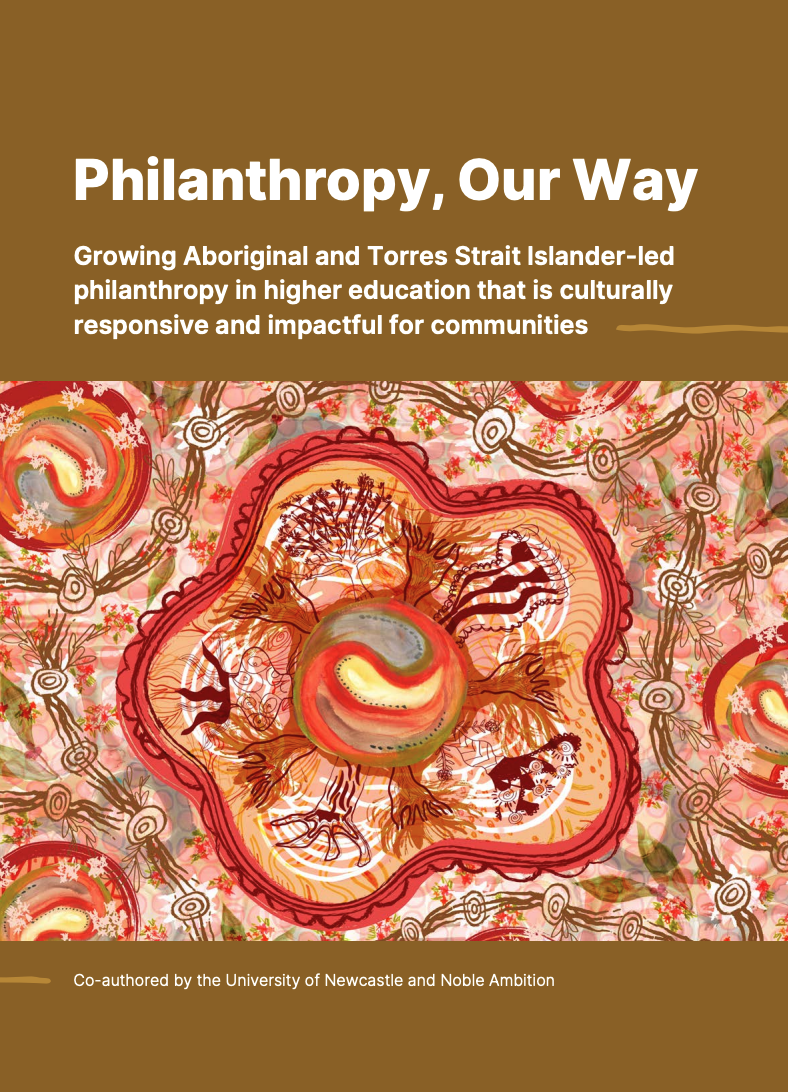
“This paper speaks to the opportunity for philanthropic investment to operate not simply as an act of giving, but as a commitment to equity, justice and long-term partnership,” Collyer said, saying universities had the chance to lead by embedding Indigenous leadership and encouraging direct collaboration between funders and Aboriginal and Torres Strait Islander communities.
“When funders invest in Indigenous-led initiatives, they are supporting more than access to learning,” she said. “They are enabling communities to lead their own futures, define success on their own terms, and generate solutions with far-reaching social and economic impact.”
Noble Ambition lead Melissa Smith said the philanthropic sector needed to make sure it had the right giving structures to most effectively help Indigenous communities thrive. “If our systems are not ready, the opportunity will not reach communities in the ways it needs to and should. We need funding models that move at the speed communities need, centre Aboriginal and Torres Strait Islander leadership and lived experience, and invest in genuine, long-term partnerships built on trust,” she said.
The authors pointed out that such work is essential as Australia undergoes its largest ever intergenerational wealth transfer, with $5.4 trillion expected to shift over the next two decades. The authors said the thinking behind Philanthropy, Our Way was also aligned with the Productivity Commission’s Future Foundations for Giving report, which highlights the need for philanthropists to deepen partnerships with Aboriginal and Torres Strait Islander organisations, including establishing an Indigenous‑led body to improve access to philanthropy.
While the report has come from academia, Loren Collyer said an example of why the discussion was needed was happening in Queensland right now, where her people, the Bandjin people, in northern Queensland, had joined with nine other groups to work on a comprehensive native title settlement with the state government.
“We've done a cultural maja, which is the nine mobs actually coming together in ceremony and signing, in our own way, an agreement that we’re working together as one governance group,” she said. “People are really keen to fund that process because the photos look great. We’ve had this cultural ceremony that looks amazing in someone’s annual report. But the next part is actually getting funding to pay for the lawyers and the barristers and the mediation and negotiation for the legal part … much less pretty. That’s the meaty, important part, but it doesn’t quite look like what people want to report on.
“It’s taken a couple of years to put Philanthropy, Our Way together but now is where I think it’s going to kick off,” she said. “It’s people understanding why this work is necessary.”
Collyer said recipients of grants were always going to be appreciative and wanted to maintain positive relationships with giving bodies, but “we also want to make sure the relationship is one where we’re on equal footing,” she said.
“It’s not just about the money.”
The report is here.
Posted on 07 Oct 2026
A major public campaign launched this morning is calling on the federal government to restore…
Posted on 07 Oct 2026
The Australian Literacy & Numeracy Foundation (ALNF) has announced a partnership with mining…

Posted on 07 Oct 2026
A conference in Darwin will this morning hear detailed, strategic plans for how Australia could…

Posted on 30 Sep 2026
Not-for-profit leaders have been warned to be wary of approaches from potential “funding partners”…
Posted on 30 Sep 2026
More than 200 fully funded Centre for Social Impact (CSI) scholarships will help equip for-purpose…

Posted on 30 Sep 2026
Personal stories are among the most powerful tools a charity can have to raise funds and awareness,…
Posted on 23 Sep 2026
A just-released major global survey of charities has found that demand for charity assistance has…
Posted on 23 Sep 2026
Fresh from welcoming delegates to last week’s Philanthropy Australia conference in Brisbane,…

Posted on 23 Sep 2026
A national strategy to develop Australia's regional cities is needed to break the housing…

Posted on 23 Sep 2026
Eight years after a report to Treasury first suggested the charities regulator should be more…
Posted on 17 Sep 2026
Australia’s biggest gathering of philanthropists, which drew more than 1200 delegates to Brisbane…

Posted on 16 Sep 2026
A new partnership between Paul Ramsay Foundation (PRF) and Atlassian Foundation aims to attract…