
Pauline Hanson and the frightening lesson of ‘Years and Years’
Posted on 07 Oct 2026
Our Community's founder and leader, Denis Moriarty, writes that when he watched an over-the-top…
Posted on 17 Sep 2024
By Greg Thom, journalist, Institute of Community Directors Australia

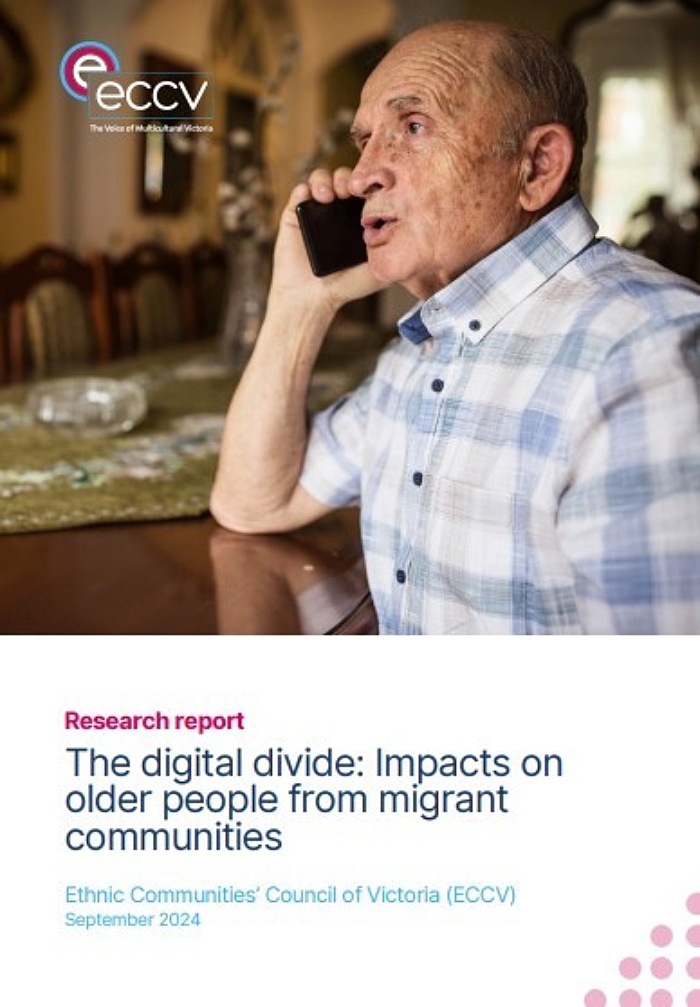
Many older Australians from migrant backgrounds are severely disadvantaged when it comes to grappling with digital technology, according to a new report.
Research released by the Ethnic Communities’ Council of Victoria (ECCV) found multicultural seniors, who already faced language barriers to accessing important information and services, now also struggle with the need to operate online.
The Digital Divide: Impacts on older people from migrant communities revealed that this lack of access can have far-reaching consequences.
These ranged from poorer physical and mental health and less control over decision-making to increased risk of elder abuse, social isolation and a greater vulnerability to exploitation and scams.
ECCV chair Eddie Micallef said digital exclusion was now a critical issue for older people from migrant backgrounds.
“Digital illiteracy has become a new disability, especially for older people who are already facing barriers such as low literacy in English and their own language,” he said.
The report said that during the covid pandemic and associated lockdowns, increased reliance on digital communication heightened the barriers for older people from migrant and refugee backgrounds and increased their susceptibility to online scams.
Mr Micallef said this trend had continued, with many older people from ethnic communities struggling in the face of rapidly changing digital technologies and the growing need to connect online to access government services such as Medicare, do their banking, pay their electricity bills and even pay for car parking.
“We need proactive policies, programs and services that prioritise the human rights and quality of life of all seniors so that no one is left behind.”
The report said the requirement to go online to manage life’s essentials had become ubiquitous, with seniors increasingly asked to log in, create an account, download an app, or navigate their way through English-language website pages to find their way to information in their preferred language.
This was compounded by the fact that not all multicultural seniors are literate in their own language, making access to text-based information problematic.
The report said websites were often incomprehensible to seniors because they used small print, used technical language or jargon, and were inaccessible to people who were vision- or hearing-impaired, which added to the stress faced by seniors trying to navigate the digital landscape.
Widening the digital divide was the fact that not all seniors had the capacity or financial means to obtain internet access, smart phones, laptops or other digital devices – or even email addresses.
“Very often, this presents a substantial impediment to connecting with the supports, services or information they need,” the report found.
While face-to-face culturally appropriate training in their preferred language was the answer for some members of the elderly migrant community, the report conceded that many older people would never become digitally literate.
The report said that for this group, personal contact with support workers and health providers who could speak in their preferred language was crucial, as was the provision of information through ethnic community members and leaders in places where people already met and felt safe and heard.
The report said lucky seniors had a digitally literate family member or friend who spoke their language and could help them.

Those who didn’t often felt ashamed or embarrassed to ask for help after a lifetime of managing their affairs independently and instead gave up, going without the services they needed.
“ECCV’s report makes a range of recommendations to improve digital inclusion, while advocating for the maintenance of critical human-based communication and support,” said Mr Micallef.
The report called for:
ECCV said the research findings were supported by grassroots intelligence from migrant communities and the ethnic support sector.
Research showed that many seniors responded well to culturally appropriate face-to-face training and mentoring.
However, a significant number of older people needed alternative avenues for accessing information and services, such as paper, phone, or face-to-face options.
“Many older people will never become digitally literate, so we must continue to provide digital alternatives,” said Mr Micallef.
“We need proactive policies, programs and services that prioritise the human rights and quality of life of all seniors so that no one is left behind.”
Posted on 07 Oct 2026
Our Community's founder and leader, Denis Moriarty, writes that when he watched an over-the-top…

Posted on 07 Oct 2026
A major public campaign launched this morning is calling on the federal government to restore…

Posted on 07 Oct 2026
The Australian Literacy & Numeracy Foundation (ALNF) has announced a partnership with mining…

Posted on 07 Oct 2026
A conference in Darwin will this morning hear detailed, strategic plans for how Australia could…

Posted on 07 Oct 2026
Joseph Friedman is co-founder and publisher of About Time, Australia’s only newspaper for…

Posted on 30 Sep 2026
There's been a lot of talk about AI this week, and some of it has been frightening. So, is AI good…

Posted on 30 Sep 2026
After the biggest AFL game of the year, one player proudly wore the flag of his birth country and…

Posted on 30 Sep 2026
At 21 years old, Tate Donohoe is the founder of Ecodia, an AI-assisted software development company…

Posted on 30 Sep 2026
Not-for-profit leaders have been warned to be wary of approaches from potential “funding partners”…
Posted on 30 Sep 2026
More than 200 fully funded Centre for Social Impact (CSI) scholarships will help equip for-purpose…

Posted on 30 Sep 2026
Personal stories are among the most powerful tools a charity can have to raise funds and awareness,…

Posted on 23 Sep 2026
In his new book Our Place, policy expert Matt Lloyd-Cope argues that housing must be at the heart…