
NFP tech experts urge orgs to scale up cybersafety
Posted on 15 Oct 2026
Good cybersecurity must be the foundation of not-for-profits’ efforts to adopt artificial…
Posted on 10 Jun 2026
By Matthew Schulz, journalist, Community Directors
Australia’s leading drug and alcohol information provider has used AI to transform the way it educates people – especially young people – about drugs.
The Alcohol and Drug Foundation's (ADF’s) drug information bot, Dib, launched in May 2025 as one of Australia's first purpose-built health information chatbots. Since then, the friendly-looking bot has had more than 27,000 conversations – and the data tells a revealing story.
Sixty per cent of those conversations have been with young people, according to Cinzia Marrocco, the ADF's head of marketing and communications – an audience the foundation never specifically designed for.
"This is really significant for us because our website was not specifically written for young people," Marrocco said. "What we're finding is that through the use of large language models powering our chatbot, young people are coming to our website and engaging in language they understand."
"Often people feel stigmatised or judged, and those feelings can become barriers to accessing information and support. We've worked hard to remove those barriers so people can freely ask questions."
The ADF developed Dib in direct response to a recognised gap in how people research drugs and alcohol online. It found that traditional health websites were hard to navigate, while general AI tools could not be trusted for accuracy. The resulting bot was built with input from an advisory group comprising doctors, academics and people with personal experience of drug and alcohol use.
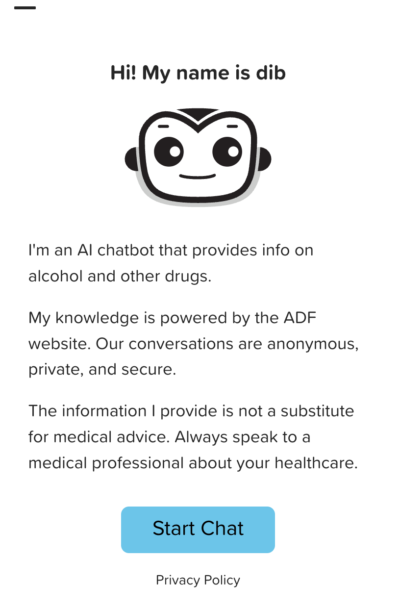
Dib uses retrieval-augmented generation (RAG), drawing answers exclusively from ADF-vetted website content, and it is designed with firm boundaries. For example, the bot will not provide advice on illegal activities such as making or obtaining illicit drugs. It offers users the option to complete the alcohol, smoking and substance involvement screening test (ASSIST), which can help identify risk levels and prompt engagement with support services.
The bot’s central design goal was to tackle stigma, including the stigma people feel when searching for verified drug information online, and the barrier of speaking one-to-one about personal drug use. The bot requires no personal information to use, and every conversation is anonymous.
"Privacy is paramount," Marrocco said. "Often people feel stigmatised or judged, and those feelings can become barriers to accessing information and support. We've worked hard to remove those barriers so people can freely ask questions."
Insight into who is using Dib has been made possible by a sibling tool, Dab (digital analytics bot), which the ADF built with Google Analytics and other AI tools. Dab generates dashboards that track conversations, topics and subtopics, giving the foundation a detailed picture of what people are asking about and where information gaps exist.
"Dib provides us with really rich information about the types of questions people are asking about alcohol and other drugs," Marrocco said. "We use that information to create new content, identify content gaps, and provide information on topics that are generating a lot of questions. This helps us meet the needs of people both on and beyond the website."
Dib conversations are also monitored by automated systems and human reviewers. Marrocco said the ADF’s AI policy was now in its third iteration in 18 months, which reflects the pace at which the organisation has had to adapt its governance frameworks.
For other health and community sector organisations considering similar tools, Marrocco said the ADF is ready to share.
"I think we can all learn from each other in this space," she says. "We're all adapting to rapid technological change, especially when it comes to providing information in our sector. Information about alcohol and other drugs, if not delivered correctly, can have devastating consequences. We're very happy to share our learnings about how we keep Dib safe and how we ensure the people accessing its information are safe as well."
43 examples of NFPs using AIs (including Dib)
Community Directors houses a huge web library of free, practical resources, and here's where to find help related to technology and artificial intelligence. You’ll find guidebooks, templates, policies and more articles covering issues such as data, cybersecurity, technology planning, ethics and using artificial intelligence.
Posted on 15 Oct 2026
Good cybersecurity must be the foundation of not-for-profits’ efforts to adopt artificial…

Posted on 15 Oct 2026
A few years ago, I sat on a small community board that was still held together by email threads and…

Posted on 15 Oct 2026
“Build a better mousetrap, and the world will beat a path to your door”, the old saw goes.…

Posted on 15 Oct 2026
The nation's digital inclusion advocate is pushing for more equity in the rollout of AI in light of…

Posted on 15 Oct 2026
Not-for-profit leaders should be conducting regular “fire drills” that replicate AI-powered…

Posted on 15 Oct 2026
Boards that leave cybersecurity to the one director with IT expertise are leaving their…

Posted on 15 Oct 2026
Community Directors has a warehouse-style office filled with artworks, and if I glance up towards…
Posted on 15 Oct 2026
As the manager of a palliative care service, Stephanie Kirkman Meikle has learnt that the prospect…

Posted on 14 Oct 2026
A special guest with her finger on the pulse of one of the biggest issues facing Australia –…

Posted on 17 Sep 2026
Australia’s biggest gathering of philanthropists, which drew more than 1200 delegates to Brisbane…

Posted on 17 Sep 2026
Experts in Australian philanthropy say there are stark differences between philanthropic money and…

Posted on 17 Sep 2026
One of Australia’s foremost fundraising observers says Australian not-for-profits must get the…