
NFP tech experts urge orgs to scale up cybersafety
Posted on 15 Oct 2026
Good cybersecurity must be the foundation of not-for-profits’ efforts to adopt artificial…
Posted on 13 Aug 2026
By Matthew Schulz, journalist, Community Directors

Not-for-profits are full of people with great ideas, but that doesn’t mean they are set up for innovation that can boost revenue, impact and staff satisfaction.
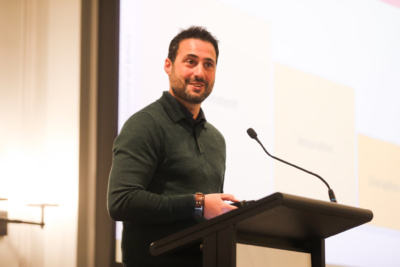
As one of the few people in Australia who has held a dedicated sector role in innovation leadership – there are about 50 holding those positions now – Mike Davis knows from hard-won experience what it takes to make innovation work.
Davis, the founder of Shackleton Labs and former innovation lead at Good Shepherd Australia and New Zealand, spoke with Community Directors ahead of a free webinar called AI and Innovation Readiness.
The one-hour webinar – which targets board members – aims to provide organisations with an understanding of how they can use AI to prepare to innovate, and it will examine several case studies.
"The biggest shock factor in most of my presentations is that people don't even know there's a sector-wide definition of innovation," Davis said. "What is it? How do we do it? How do we understand it? What's the benefit?"
Davis’s preferred definition of innovation is this: “The process, skillset or result of creating new programs or projects that create social and economic value for an organisation, its clients, beneficiaries, partners and community.”
"When you run a pilot, there's an assumption that it might not work, but the learnings that you get from that pilot will help you do the next one better. That's the bullet that everyone has to bite."

Davis said several studies show that successful innovation programs in the sector:
That said, he also points out that an estimated 90–95 per cent of innovation initiatives “fail”, although he qualifies that characterisation.
“When you run pilots, they're not success or fail," Davis said. "When you run a pilot, there's an assumption that it might not work, but the learnings that you get from that pilot will help you do the next one better. That's the bullet that everyone has to bite."
Davis also likes to point to the fact that while innovation is something that 80 per cent of organisations strive for, only about 40 per cent are set up to carry it out.
He stresses that innovation is not just about great ideas.
"It's very easy to just focus on the ideation part of innovation, which is the fun, creative bit. Everyone's got ideas," Davis said. "But when you look at the hype around transformation and then look at the state of the sector, very little is actually coming through the pipeline."
The goal should not be a single program or a burst of new ideas, he said. A well-run, well-designed innovation program should build the culture, skills, governance and leadership to enable innovation to work for an organisation, instead of stalling after the initial pitch.
"People think a lot about the technology and far less about the organisational setting, skills, capability, governance and leadership that are going to drive adoption," Davis said. "That's why you see piecemeal, fragmented approaches to pilots that start, stop, and mostly fail."
Asked why a stretched sector should spend energy and funding on innovation, Davis pointed to the fact that the for-purpose sector was lagging behind the corporate and government sectors. As a result, it was not taking advantage of the benefits that innovation could bring.
"If you look at our sector, it's fair to say it's been starved of funding to support capability, capacity and quality talent, just about every area," he said.
"Because of that chronic underinvestment in the way that not-for-profits run and are funded, there's been a real lack of people in the sector who understand the technology, understand how to work with it, and even have the right technology to deliver the same sort of solutions we've seen in other sectors," he said.
"As a result, the sector's fallen really far behind. Every time there's a shift in technology, our sector takes five to 10 years to reach a similar standard, unless you're a real leader in the space."
Davis said the government had had its own reckoning with declining innovation linked to an over-reliance on outsourcing.
"Government went through an interesting period where it was flush full of consulting jobs, outsourcing everything to consulting," he said. "That was great for the consulting companies, but it meant there wasn't much growth in internal capability or skills.”
He said there had since been a turnaround, with agencies now realising that they needed “to invest resources internally and get better ourselves at doing these hard things."
Similarly, in the third sector the issue was not a shortage of talent, but a lack of a pathway to develop their skillsets.
"We have incredibly capable, bright people," he said. "But if you even think about things like professional development and training people up to be innovators, we don't do any of that." By his own estimate, fewer than 50 people across the entire Australian for-purpose sector hold a genuine innovation leadership role, and many of those are handed the job by chance rather than by design.
"That gap, given all the pressures on the sector now, is getting exponential," Davis said.

Davis said innovation often dies not for lack of enthusiasm, but for lack of a line item.
"Innovation, because it's quite an ambiguous word, is co-opted a lot to sort of bolt on to vision and strategic statements of grandeur and ambition by boards and executive teams," he said.
"What is in the budget to support innovation? We don't see anywhere near enough clear budget lines with items around innovation."
He said examples of budget items included funding for an innovation lab or hiring someone to run an innovation portfolio, instead of folding the responsibility into an existing role.
"If you talk about innovation regularly in CEO emails or board communications, but you haven't got anyone in the organisation who's been hired to manage an innovation portfolio or lead it, then people will not be taking it seriously," he said. "The culture isn't going to lend itself towards being transformational and leading. It'll be a follow-up group instead."
"What gets funded actually gets measured and managed. If it's not actually in the budget, a discrete line item, or a strategic priority, it usually doesn't get done very well. And it's not that important to the organisation, despite what they might be saying."
He is worried that the word has become overused in meetings – without the funding to back it up – and the result is "it's become this buzzword that ends up meaning nothing, because people use it for everything," he said. "It's misappropriated."

Davis said his experience building “AnswerSmart” at Good Shepherd was an example of the promise and the risk of innovation.
A pitch for the project won Good Shepherd's first internal “Shark Tank”, a staff competition Davis ran in 2024 to attract ideas to be piloted and scaled for the organisation.
AnswerSmart grew into two related tools. One used AI to help frontline staff quickly connect people experiencing family and domestic violence with the right service. This could be housing, legal or mental health support, cutting through what could otherwise be an inconsistent referral process across a national organisation.
The other targeted Good Shepherd's human resources function, using an AI tool trained on internal policies so that staff could get instant answers on entitlements instead of tying up HR staff by phone or email. Davis said the tool saved about 30 per cent of time lost to repetitive queries.
The client-facing referral tool is still running today, and it has since attracted grant funding to develop it further. But Davis was candid that the project did not travel as smoothly as it could have.
"We had no policy. We didn't have enough budget. We didn't have the support internally, the culture wasn't right, and we didn't spend enough time on it," Davis said.
Good Shepherd had preserved and adapted the tool, he said, but the early experience of “failure” was partly what had prompted him to guide others to better innovation.
"For many organisations this is going to resonate, because they'll say: that was us," he said.
Davis's framework for closing the innovation readiness gap consists of five drivers.
Davis nominated governance as the issue that often tripped up organisations early.
"Governance is the first thing you've got to get right before you jump into the sandbox," he said.
Culture though, was more important in the longer term. "Culture is probably the biggest enabler or crusher of these opportunities. It's also the hardest thing to change."
And the related issue of leadership behaviour was also key, he said, warning that leaders needed to be flexible.
"Imagine telling someone they've got a 95 per cent chance of failing, and then breathing over their shoulder the whole time," he said. "That's not pleasant for anyone, and they won't want to do it again, regardless of the outcome."
Davis's practical advice for a first project is to avoid ambition.
"This is my favourite problem to solve in AI," he said. "It's thinking about what is the most automatable, low-value task a department is doing, and how do we give that to the [AI] agents, so the people in these teams can focus on higher priority human or client-facing work."
He pointed to policies and procedures, of the kind buried in HR, as a textbook example, rather than anything client-facing or reputationally sensitive. "These are the best use cases, not the hard ones," he said. "You see lots of nutty use cases where organisations want to build a whole office of agents with one head agent running everything. You want to grab the low-hanging fruit – that is actually quite simple. If you nail the first pilot, you'll instil the culture and confidence you need to really run an effective innovation program."
The underlying logic, he said, was about freeing up people to do what only people can do. "How do we repurpose really low-value, automatable tasks to a computer? Because that's what computers are invented for, so people can use creativity, judgement, discretion, and lived and sector experience to make good decisions."
Davis does not dispute that most innovation attempts fail, and he said the high failure rate was on par with those of new businesses and start-ups. But those failures were also learning opportunities.
He cited one program at Good Shepherd as an example of building capability regardless of any single pilot's outcome: a rotating Microsoft Copilot Studio licence, shared with 100 of the organisation's 500 staff, with the group reconvening monthly to compare notes on what was and wasn't working. The point was never that every person's experiment would succeed. "You've got to account for the skills uplift you get from all these people engaging with the tools," Davis said. "It's an argument about what we're looking to uplift capability at the end of the day, and that's something we don't invest well in if you look at learning and development budgets in our sector."
Treating the pilot as a structured experiment rather than a bet that either paid off or embarrassed someone made high failure rate much more tolerable, Davis said.
Although most of the sector’s current conversation about innovation – and tech more generally – centres on AI, Davis said the five-driver framework wasn’t reliant on any single technology.
"Whether you want to do place-based change, systems change work, or whatever type of innovation you want to do, this will all stand up the same way," he said.
Download our free 32-page guide NFP Innovation on a Shoestring
Mike's free webinar: AI and Innovation Readiness
Mike Davis: How innovation can improve results and job satisfaction in the NFP sector
Special editions: technology | artificial intelligence | change management
Find more resources in our tools and resources section
Posted on 15 Oct 2026
Good cybersecurity must be the foundation of not-for-profits’ efforts to adopt artificial…

Posted on 15 Oct 2026
A few years ago, I sat on a small community board that was still held together by email threads and…

Posted on 15 Oct 2026
“Build a better mousetrap, and the world will beat a path to your door”, the old saw goes.…

Posted on 15 Oct 2026
The nation's digital inclusion advocate is pushing for more equity in the rollout of AI in light of…

Posted on 15 Oct 2026
Not-for-profit leaders should be conducting regular “fire drills” that replicate AI-powered…

Posted on 15 Oct 2026
Boards that leave cybersecurity to the one director with IT expertise are leaving their…

Posted on 15 Oct 2026
Community Directors has a warehouse-style office filled with artworks, and if I glance up towards…

Posted on 15 Oct 2026
As the manager of a palliative care service, Stephanie Kirkman Meikle has learnt that the prospect…

Posted on 14 Oct 2026
A special guest with her finger on the pulse of one of the biggest issues facing Australia –…

Posted on 17 Sep 2026
Australia’s biggest gathering of philanthropists, which drew more than 1200 delegates to Brisbane…

Posted on 17 Sep 2026
Experts in Australian philanthropy say there are stark differences between philanthropic money and…

Posted on 17 Sep 2026
One of Australia’s foremost fundraising observers says Australian not-for-profits must get the…