
Pauline Hanson and the frightening lesson of ‘Years and Years’
Posted on 07 Oct 2026
Our Community's founder and leader, Denis Moriarty, writes that when he watched an over-the-top…
Posted on 26 Aug 2025
By David Crosbie, CEO, Community Council for Australia

There is no Department of Charities in the federal government, no red book, no blue book for an incoming minister prepared by a team of diligent public servants. In fact, there are no public servants employed by the federal government to monitor or look after the effectiveness and capacity of the charity sector, nobody monitoring our economic and social contribution to communities.
Of course, charities have a regulator, the Australian Charities and Not-for-profits Commission, and the ACNC does an outstanding job of engaging with the sector and setting standards for governance and reporting. The ACNC is a very good regulator, but it is not an organisation that has a mandate on sector capacity.
And we have one of the best qualified charities ministers in the world in Dr Andrew Leigh. Who else in any government anywhere has a PhD related to community connectedness? And Leigh has written more than a dozen books, including Disconnected in 2010, and Reconnected: A Community Builder’s Handbook in 2020 (with Nick Terrell, his chief of staff). Dr Leigh is an excellent Assistant Minister for Charities in terms of his knowledge, experience, insight and understanding, but he has not been given the significant resources needed to prosecute the charities and not-for-profits reform agenda.
This week I have again been reminded of how difficult it can be to seek support from government for policies that will have a positive sector-wide impact, as I have found myself revisiting the same arguments about what the sector needs to be more productive and effective.

For years, charities have argued the need for longer term contracts to provide more certainty in our sector. Time and again, report after report, consultation after consultation, the case is made – even agreed. But little changes. Short-term contracting and funding uncertainty remain the norm, from both governments and philanthropists. This is the reality for most charities.
Last year, the charity sector was able to obtain a small exemption from the new employment law requirement to make every employee who has been contracted by a charity more than once a permanent member of staff. The exemption CCA argued for and achieved meant that charities could align employment contracts using fixed term contracts to the term of their funding agreement, within certain limitations.
If a charity obtained a one-year funding agreement to run a program, it could employ someone on a one-year fixed contract, and if it was rolled over for another 12 months, the same staff member could re-contract for another 12 months, and again the next year.
Of course, if the contract was for five years or more, or the employee had been employed by the charity in any capacity for a total of seven years, they still needed to be employed as a permanent member of staff.
The exemption to the requirement to employ staff on a permanent basis after two years or a maximum two contracts (if total employment was under two years) is due to run out at the end of this year, and unions oppose the continuation of the exemption. The Department of Employment and Workplace Relations is now consulting on the issue and has held meetings and attended forums on the exemption. CCA is not confident that the harm done by charities having to divert funds from their purpose to provide for possible redundancy liabilities for staff employed against short-term funding contracts is seen as a serious issue. Having to make provision for redundancy is not seen as a barrier to permanently employing staff who were previously contracted, even when the funding is likely to cease within 12 or 24 months. Charities choosing to be honest about the likelihood of staff losing their role if the funding is not rolled over (again) and only employing staff on contracts for as long as the funding allows is being portrayed by some as bad management.
“It’s clear that doing good work is not enough, persevering is not enough, continuing to make the arguments and promote the value of our contribution to our communities is not enough. Even winning short term reprieves is not enough. All of us need to be better advocates.”
Ideally, CCA’s submissions outlining these and other related issues would have been backed up with a comprehensive set of statistics about patterns of employment across the charity sector. No such statistics exist, which allows the unions to talk about current employment patterns as though everyone employed in the charity sector operates under the Social, Community, Home Care and Disability Services Industry Award (SCHADS award) and is fully supported by government funding. This is clearly a misrepresentation of reality. But without a more comprehensive sector overview, this is a view government tends to adopt.
In practice, I fear the only way CCA will be taken seriously in advocating to give charities some limited flexibility in when they contract staff and when they permanently employ them is to win enough support in the Senate to force a compromise – which is how the exemption came into being in the first place. Winning this support is a task CCA is now engaged in.
The second issue that again brought home the reality of advocacy for whole-of-sector support from government relates to the lack of cybersecurity funding for charities and not-for-profits. We know from Infoxchange surveys that our sector is highly vulnerable to cybersecurity attacks and that the sector often holds important personal information as well as payment methods and details.
Many government departments have received additional funding to deal with cybersecurity threats, as has the small business sector. But despite intensive collaborative lobbying from many across the charity and not-for-profit sector (including CCA) and a concerted effort to work with government to design the best responses, no funding has been made available to support much-needed cybersecurity programs. And paying the full cost of service delivery, including recognising and paying a fair contribution towards supporting the organisational capacity programs rely on, is a rare exception. Not the norm.
The submissions from our sector are noted, but again and again governments choose not to act on what is needed to enable charities to be more productive and effective.
It’s clear that doing good work is not enough, persevering is not enough, continuing to make the arguments and promote the value of our contribution to our communities is not enough. Even winning short-term reprieves is not enough. All of us need to be better advocates. And that is the key challenge, not just to CCA and other peaks, but to all of us across the charity and not-for-profit sector. If we want things to change, we have to begin by changing ourselves.
Posted on 07 Oct 2026
Our Community's founder and leader, Denis Moriarty, writes that when he watched an over-the-top…

Posted on 30 Sep 2026
There's been a lot of talk about AI this week, and some of it has been frightening. So, is AI good…

Posted on 30 Sep 2026
After the biggest AFL game of the year, one player proudly wore the flag of his birth country and…

Posted on 23 Sep 2026
In his new book Our Place, policy expert Matt Lloyd-Cope argues that housing must be at the heart…

Posted on 23 Sep 2026
There are solutions to counter the rise of One Nation but they might not be residing in the mess…

Posted on 03 Sep 2026
Denis Moriarty has an issue with insurance companies varying premiums because of what they perceive…
Posted on 02 Sep 2026
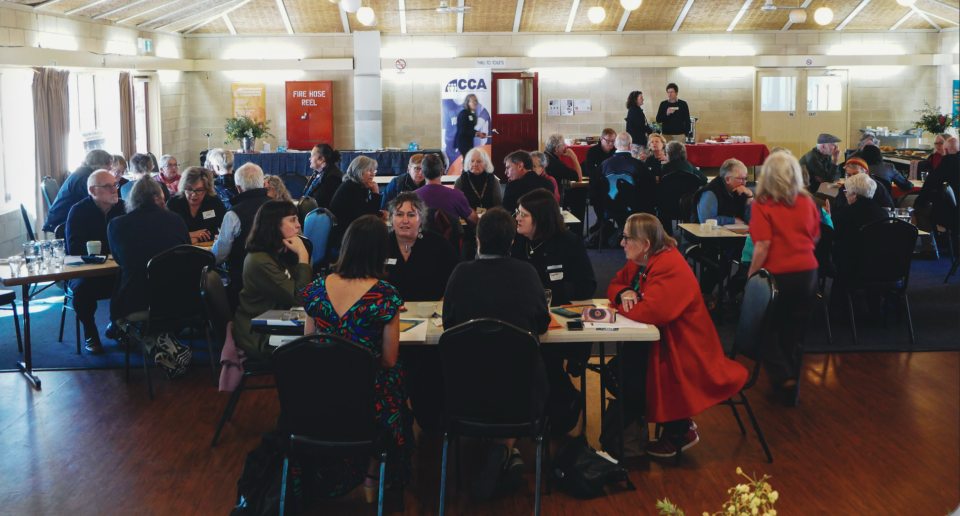
Yesterday, at a meeting just outside Castlemaine in Victoria, 70 people came together to hear…

Posted on 26 Aug 2026
Our Community's founder and leader, Denis Moriarty, says he commissioned a new piece of street art…

Posted on 19 Aug 2026
Government funding is at the centre of Australia's charity and not-for-profit sector – our number…

Posted on 12 Aug 2026
Our Community's founder and leader, Denis Moriarty, says fostering a child was his worst nightmare,…

Posted on 05 Aug 2026
The charity and not-for-profit sector is vital to our economy and the wellbeing of communities…

Posted on 05 Aug 2026
As the Global Impact Summit kicks off in Sydney today, Equitable Philanthropy’s Catherine Brooks…