
25 years after Tampa, the politics of fear are still setting the terms
Posted on 14 Oct 2026
In the ongoing political debates about migration levels, Asylum Seeker Resource Centre founder Kon…
Posted on 18 Feb 2026
By David Crosbie, CEO, Community Council for Australia

Around 50 per cent of all funding for charities in Australia comes from government. The nature of this funding, how it is granted, the terms and agreements it requires, who gets it, how it is accounted for, and the performance measures and reporting all make a big difference to charities across Australia and the communities they serve.
Government funding is one of the most critical aspects of the ecosystem in which charities operate.
There is a lot of talk about philanthropy and fundraising in our sector, but seemingly much less talk about government funding. That makes no sense at one level. Philanthropy contributes less than one fifth of the revenue government funding provides (philanthropy accounts for around 8.5 per cent of all charity revenue).

And yet the lack of discussion about government funding also makes sense, because many charities are concerned about criticising governments when they are also seeking government grants. Government funding can not only make or break many charities, the way that grant programs are administered can completely distort the nature of charity service provision across Australia.
Four years ago, the Australian National Audit Office (ANAO) reviewed the then Streamlining Government Grants Administration (SGGA) program (grants hubs) approach to government grant giving. Below are the first two statements in the summary conclusion of the ANAO report. This is a long quote, but I think it makes important points that deserve acknowledgement:
Conclusion
11. There is insufficient evidence to demonstrate the SGGA Program improved the effective and efficient delivery of grants administration. Core deliverables were not achieved, and shortcomings in the design and operation of the (grant) hubs impacted on the realisation of the intended SGGA Program benefits (better outcomes for grant applicants and recipients, reduction in red tape, and efficiencies for government).
12. The design and governance of the SGGA Program was not effective. The design of the SGGA Program was not supported by a sound evidence base. Governance arrangements were established, but did not support achievement of program outcomes, benefits and deliverables. Planning was not seen through to completion, impacting the achievement of deliverables. There was a benefits realisation framework, but it was not applied. The SGGA Program could not demonstrate the achievement of intended outcomes due to a lack of measurable indicators, baselines and targets. In relation to core deliverables, DSS and Industry built two grants hubs, but did not deliver a single whole-of-government grants administration process with six different workflows, a data warehouse or market testing…
Operation of Grants Hubs, Australian National Audit Office
The ANAO report notes that in the year 2019–20 the programs it was examining granted $8.4 billion to 36,279 service providers through 768 separate grant programs.
768 grant programs seems like a big number, but these grant programs account for less than 10 per cent of the over $100 billion charities received in revenue from governments across Australia in 2023.
“For CCA, one of the main concerns about government grants is the lack of active engagement or meaningful dialogue between the charity and not-for-profit sector and grant-giving agencies about how government contracting can be improved.”
These big numbers not only reinforce the importance of government grants to charities, they also highlight that one of the most important roles of government is to properly administer government funds distributed through grant programs.
There are many well administered government grant programs operating in Australia. There are also some innovative grant program initiatives being rolled out by some government departments: ongoing funding partnerships, co-design of programs, long term core funding models, etc. These initiatives are welcome, but too many of these “exceptional” grant funding arrangements will come and go, exist for a time and then fade away under the pressure of government departments needing to find savings or roll out quick-fix programs and announcements to meet political ends.
Grant programs are arguably better administered now than previously with more extensive use of programs like SmartyGrants, but CCA is still regularly contacted by charities who have been through what could only be described as a distressing, time-consuming and dysfunctional government grant program experience.
The tendency for government to adopt short-term, short-changed funding arrangements that require extensive applications for limited funding that doesn’t fully pay the cost of the service or program provision being contracted is still not unusual.
If you look hard enough in the federal Department of Finance you will find a Grants Policy Branch, seemingly responsible for improving government grant processes. As the department’s website puts it, “The Branch is reviewing Commonwealth grants administration practices through the Modernising Commonwealth Grants Administration project. This looks to ensure Commonwealth grants administration is efficient, user focussed, technology enabled, data driven and fit-for-purpose.”
As a peak body, CCA has put forward questions about the work of the Grants Policy Branch through the Senate Estimates process. We await responses.
For CCA, one of the main concerns about government grants is the lack of active engagement or meaningful dialogue between the charity and not-for-profit sector and grant-giving agencies about how government contracting can be improved. There is no evidence that the Department of Finance Grants Policy Branch is itself adopting a “user focussed” approach.
The bottom line is that the productivity and effectiveness of the charity sector depend in part on the way governments run grant programs.
It’s critical our sector has meaningful dialogue with governments to ensure everyone fully benefits from the $110 billion worth of government grants going to Australian charities.
If governments across Australia are genuinely committed to greater productivity and effectiveness of their grant programs, a good first step would be to actively engage with the charity and not-for-profit sector about how they could improve their grant policies and practice.
We’d all be happy to help.
David Crosbie has been CEO of the Community Council for Australia for the past decade and has spent more than a quarter of a century leading significant not-for-profit organisations, including the Mental Health Council of Australia, the Alcohol and Other Drugs Council of Australia, and Odyssey House Victoria.
Posted on 14 Oct 2026
In the ongoing political debates about migration levels, Asylum Seeker Resource Centre founder Kon…

Posted on 14 Oct 2026
Over the weekend, federal Liberal leader Angus Taylor told the Conservative Political Action…

Posted on 07 Oct 2026
Our Community's founder and leader, Denis Moriarty, writes that when he watched an over-the-top…

Posted on 30 Sep 2026
There's been a lot of talk about AI this week, and some of it has been frightening. So, is AI good…

Posted on 30 Sep 2026
After the biggest AFL game of the year, one player proudly wore the flag of his birth country and…

Posted on 23 Sep 2026
In his new book Our Place, policy expert Matt Lloyd-Cope argues that housing must be at the heart…

Posted on 23 Sep 2026
There are solutions to counter the rise of One Nation but they might not be residing in the mess…

Posted on 03 Sep 2026
Denis Moriarty has an issue with insurance companies varying premiums because of what they perceive…
Posted on 02 Sep 2026
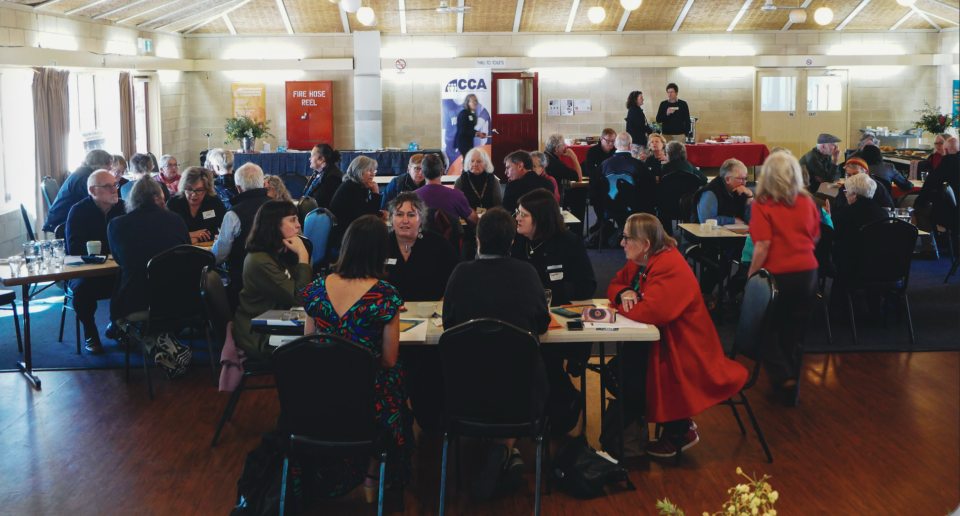
Yesterday, at a meeting just outside Castlemaine in Victoria, 70 people came together to hear…

Posted on 26 Aug 2026
Our Community's founder and leader, Denis Moriarty, says he commissioned a new piece of street art…

Posted on 19 Aug 2026
Government funding is at the centre of Australia's charity and not-for-profit sector – our number…

Posted on 12 Aug 2026
Our Community's founder and leader, Denis Moriarty, says fostering a child was his worst nightmare,…