
Pauline Hanson and the frightening lesson of ‘Years and Years’
Posted on 07 Oct 2026
Our Community's founder and leader, Denis Moriarty, writes that when he watched an over-the-top…
Posted on 24 Sep 2025
By David Crosbie, CEO, Community Council for Australia

If a business ran the government, a corporatocracy would likely emerge, prioritising profit over social good, leading to a government focused on corporate interests rather than citizen well-being. Essential services could suffer, like public safety or education, as their profitability would be questionable. This shift could result in reduced public services, increased economic inequality, greater environmental damage, and a government that prioritises corporate needs and benefits over the general population. (AI summary of corporatocracy)
The US is lurching towards becoming a corporatocracy.
One of the most worrying aspects of the emerging corporatocracy is the US administration’s determination to limit the effectiveness of the not-for profit sector. When I talk with colleagues in the US, I hear that they’re finding it increasingly difficult to operate in what is becoming a legal and political minefield.
It’s not surprising that US not-for-profits are targets in the US. Charities and not-for-profits are one of the most important protections against the various forms of corporatocracy.
In Australia, charities and not-for-profits are the heartbeat of our communities, supporting us all in countless ways. Our sector offers services in critical areas of our lives: health, education, arts, environment, emergency services, employment, housing, disability, media, aged care, childcare – you name it, there’s a charity out there making a difference.
Beyond providing vital services in our communities, many charities and not-for-profits take on an even bolder role: holding governments to account, pushing for policies that serve all Australians, not just a privileged few. This advocacy for government policies and practices that are about public benefit rather than financial gain for those who are already wealthy is a critical aspect of the work of the Australian charity and not-for-profit sector.
There is also a special group of charities and not-for-profits that operate as a buffer between our communities and the power of big business.
I note that there are many good businesses in Australia seeking to strengthen their communities and wanting to achieve a better Australia as well as generate a profit. But there are also companies that have a track record of repeatedly putting profits well above any community or environmental concerns.
“What I see as the emerging strength in many of these organisations is that they’ve done the hard work. They draw on solid evidence and offer solutions, not just slogans; they promote practical ways forward that will make a difference, not just criticism of what is.”
Perhaps the best examples in Australia of charities and not-for-profits that face a daily David and Goliath struggle against vested business interests are the environmental organisations battling against the immense power and wealth of fossil fuel giants.
But they’re not alone. In practice, the battlegrounds between our sector and exploitative big business are many and varied.
Currently, there are Australian charities and not-for-profits standing up to the global tech titans, calling out the rampant data theft and the monetisation of our personal information, and working to place limits on the damage tech companies can do to the most vulnerable, including our children.
Other charities and not-for-profits are pushing back against the relentless marketing and exploitation of alcohol, tobacco and gambling companies, demanding that public interest and safety are not sacrificed on the altar of corporate profit.
This week, we’ve seen the Australian Communications Consumer Action Network, a member of the Community Council for Australia, publicly taking on the lack of regulation and accountability within telco companies that have clearly put profits above community safety and wellbeing.
What unites these charities and not-for-profits is their willingness to call out inappropriate behaviour from mega-corporations even though many of these companies have massive war chests to protect their profits. Many of these same companies are backed by mainstream media and politicians they have bought off in one way or another.
What inspires me most isn’t just the courage these charities and their leaders show in challenging exploitation by the powerful, although all too often they do not get the praise they deserve. What I see as the emerging strength in many of these organisations is that they’ve done the hard work. They draw on solid evidence and offer solutions, not just slogans; they promote practical ways forward that will make a difference, not just criticism of what is. They build collaborations. They have good people working behind the scenes developing well informed policies.
Policy work in charities is not always valued, but if we are to make sustainable changes in people’s lives, the economic, regulatory and political structures that drive both good and bad practice need to be addressed. Knowing what’s wrong and knowing where we need to get to is only part of the story. We don’t celebrate our policy workers enough, but without them the depth and strategic direction of our advocacy are limited.
When we think about charities and not-for-profits in Australia and the role they play, we should never underestimate the importance of the leaders in our sector who call out and stand up to inappropriate and exploitative practices. The buffer they bravely provide against much more powerful vested interests is a critical component in preserving our democracy and enabling us to achieve the kind of Australia we would like to live in.
David Crosbie has been CEO of the Community Council for Australia for the past decade and has spent more than a quarter of a century leading significant not-for-profit organisations, including the Mental Health Council of Australia, the Alcohol and Other Drugs Council of Australia, and Odyssey House Victoria.
Posted on 07 Oct 2026
Our Community's founder and leader, Denis Moriarty, writes that when he watched an over-the-top…
Posted on 30 Sep 2026
There's been a lot of talk about AI this week, and some of it has been frightening. So, is AI good…

Posted on 30 Sep 2026
After the biggest AFL game of the year, one player proudly wore the flag of his birth country and…

Posted on 23 Sep 2026
In his new book Our Place, policy expert Matt Lloyd-Cope argues that housing must be at the heart…

Posted on 23 Sep 2026
There are solutions to counter the rise of One Nation but they might not be residing in the mess…

Posted on 03 Sep 2026
Denis Moriarty has an issue with insurance companies varying premiums because of what they perceive…
Posted on 02 Sep 2026
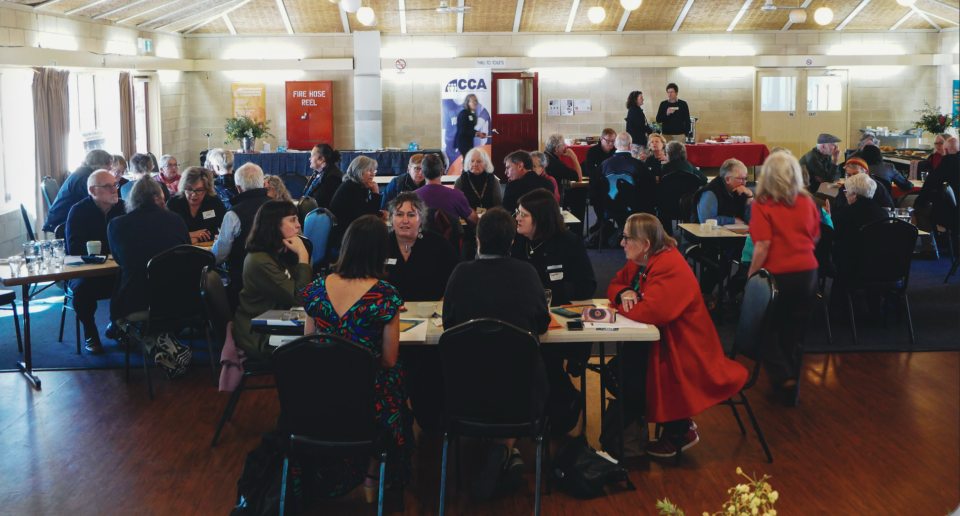
Yesterday, at a meeting just outside Castlemaine in Victoria, 70 people came together to hear…

Posted on 26 Aug 2026
Our Community's founder and leader, Denis Moriarty, says he commissioned a new piece of street art…

Posted on 19 Aug 2026
Government funding is at the centre of Australia's charity and not-for-profit sector – our number…

Posted on 12 Aug 2026
Our Community's founder and leader, Denis Moriarty, says fostering a child was his worst nightmare,…

Posted on 05 Aug 2026
The charity and not-for-profit sector is vital to our economy and the wellbeing of communities…
Posted on 05 Aug 2026
As the Global Impact Summit kicks off in Sydney today, Equitable Philanthropy’s Catherine Brooks…