
‘The mind boggles’: federal envoy blasts NT housing decision
Posted on 14 Oct 2026
The federal government’s special envoy for social housing and homelessness, Josh Burns MP, has…
Posted on 18 Mar 2026
By Nick Place, journalist, Community Directors

A unique new guide aims to help Australian organisations create more respectful and inclusive workplaces for staff who self-identify as neurodivergent by collecting data on neurodivergence in their workforces.
Created by Amaze, a not-for-profit that aims to create a more inclusive world for autistic people and their families, and Diversity Council Australia (DCA), the guide draws on insights from a national community survey of almost 3000 people, including more than 2200 neurodivergent individuals, plus HR, diversity and inclusion professionals.
Neurodiversity Data at Work aims to provide practical, evidence-based guidance on collecting neurodiversity data through HR systems and workplace surveys, the authors said. It is grounded in lived experience and national and international research.

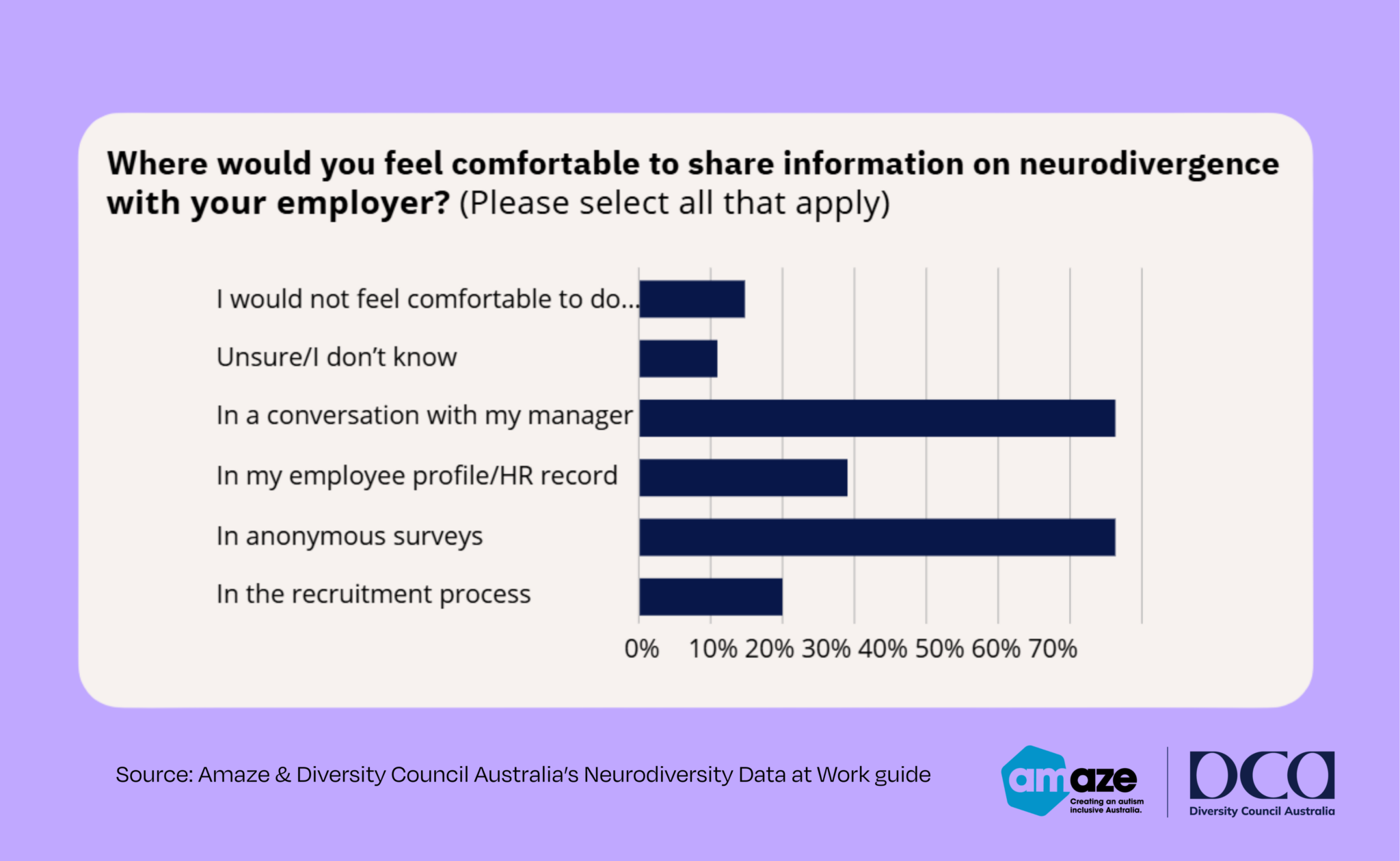
The guide highlights that there is still stigma attached to neurodiversity in Australia. For example, when asked how comfortable they would be in sharing information about neurodivergence with their employer, 15 per cent of employees surveyed said they flat out would not feel comfortable doing so, while another 20 per cent said they would not be comfortable raising neurodiversity in the recruitment process. Most said they would be okay about sharing such information in a one-on-one meeting with their manager or in an anonymous survey.
“Neurodiversity is increasingly recognised in workplaces, but it is rarely visible in workforce data,” said the CEO of Amaze, David Tonge.
“Without that visibility, organisations cannot see where barriers sit or whether their inclusion efforts are improving outcomes. Establishing safe, voluntary ways to understand workforce neurodiversity is a critical step toward designing workplaces where neurodivergent people can participate and progress,” he said.
Meaningful inclusion of neurodivergent workers had been hampered by a lack of data and understanding, said DCA CEO Catherine Hunter.
“An estimated 15 to 20 per cent of people are neurodivergent, yet until now, many organisations haven’t had the tools they need to understand their employees’ experiences or the barriers they face at work,” she said.
“Capturing neurodiversity data safely and respectfully is a vital first step toward identifying and removing these barriers. The guide places people’s lived experiences at the centre, prioritises trust and safety, and provides practical, evidence-based support to help organisations use data to drive positive change.”
Speaking to the Community Advocate, Tonge said the lack of available data meant even well-meaning companies could be blind to how neurodivergent employees may be struggling.
“What we hear is, ‘Well, no one’s disclosed it, therefore we must be doing a good job,’ or ‘There’s not enough evidence to prompt us to do anything,’” he said. “You hear these comments from business leaders sometimes who are probably not as neurodiversity-affirming because they don’t understand and they don’t necessarily have the data to help them understand what percentage of the workforce might have some additional needs, or [ways employees might] be able to potentially share a bit about themselves that could make them either more engaged, more productive, or feel more safe.
“Just because the data doesn’t exist doesn’t mean it’s not happening. It’s like this hidden thing. If you don’t measure or monitor, how can you work out if there are any changes that you can do?”
“Just because the data doesn’t exist doesn’t mean it’s not happening. It’s like this hidden thing. If you don’t measure or monitor, how can you work out if there are any changes that you can do?
“Or in fact, for all this money you’ve spent on your DEI [diversity, equity and inclusion] teams over the years, what have they done? Unless you measure it, how are you going to prove that? If you’re a bigger organisation, how are you going to report on that and say, well, actually, we’ve got a better engaged workforce.”
Tonge said the power of the guide was that it offered leaders and human resources managers an opportunity to start conversations with staff, and be “quite sensitive and safe with it, rather than being: have you got a disability? Give us the documentation!”
He said it was reasonable that employees were only willing to share such personal information if they felt the information would be treated with respect, would be confidential and secure, and would actually lead to changes that could make their work more efficient, more productive and more supportive.
Amaze and DCA said the Neurodiversity Data at Work guide outlines six guiding principles for respectful, safe and accurate data collection, alongside step-by-step guidance on how to approach collecting neurodiversity data – including sample questions and reporting suggestions.
“Crucially, this guide supports organisations to build trust, protect privacy, manage risk and commit to meaningful action,” said Hunter.
“Neuroinclusion isn’t about fitting people into existing systems. It’s about co-designing workplaces that work for all minds. Neurodiversity Data at Work helps organisations move beyond assumptions, reduce stigma, and create environments where everyone can perform at their best – which ultimately unlocks more productive, more engaged and more innovative workplaces.”
The guide helps employers to establish baseline data that can be used alongside other workforce insights to:
Tonge said companies that embraced the guide could, in fact, enjoy a competitive advantage. “If they’re a great employer and they can say we’re an employer of choice and we’ve got 25 per cent of employees who identify and that describe themselves as living with some neurodivergence, and they’ve got loyal staff, it could be a real selling point for other neurodivergent potential employees as well. It’s win-win in my mind.”
The guide can be accessed here, at DCA's website.
Posted on 14 Oct 2026
The federal government’s special envoy for social housing and homelessness, Josh Burns MP, has…

Posted on 14 Oct 2026
The Reserve Bank’s move to ban card payment surcharges has led to complications for charities and…

Posted on 14 Oct 2026
A special guest with her finger on the pulse of one of the biggest issues facing Australia –…
Posted on 07 Oct 2026
A major public campaign launched this morning is calling on the federal government to restore…

Posted on 07 Oct 2026
The Australian Literacy & Numeracy Foundation (ALNF) has announced a partnership with mining…

Posted on 07 Oct 2026
A conference in Darwin will this morning hear detailed, strategic plans for how Australia could…

Posted on 30 Sep 2026
Not-for-profit leaders have been warned to be wary of approaches from potential “funding partners”…
Posted on 30 Sep 2026
More than 200 fully funded Centre for Social Impact (CSI) scholarships will help equip for-purpose…

Posted on 30 Sep 2026
Personal stories are among the most powerful tools a charity can have to raise funds and awareness,…

Posted on 23 Sep 2026
A just-released major global survey of charities has found that demand for charity assistance has…
Posted on 23 Sep 2026
Fresh from welcoming delegates to last week’s Philanthropy Australia conference in Brisbane,…

Posted on 23 Sep 2026
A national strategy to develop Australia's regional cities is needed to break the housing…