
Pauline Hanson and the frightening lesson of ‘Years and Years’
Posted on 07 Oct 2026
Our Community's founder and leader, Denis Moriarty, writes that when he watched an over-the-top…
Posted on 12 May 2025
By Greg Thom, journalist, Institute of Community Directors Australia

Advocating for the community sector to be front and centre in the national conversation should be a priority goal when dealing with the new federal government, according to a senior sector leader.
Australian Council of Social Services (ACOSS) CEO Cassandra Goldie said it was important the sector did not miss the opportunity to achieve better outcomes for disadvantaged Australians presented by the return to power of the Albanese government.
“We have not got a government that puts the community sector front and centre,” said Goldie.
“There's a lot of talk about productivity in business and it can be very excluding of the community sector.

“So, I think this is sort of first order of business for us as we seek to engage again with a new government that is coming in.”
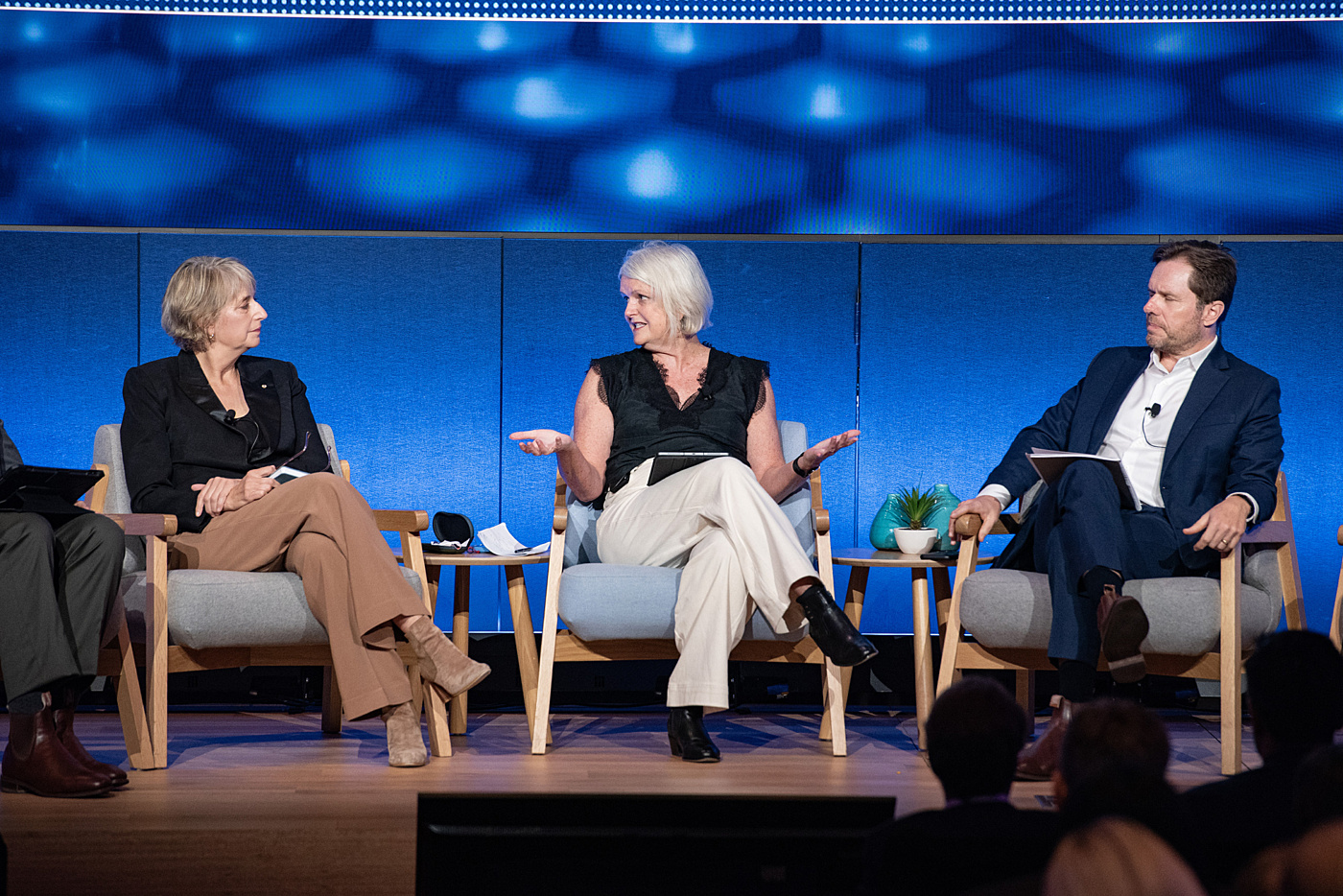
Goldie made the comments during a panel discussion at the recent Infoxchange Technology for Social Justice conference in Melbourne.
The Future of the Sector and Role of Technology: Where To From Here? panel also included ACNC commissioner Sue Woodward, The Smith Family CEO Doug Taylor, and Brett Szmajda, general manager of the National Artificial Intelligence Centre (NAIC).
The panel was moderated by Institute of Community Directors Australia journalist Matthew Schulz.
Much of the panel discussion explored the implications of artificial intelligence (AI) adoption by the sector, which has increased substantially over the past year.
Infoxchange's 2024 Digital Technology in the Not-for-Profit Sector Report revealed that 76 per cent of organisations are now using AI tools, up from 52 per cent the year before.
Goldie said if handled properly, harnessing innovative technology such as AI could help the sector act as a counterweight to the rise of far-right politics in Australia.
“I think it’s of concern that the rise of the far right in Australia is still real and it is more important than ever to be a counterforce to that,” she said.
“We see incredible opportunities with AI from an efficiency perspective, but the filter on efficiency is always effectiveness.”
Goldie said the key to doing this successfully was to use the potential benefits that flowed from technological innovation to focus more on love of community and human connection.
“I think we really have to take that up and just say this (AI) is not about losing more jobs, it's actually about putting more care customers into Centrelink,” she said.
“You know, real people on the end of a phone who can actually provide the support, and they are supporting the technology to do the job.”
Goldie said the government spent a great deal of time talking about productivity, which is often code for cutting costs.
“Within the whole of the government and bureaucracy, good people are under pressure constantly looking to find ways to save money.
“We (sector) have to back in a different discussion to say, actually, we have to be investing more in the kind of economic and social activity which is human beings and the technology that's behind that.
“The way to use new technology is not to disconnect ourselves from human beings, but actually to use the efficiencies (created) out of that so that we spend more time, real time with real people, caring for each other and looking after communities and the social outcomes that can come from that.”
The Smith Family CEO Doug Taylor agreed and said a principled approach to AI should be firmly on Canberra’s agenda.
“I think there’s a huge opportunity to really shape those principles, for our organisations to advocate and influence corporations and the principles they use and in turn governance, so we don’t see some of the risks play out,” he said.
Taylor said data, digitisation, digital inclusion and AI were all core elements of The Smith Family’s strategy to close the gap in educational equity for young Australians.
The overriding principle to transforming its operations in this way was to do so while maintaining a level of humanity.
“We are finding ways to invest in those opportunities as best we can but also be very focused on the first principle of do no harm.”
Taylor listed examples ranging from the use of bots to improve fundraising, to a new trial of AI tutoring for 700 students as examples of its commitment to harnessing the power of technology to do good.
“We see incredible opportunities with AI from an efficiency perspective, but the filter on efficiency is always effectiveness,” said Taylor.
“The degree to which we can demonstrate better outcomes for the young people that we’re absolutely focused on.”
Watch the video of the full panel discussion below.
Posted on 07 Oct 2026
Our Community's founder and leader, Denis Moriarty, writes that when he watched an over-the-top…

Posted on 07 Oct 2026
A major public campaign launched this morning is calling on the federal government to restore…

Posted on 07 Oct 2026
The Australian Literacy & Numeracy Foundation (ALNF) has announced a partnership with mining…

Posted on 07 Oct 2026
A conference in Darwin will this morning hear detailed, strategic plans for how Australia could…

Posted on 07 Oct 2026
Joseph Friedman is co-founder and publisher of About Time, Australia’s only newspaper for…

Posted on 30 Sep 2026
There's been a lot of talk about AI this week, and some of it has been frightening. So, is AI good…

Posted on 30 Sep 2026
After the biggest AFL game of the year, one player proudly wore the flag of his birth country and…

Posted on 30 Sep 2026
At 21 years old, Tate Donohoe is the founder of Ecodia, an AI-assisted software development company…

Posted on 30 Sep 2026
Not-for-profit leaders have been warned to be wary of approaches from potential “funding partners”…
Posted on 30 Sep 2026
More than 200 fully funded Centre for Social Impact (CSI) scholarships will help equip for-purpose…

Posted on 30 Sep 2026
Personal stories are among the most powerful tools a charity can have to raise funds and awareness,…

Posted on 23 Sep 2026
In his new book Our Place, policy expert Matt Lloyd-Cope argues that housing must be at the heart…