
When meaningful work becomes too much
Posted on 04 Nov 2026
Working for a cause you believe in can be deeply rewarding, but it can also lead to burnout. Jackie…
Posted on 04 Nov 2026
By David Crosbie, CEO, Community Council for Australia

I watched an angry man on the TV news. “Australia is stuffed, going backwards,” he said. “No one is doing anything about it.” Around him, a sea of protesters agreed.
My first instinct was to dismiss him, because his anger was aimed at migrants, governments, and welfare payments to the marginalised. But there’s more to this story.
There are plenty of theories about why we’ve become so angry, and about the roles played by social media and technology. But one issue underpins them all: our money doesn’t go as far as it used to. Food, transport and medicine – everything seems to cost more. Rich or poor, we all know it. And the consequences extend well beyond our economy.
On paper, Australia is doing fine. The economy grew by 2.1 per cent in the past 12 months, compared with 1.2 per cent in the UK. Unemployment is 4.7 per cent. We’re not in recession (yet), and interest rates are well below the 17% of the early 1990s even with this week’s rises.
Yet consumer confidence is at a 30-year low, and most people say they were better off five years ago.
Importantly, the economic pain isn’t shared evenly.
Older wealthy Australians with high home equity and savings see rising prices as an inconvenience rather than a crisis. But renters, people on low or fixed incomes, and people relying on government payments have no wealth buffer. Many young people can’t cover their day-to-day costs, let alone hope to save enough to own a home. While some of the big businesses are posting record profits, most small businesses are feeling the squeeze. The divide in our experience of cost-of-living increases runs through our geography too: city versus country, wealthy suburbs versus poorer areas.
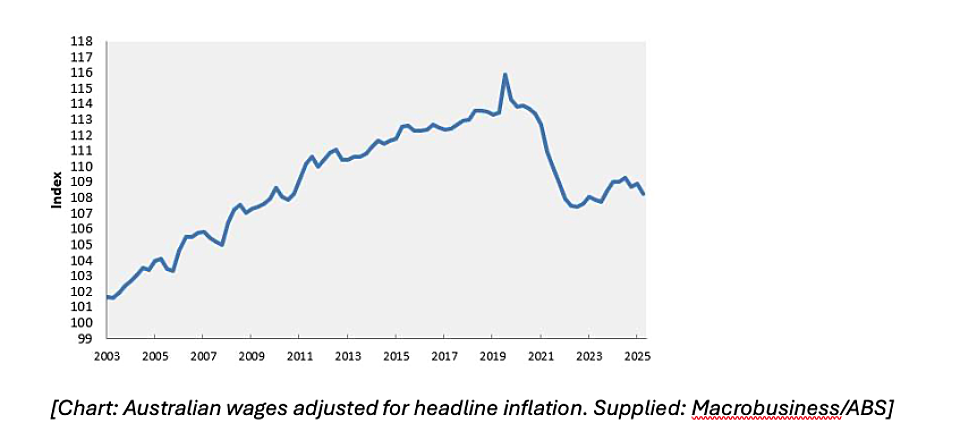
So in many ways, the angry man is right. Most of us are worse off. Adjusted for inflation, wages are back at 2011 levels, but we’re paying 2026 prices. And housing, among other essentials, is much less affordable.
In our sector, cost-of-living increases hit charities and NFPs in many ways. Just keeping the doors open is a struggle, which leaves little to invest in digital technology, AI, staff training and development, energy transition or new infrastructure.
Donations get harder to win as consumer confidence and real disposable income fall. Governments are looking for cuts, not new spending. And demand for essential services keeps climbing as needs grow in our communities.
The rising inequality across our communities feeds a level of distrust which can make working with marginalised communities even harder.
Politics offers no easy fix. Cutting back on government spending is always popular, until the cuts actually happen, and then they’re not. A good recent example is what happened when the federal government chose to reduce government-funded welfare for the rich through budget changes to tax concessions on negative gearing, capital gains and family trusts. The righteous outcry of those with family trusts and property investments continues to fuel well-resourced national campaigns against the government.
Higher taxes are not an easy solution. Any government push for increased taxes would create an unmissable political target for its opponents (I personally favour a targeted and limited estate duties tax on the super-rich).
“Despite facing their own pressures, charities and NFPs stand between Australians’ justified frustration and the unravelling of social cohesion.”
The current economic squeeze makes charities and NFPs more important than ever. Despite facing their own pressures, charities and NFPs stand between Australians’ justified frustration and the unravelling of social cohesion.
As Demographics Group co-founder Simon Kuestenmacher wrote earlier this year in InDaily, “A nation’s most important infrastructure isn’t just roads and rail, it’s the invisible network of trust that allows strangers to cooperate and feel as part of the same nation. And unlike highways, that infrastructure grows every time people actually meet and work together on eye level.”
We can’t dismiss the anger or the push for radical change in a society that no longer feels fair. What we can do is act collectively as a sector through groups like the Community Council for Australia and other peak bodies to provide options for increasing hope, understanding and opportunity.
Most importantly, we can make sure the answer to inequality isn’t blaming marginalised “others”, but having the courage to work together and build a fairer Australia, the kind of Australia we all want to live in.
David Crosbie has been CEO of the Community Council for Australia for the past decade and has spent more than a quarter of a century leading significant not-for-profit organisations, including the Mental Health Council of Australia, the Alcohol and Other Drugs Council of Australia, and Odyssey House Victoria.
Posted on 04 Nov 2026
Working for a cause you believe in can be deeply rewarding, but it can also lead to burnout. Jackie…
Posted on 28 Oct 2026
Altering Australia’s path from anger and potential violence needs more than asking one another to…

Posted on 28 Oct 2026
Are compliance processes crowding out the boardroom conversations that really matter? The…

Posted on 21 Oct 2026
The wider not-for-profit sector doesn't pay much attention to owners corporations, but maybe it…
Posted on 14 Oct 2026
In the ongoing political debates about migration levels, Asylum Seeker Resource Centre founder Kon…
Posted on 14 Oct 2026
Over the weekend, federal Liberal leader Angus Taylor told the Conservative Political Action…
Posted on 07 Oct 2026
Our Community's founder and leader, Denis Moriarty, writes that when he watched an over-the-top…
Posted on 30 Sep 2026
There's been a lot of talk about AI this week, and some of it has been frightening. So, is AI good…

Posted on 30 Sep 2026
After the biggest AFL game of the year, one player proudly wore the flag of his birth country and…

Posted on 23 Sep 2026
In his new book Our Place, policy expert Matt Lloyd-Cope argues that housing must be at the heart…

Posted on 23 Sep 2026
There are solutions to counter the rise of One Nation but they might not be residing in the mess…

Posted on 03 Sep 2026
Denis Moriarty has an issue with insurance companies varying premiums because of what they perceive…