
25 years after Tampa, the politics of fear are still setting the terms
Posted on 14 Oct 2026
In the ongoing political debates about migration levels, Asylum Seeker Resource Centre founder Kon…
Posted on 14 Oct 2026
By David Crosbie, CEO, Community Council for Australia

Over the weekend, federal Liberal leader Angus Taylor told the Conservative Political Action Conference in Brisbane that he would protect Australia from “activists”. A Coalition government would “introduce a Bill which will override activist-driven legislation and lawfare that’s stopping projects”, he said, and put in place “laws to protect our national flag, our national day, and our memorials from activists.”
Mr Taylor is not alone in his condemnation of activism. Nationals leader Matt Canavan has said, “We will not let activists destroy Australia with their ideology that makes not one degree of difference.” In an address to the National Press Club in June, Pauline Hanson attacked “the activists in [the ABC’s] ranks”.
The message is clear: activists are a threat to Australia and our way of life.
I couldn’t disagree more. Australia needs activists, and right now it needs activists more than ever.
“Activist” is a label, not a description. People who work for change inside institutions are typically labelled lobbyists or advocates. People who push for change from the outside, through protest or direct action, are labelled activists. Often, though, the two groups are doing much the same thing – the difference is your point of view. The label “advocate” or “activist” typically says more about the person using it than the person doing the activity. For many politicians, the term “activist” just means someone whose cause you oppose.
By most measures, Senator Canavan and Senator Hanson are activists too. They see something they think is wrong, and they campaign loudly to change it. Canavan often dresses up in high-vis work gear like a miner (he is a former management consultant). Senator Hanson wore a hijab into Parliament. These are forms of advocacy and activism.
Activists built modern Australia. For most of human history, kings and emperors ruled by birthright, might made right, and people without power or wealth were oppressed or enslaved. Activists changed that. Many of the rights we now take for granted were won by people who were labelled troublemakers and worse in their day. There is a long list of social reform driven by activism, including:
Many reforms that were once dismissed as radical are now mainstream.
“If we’re going to achieve the kind of Australia we want to live in, we need more activists, not fewer.”
Activism doesn’t always succeed, and it isn’t always welcome. Movements can form on every side of an issue. Some tactics alienate the public, and disruptive protest can hurt people who were never the target. But the answer to activism we disagree with is more informed debate and engagement, not laws designed to silence one side.
Activism has real benefits for individuals and communities. The many studies of activist movements show that it can:
For charities and not-for-profits, advocacy and activism do more than put a cause on the agenda. Acting together builds connections and makes organisations stronger, even when the change they’re seeking doesn’t come.
Charities have the right – and the responsibility – to be advocates. The High Court’s 2010 Aid/Watch decision and the Charities Act 2013 confirm that advocating for change can itself be a charitable purpose. Charities have a clear legal basis for the advocacy and activism that has driven so much of our national progress, providing they are not breaking the law. Given the rising divisive politics of selfishness, these core provisions that legitimise advocacy for charities in Australia may need to be protected over time.
Australia faces global disruption, climate change and a difficult economy where inequality is increasing. When political leaders promise to legislate against activists, charities and not-for-profits must not be intimidated into silence. The best protection for our right to advocate for our cause and our communities – both inside and outside of the political process – is to keep advocating.
If we’re going to achieve the kind of Australia we want to live in, we need more activists, not fewer.
David Crosbie has been CEO of the Community Council for Australia for the past decade and has spent more than a quarter of a century leading significant not-for-profit organisations, including the Mental Health Council of Australia, the Alcohol and Other Drugs Council of Australia, and Odyssey House Victoria.
Posted on 14 Oct 2026
In the ongoing political debates about migration levels, Asylum Seeker Resource Centre founder Kon…

Posted on 07 Oct 2026
Our Community's founder and leader, Denis Moriarty, writes that when he watched an over-the-top…

Posted on 30 Sep 2026
There's been a lot of talk about AI this week, and some of it has been frightening. So, is AI good…

Posted on 30 Sep 2026
After the biggest AFL game of the year, one player proudly wore the flag of his birth country and…

Posted on 23 Sep 2026
In his new book Our Place, policy expert Matt Lloyd-Cope argues that housing must be at the heart…

Posted on 23 Sep 2026
There are solutions to counter the rise of One Nation but they might not be residing in the mess…

Posted on 03 Sep 2026
Denis Moriarty has an issue with insurance companies varying premiums because of what they perceive…
Posted on 02 Sep 2026
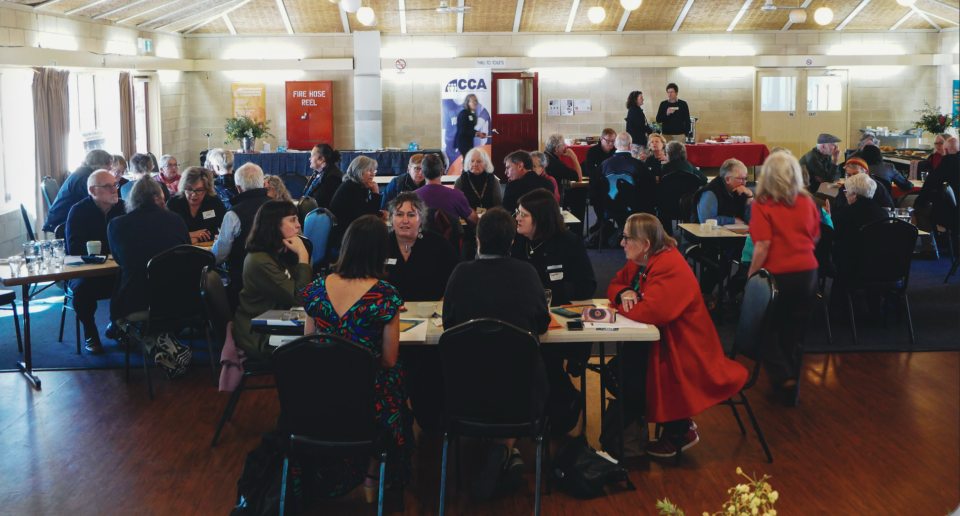
Yesterday, at a meeting just outside Castlemaine in Victoria, 70 people came together to hear…

Posted on 26 Aug 2026
Our Community's founder and leader, Denis Moriarty, says he commissioned a new piece of street art…

Posted on 19 Aug 2026
Government funding is at the centre of Australia's charity and not-for-profit sector – our number…

Posted on 12 Aug 2026
Our Community's founder and leader, Denis Moriarty, says fostering a child was his worst nightmare,…

Posted on 05 Aug 2026
The charity and not-for-profit sector is vital to our economy and the wellbeing of communities…