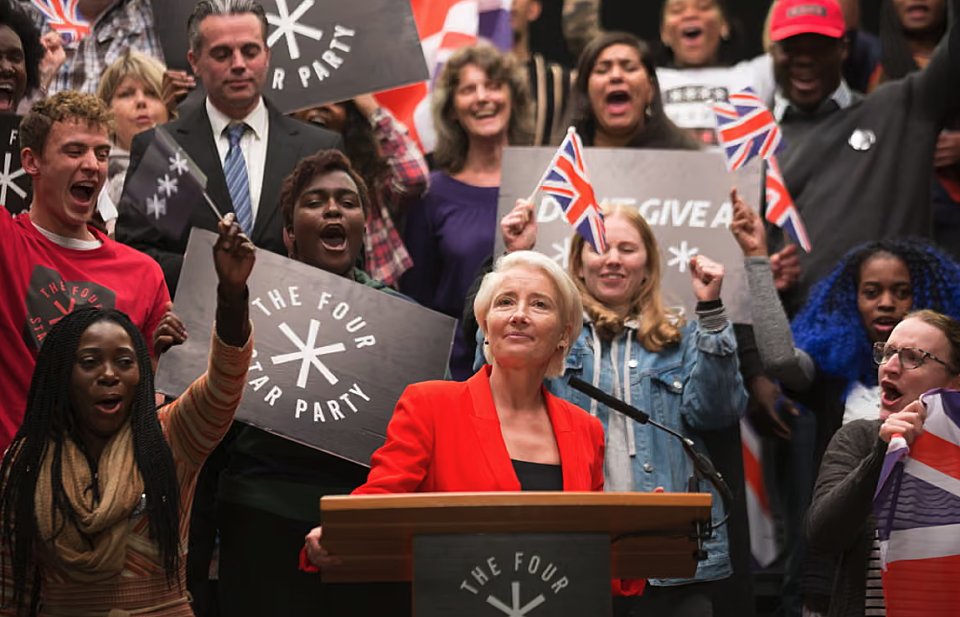
Pauline Hanson and the frightening lesson of ‘Years and Years’
Posted on 07 Oct 2026
Our Community's founder and leader, Denis Moriarty, writes that when he watched an over-the-top…
Posted on 08 Apr 2026
By Denis Moriarty, founder and group managing director, Our Community

It doesn't seem unreasonable to ask our political parties to actually outline their policies, what they stand for and why we should support them, writes Our Community's founder and leader, Denis Moriarty.
Pauline Hanson’s One Nation (PHON) has surged in the opinion polls, and rather surprisingly, those poll numbers have held up in the party’s actual votes, at least in South Australia, where over 200,000 people put the party first on the ballot at the state election last month.
PHON is generally typecast as a party of protest, rather than actual policies, and I’d be very surprised if even a quarter of those voters went to the trouble of looking up the party’s policies online. Those who did would have found an Issues page with 29 sub-headings – general ones like Education, Immigration, Health and Fisheries, along with specific gripes about Stop the Rorts and Firearm Ownership (and at least six dismissing climate change) – for a total of about 10,000 words.

I could say a lot about these policies, almost universally derogatory, but that’s not actually what I’m on about today, which is the difference between personality-driven issue-by issue parties and parties of government. Pauline Hanson doesn’t really expect to find herself on the Treasury benches any time soon, whatever she says, and so doesn’t feel obliged to cobble together an entire range of consistent, detailed, coherent and credible proposals. The Liberals and Labor – the parties that have alternated in power nationally for the past 80-odd years – have a higher bar to meet.
You’d think so, at least. But that doesn’t really seem to be true.
If you look up the Liberal Party’s policies online you get a page called Our Plan that runs to a mere 380 words of general principles before dropping back to a list of particular issues such as “Securing the Port of Darwin” and “Restoring Funding for Crucial Suicide Research” – important issues, certainly, but directed at specific voter interests rather than setting out broad approaches to national priorities.
If you turn to the Labor Party looking for more clarity on the major challenges of our time you’ll be just as disappointed, if not more so; a page headed Building Australia’s Future runs to a staggering 46 words before going to the press releases (“Strengthening Medicare”, for example, “Helping With the Cost of Living”, and six more). There’s not even a pretence of looking at the big picture. By comparison, Clive Palmer’s United Australia Party policy page, at nearly 2000 words, is practically encyclopaedic.
Taking an obvious example, PHON’s policy on immigration – the party’s reason for being – runs to 320 words. The Liberal Party has 85 words on the topic in Angus Taylor’s overview. Labor’s policy homepage has nothing whatsoever.
“The parties of government are distinguishable from on-and-off culture-war meme-driven chancers only because they’re even less willing to talk about the big issues.”
There are other possible sources of information on party beliefs. There’s the Labor Party Platform, of 170 pages, from 2023. It’s not clear how much of that is still relevant, but the Liberals don’t have their platform online at all (given how many changes of leader they’ve had since ’23, I suppose that’s understandable).
You could, as a good citizen, go through everything that Labor or Liberal politicians have said about every major issue since, say, 2023, and painstakingly piece it all together to assemble each group’s range of policies. You could in theory then use that to reverse-engineer their political philosophies. In practice, perhaps one voter in a thousand could ever be arsed to do anything of the sort. At best, we delegate that intensive boredom to our political commentators, with all their leanings towards horserace coverage and undisclosed biases.
The upshot is that the parties of government are distinguishable from on-and-off culture-war meme-driven chancers only because they’re even less willing to talk about the big issues. The Albanese government doesn’t want to convince you to agree with its immigration policy, because it doesn’t want to talk about immigration at all (and because it doesn’t want to put anything in writing that would interfere with its ability to shove its past commitments down the memory hole).
I work with Australian not-for-profits. My company advises not-for-profits on how to get the message out on why they’re important, why people should support what they’re doing, and what their unique advantage is. Every community group has to be able to sell its enterprise to a prospective supporter in the time it takes a lift to go up four floors. It also needs policies, and we at Our Community have an extensive online Policy Bank to provide policy examples covering everything from affirmative action to volunteer management. I don’t see why I can’t ask my government to offer the same.
Parties want to talk about the minor changes they’re promising, not the great sluggish mass of what every government is inevitably doing. They want to identify symbolic gestures that add colour and movement and inspiration but have marginal impact on the budget – to campaign in oratory and govern in prose.
No party that has any hope of being in government can hope to explain to its supporters the real reasons why they’ve ended up where they have. The electoral calculations, the cross-factional bargains, the economic trade-offs – the exact constituents of the democracy sausage – are kept behind closed doors for a reason. The best governments maximise the ratio of public interest to regrettable compromise, but that’s not a slogan that can maximise your youth vote.
Still, if the major (for the moment) parties don’t want to discuss the big picture they can hardly complain if Australian voters drift to getting their political education from TikTok videos. If party affiliation doesn’t have any admissible ideological content, you’d expect exactly the continuing drift towards minor parties and independents that we see occurring at every single election. The term ‘party of government’ is in danger of going the way of the buggy whip.
Denis Moriarty is group managing director of OurCommunity.com.au, a social enterprise that helps the country's 600,000 not-for-profits.
We're proud to take a stand on progressive issues. Here are more recent opinion pieces.
Posted on 07 Oct 2026
Our Community's founder and leader, Denis Moriarty, writes that when he watched an over-the-top…

Posted on 30 Sep 2026
After the biggest AFL game of the year, one player proudly wore the flag of his birth country and…

Posted on 23 Sep 2026
There are solutions to counter the rise of One Nation but they might not be residing in the mess…
Posted on 03 Sep 2026
Denis Moriarty has an issue with insurance companies varying premiums because of what they perceive…
Posted on 26 Aug 2026
Our Community's founder and leader, Denis Moriarty, says he commissioned a new piece of street art…

Posted on 12 Aug 2026
Our Community's founder and leader, Denis Moriarty, says fostering a child was his worst nightmare,…

Posted on 15 Jul 2026
Our Community's founder and leader, Denis Moriarty, on what's special about the shared workplace…

Posted on 08 Jul 2026
The Royal Australasian College of Physicians has found itself facing serious scrutiny from the…

Posted on 30 Jun 2026
Australian house prices rose roughly 8,300 per cent between 1970 and 2025, so it would seem…
Posted on 17 Jun 2026
If charges are proven that members of the Brethren movement took part in partisan political…

Posted on 03 Jun 2026
Why exactly are we still getting a day off to celebrate a day that is not the actual birthday of…

Posted on 20 May 2026
It is not really a surprise that we have trouble getting our heads around what the rise of…